A couple years ago he also made a video about these trucks more broadly - https://www.youtube.com/watch?v=jN7mSXMruEo
What's truly maddening is how many of these vehicles which _do not_ meet European safety standards are _already_ in Europe. Walk around Hilversum in the Netherlands and you will see plenty of Dodge Rams (mostly 1500's, but there's even a 2500 Dually usually parked on the sidewalk ("pavement "for Brits) where my kids used to go to school). They're imported under "Individual Vehicle Approval" rules, exempting them from type safety requirements, and on top of that are almost always registered as "business vehicles" (you can tell from the V plate) which means they pay an absolute pittance in tax.
I moved here to get away from American kindercrushers (among other reasons) and I am profoundly concerned that Europe is being invaded by these machines.
(Edit) Worth noting is that a lot of Dutch street design is based on the idea that people _can_ share space with cars in dense, low speed environments, but that assumption flies out the window when the vehicles are so large you can't even see a kid walking or biking to school.
Further edit - source - https://www.motorfinanceonline.com/news/dodge-ram-registrati... 5,000 Dodge Rams imported in to Europe in 2023 alone.
These rules need to start discriminating between "safe for the passenger who bought it" and "safe for everyone else sharing the public space". Let people easily import some old Model T or a cute kei truck but not something that will kill someone else's kids who they can't see.
They'd quickly find out when they're not being subsidized by the general public and people actually have to pay their way to use their vehicles through tolls to people amortizing their road maintenance costs, that the smaller more pedestrian safe cars are the ones that make sense to operate.
Usually what happens is smaller cars subsidize everyone else due to paying a disproportionate tax vs axle weight^~(2-4 depending on fatigue pathway). Depending on tax structure possibly pedestrians/cyclists too but they are usually parasitic on tax basis.
("murder" is a bit an extreme reaction but the more realistic idea may be to make harsher judgements the more pointlessly large and dangerous the vehicle is)
The easiest way to decrease unnecessary oversized vehicles, frankly, is to require them be painted pink and flowery. Many men in America pick big vehicles as they're perceived as masculine, and a basic paint job to attack this psychological would probably work.
Less jokingly, add mechanical speed limits to them. Big heavy vehicles are extremely dangerous, but that danger is closely related to speed.
Other options include adding excessive cameras and radar equipment, so the front of the vehicle isn’t a blind spot. Cars have plenty of cameras and mirrors already, so it’s not novel to drivers. It’s a missed opportunity already since this could really be implemented by major manufacturers within a year.
You can’t probably blame 100% of that difference on the design standards of US vehicles. But probably a high proportion of them!
They are all business vehicles as the premiums would be so insane no person would pay it (which is a hint why they should not be in the road). The problem comes when the crash out costs the business and then you get nothing due to type of insurance (pretty much we pay nothing you pay everything yourself), or the ability of companies to fight endless court battles which your insurance likely does not cover.
My way of middle fingering them is reporting them every time they are either on the curb when there is a parking spot (not legal, blocking pedestrian access is only partially legal when there is no parking pace nearby and you leave enough space), or when they overextend onto the road which is a judgement call and up to the enforcing officer.
You also need to keep notice of people trying to get the municipality to widen parking spots and block that.
https://www.parkeerbord.nl/wetgeving/is-parkeren-op-de-stoep...
This spot used to drive me absolutely insane when walking to school with my kids - the gemeente even added marked parking spots and drivers just stole the footpath anyway, so we had to walk in the street, and the gemeente straight refused to issue tickets. The guy on the phone told me "it's not causing any trouble" because hey, it's not like _he's_ ever had to push a pram in the street.
If you get injured because the municipality refused to act they are on the hook. Thell them you want it on paper they say they will do nothing to prevent this and you want them telling you specifically you have to walk on the street because they do not act on illegally parked cars.
Edit: where I live I have the option of specifically reporting a dangerous situation which in your case I would: near school zones with children involved it always is in my opinion but who am I to judge. It also helps if more people complain. We have a load of parking tourists here since the municipality mode the payed zones so more traffic and more annoyances. My first messages got impolitely unanswered but after a year of complaining by pretty much everyone they finally start doing things.
RIP Cor H., one of a kind. I'm pretty sure the fact that in that neighborhood even now people are religiously parking on the street and never on the sidewalk is a remnant of his presence in this world.
For example, a Mercedes Sprinter in the standard long box configuration (as is used by local grocery delivery services, plumbers and the likes where I live) is 7.4 meters long , way longer than even the longest American pickup trucks (for some of them, several meters longer!), and is just as wide as them.
In custom box or pickup bed configuration (used by e.g., gardeners), these vehicles get wider (and sharper).
It's the norm in many businesses for employees to drive their work vehicle home and park it where they live, so they're everywhere. Not as many as regular passenger cars of course, but you'll see them on any residential road. Gardeners, plumbers, electricians, delivery services, this is the norm for all of them (a perk of sorts). Even big name-brand logistics companies, as it's common for the drivers to be independent contractors owning the van themselves so home is the only place to park.
They are also used for errands. They're legal for private use proportionate to the amount of VAT paid irrespective of registration type here, so you'll see them pick up/drop off kids, do groceries, recycle bottles, etc. in such vehicles too. Pretty sure that would be just as legal where you are given familiar EU rules.
My mom who is originally from Bergschenhoek claims her elder brother taught her to drive, in a Dodge truck, probably post WW2 in a model like this one: https://en.wikipedia.org/wiki/Dodge_T-,_V-,_W-Series
I don't know whether there are hordes of bejaarden buying Dodges for nostalgic reasons, but that would mean the Dodge brand has some insane staying power. My guess would be that is absurd and unlikely.
I really dig your deadpan sprinkling of Nederlands. Some words have that etymological acuity that makes them irresistible to just deploy. I was always amazed by how many Yiddish and French words there are in Hollands.
On other hand the RAMs are not relevant for the average citizen. Crazy fuel consumption is a showstopper. And the ones with some extra cash will continue to import with German „Individual Vehicle Approval“ equivalent. In my eyes it’s another useless European regulation. Let poor people import cheap Toyotas from overseas.
A Ram was certainly relevant for this dead woman - https://www.rtl.nl/nieuws/binnenland/artikel/5521908/rouveen...
Edit: I am really curious why there is no real vehicle physical size tax in Germany. Let’s take reference as VW Golf. Smaller cars cost less, bigger more. I agree to pay more, but current insanity with RAMs and vans should be somehow regulated.
It’s so ridiculously bad that even an M1 Abrams tank has less blind spots: https://www.reddit.com/r/fuckcars/comments/140dgn8/many_popu...
Weight also matters of course. Hopefully this relatively simple ruling will fix some of that too.
The monstrously large (5.8 meters) G63 6x6 is considerably rarer (i have never seen one in person).
https://ichef.bbci.co.uk/news/800/cpsprodpb/b2ad/live/a20a6d...
from: 'Carspreading' is on the rise - and not everyone is happy about it - https://www.bbc.com/news/articles/cy7vdvl2531o
Throws in the term "Chelsea Tractor", in Australia in the 1980's they were called Toorak Tractors or simply Yank Tanks.
Honestly getting past people isn't that much of an issue. There are normally passing spots where you pull over to let people through.
"Chelsea Tractor" is more of a dig at people Range Rovers for the looks and it never been using off-road.
There is a brand in the UK that have decided to "own" the label. Not sure why you would want/need a Ineos Grenadier in London, but some people will buy one.
You do get problems in rural areas with idiots in Chelsea Tractors though. Leave them in the city -- there's no room for you in rural areas.
(For those whining about having to do the school run, just got back in my 1.6m wide car with 2 kids, 6 bags, skateboard and guitar, no problems on the 8 miles of single track road even when the lorries come the other way)
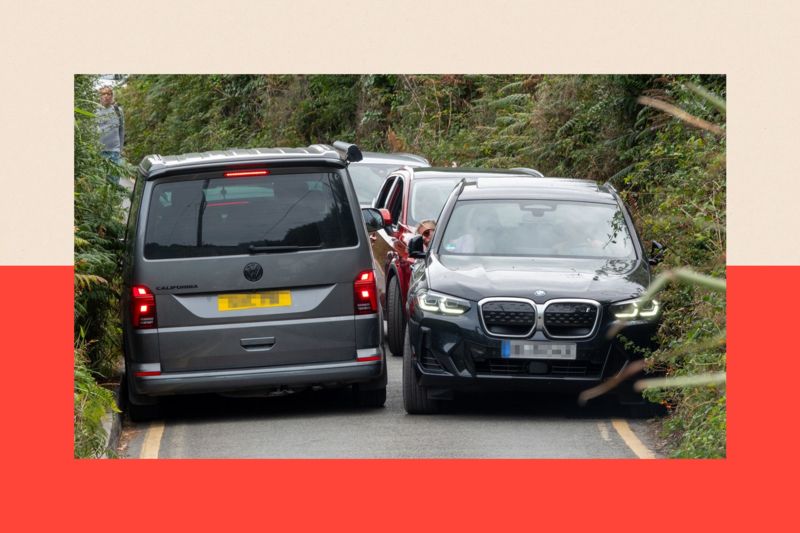
It isn't the Rural Roads in the UK. Also the cars in the photo are kinda normal sized. The Volkwagen people carrier thing in the photo isn't that wide actually.
Here's one in Utrecht https://urbanists.social/@Fuzzbizz/109608802470660144
I am quite tall, even for Dutch standards, but the hood reaches my shoulder easily. It also drives around quite a busy neighbourhood. So I expect this specific car to kill someone within the next 5 years or so.
Having said that I think these American pick-ups (and large SUV's, they are part of the same problem) are a common sight here as well and should not be allowed on the road (unless maybe you can show you need one for work or business).
They’re clustered around areas of idiots with means. I’m nowhere near a us military base but there’s a bunch of these where I live, including two or three owned at houses I pass by on my way to work.
If the US government wants to give its soldiers perks, they can rent or loan them a local car. Probably cheaper all round than flying/shipping in their financed Dodge RAM anyway.
Then again, American personnel being arseholes to the locals is well established from Okinawa to Croughton so it's probably endorsed as a power thing.
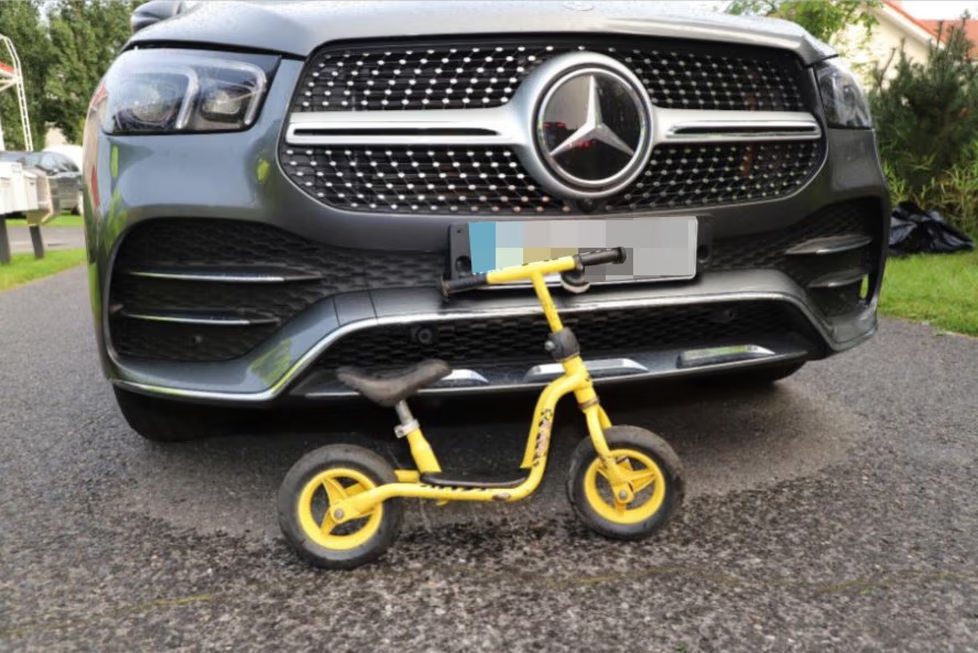
The tall grill means impact to pedestrians, bicyclists and motorcycles is basically instant death as their head - the only thing above the grill - gets whiplashed onto the rigid tip of the hood. On a normal vehicle you get your legs swiped and rotate your whole body onto an intentionally flexible area of the hood for a much gentler impact.
The visibility from the driver seat is not only much worse than our actual semis, but also worse than actual tanks. You could have half a kindergarten and a small vehicle in front of your car without knowing.
As for the tax, eh - tbf these vehicles are mostly used for business purposes by sole proprietors and the likes, and while they're stupid vehicles they do still do the job. A fully decked Iveco Daily or Mercedes Sprinter is also expensive with little registration tax. Registration tax is a weird (and arguably stupid) system, this isn't really an outlier in that regard.
I roll my eyes more when I see a sports car attempted registered as a van.
Even if the owner is using it as a rugged machine for hauling tools and supplies back and forth, they make for terrible work vehicles. A bed that's advertised as 6 foot actually measures about 5' 7" if you're lucky and the wheel wells eat into it so much that loading anything wider than maybe 4' just feels stupid. Nothing about it feels convenient or helpful when compared to a proper work van or a small flatbed. It's basically just a comfy exoskeleton for the driver to pickup groceries.
Meanwhile, I'm driving from site to site with a 4-cylinder hatchback full of tools in custom boxes I made getting twice the gas mileage. It gets some funny looks, but it gets the job done, which is more than I can say for most of the not-a-scratch-on-them trucks I see on the road, here.
As you say, they are absolutely terrible for work use as well - Japanese kei trucks famously have larger beds than some common US pickup trucks, and the size of the custom beds we use in the EU makes the US ones look like absolute kids toys - but that too I wouldn't mind too much if they were just forced to be safe and with decent emissions so the idiocy mainly affected the driver and their wallets.
I'm not too impressed with your vehicle only getting twice the gas mileage though. I'd expect more than that. :P
Yeah, mentioned in a comment, driving a Ford Expedition on holiday in the US I almost hit a hit walking down the sidewalk.
It literally had better visibility going backwards in the rear view camera than it did going forwards.
Okay. But you've posted 12 times already in this thread that isn't even an hour old, mostly emotions and hyperbolics as quoted above. Kindercrushers?
Please don't yell at any truck-driving strangers in the parking lot ("car park" for Brits) because I'm getting that vibe.
The article is equally light on actual details to support its case (ADAS is mandatory in the US, even on econoboxes), and for all we know the life saving equipment never mentioned but used to bolster their case could be... rear fog lights... or removal of the ability to shut off DRL, a largely useless feature that shortens the life of your headlamps.
These trucs signal that the driver does not care about other people, environment, climate, etc. Because they are dangerous, obnoxious and polluting. And instead of calling these things trucks, I think Kindercrusher is a perfectly apt description.
No conflict of interest there, no siree!
Don't fall into the algorithmically generated "it's them v us"
I didn't know this, but it is absolutely crazy. Every EU politician who tries to subvert car safety should be dismissed and tried for endangering public safety.
The problem is coming from the other side, the Americans are threatening to start a new trade war if the EU doesn't permit their murdermobiles on the European roads.
IMO pedestrian safety should still come above all else, but this is not an initiative coming from some EU representatives who want to own a Cybertruck. Blocking these cars can have impact on the war against Ukraine and the prices of fuel and other import products on the short term.
But the EU commission will bend and sell us out, the same way it's selling european privacy to security and data companies lobbying it (just check how many times Thorn, Palantir et al have met with EU officials, lobbying is recorded and publicly accessible).
I would suggest mandatory semi (or full) trailer truck drivers' license required for anyone who operates these. In addition, they should be indicated as a new category of "recreational trucks", with harsh penalties specific to them especially regarding road accidents.
For example, if found guilty of reckless driving, or causing accidents, the vehicle would be permanently confiscated. (On top of personal fines, loss of license etc as already sentenced by law.) Perhaps the law enforcement could then be given access to such confiscated vehicles, creating also some incentive to enforce the law.
There is still about a trillion dollars of NATO defense spending to replace if Europe does not want to be reliant on America. Doable, but spending a third of that on American equipment wouldn’t help matters.
Perhaps if Europeans got an earlier start, instead of ignoring nearly two decades of warnings and a clearly deteriorating security situation, they wouldn’t need to care so much about US policy. Better late than never.
https://economist.com/europe/2025/12/01/europe-is-going-on-a... from The Economist
And the US is not one of them
Have you even read the comment in full before responding? I'm talking about this part of it:
> Percentage of GDP to military spending has been criticized as a bad way to measure how much military spending is done and needed
But since you wouldn't get it anyways:
The "5% of GDP" is a number that US politicians came up with, seemingly out of nowhere, because they figured they want to boost their military industry.
EU countries are already spending that or even more - just look at Ukraine spending by EU countries - but since it's spent on their own domestic defense industry, US politicians don't like it. That's the point.
They don't want us spending 5% of the GDP on defense unless we buy their stuff. So here we are.
Poland spends 4.5% and that is the highest number, the rest are spending much much less.
Tell me again how they're spending more???
Most EU defense spending isn’t on US equipment (only ~35%); I don’t get where the European victim mentality is coming from here - Europe can and is building up its own defense industry.
There’s some Trump nonsense more recently about buy American, but the demands to take security seriously have been going on for nearly 20 years, and have been largely ignored until Ukraine round two.
We spend multitudes of times more than our only realistic threat. And that threat can't even wage war with Ukraine, you expect Russia to be able to fight Poland, yet alone the rest of the European countries?
Also, just a reminder: US servicemen have not been sent to fight a war for European souls since almost a century. Whereas European soldiers are actively deployed even now in the middle East for wars that Washington started.
Please start looking more at facts and less about propaganda. Of course Europe should step up in being more independent defense-wise, but you'd be a fool if you think the US does not enjoy and leverage the current status provides.
The US has previously discouraged Europe from building out its own defense industry, the current situation is due to that a dovish view of Russia therefore less of a need to spend money on equipment and troops for a land war.
The entire strategy for the last 80 years has been built around this edict.
The trade wars go both ways. Certainly it can be a bit of a collective action problem when it comes to individual countries that are smaller than the US, but the EU as a whole should be able to negotiate on even-enough footing with the US on these kinds of issues.
https://www.youtube.com/watch?v=LC9a3GR1HJY&t=371s
> I said there was no way this truck would pass a pedestrian impact safety standard. Now, I wasn't wrong that the truck won't pass a pedestrian impact safety standard, it won't! And that's why they can't sell it in Europe. [...] But I didn't realise that America has no pedestrian impact standards. [...] America actually allows companies to self-certify a variety of aspects of safety.
Thank God the French have always been suspicious about it since the Suez crisis, hence we _do_ have at least some independent capabilities.
Nobody, but it seems a lot of people care if we sell less german cars.
Do you really want to block the import of arms and financial aid to Ukraine?
If Europeans were serious about their sovereignty they’d have made very different choices up until now.
It isn’t right that America has so much power in this circumstance, but going back decades the US has been asking for Europe to take defense seriously.
Umm... yes? Since this whole debacle started, the EU has been shooting itself in the foot with all the sanctions that hurts its industries.
On the other hand, the US did the smart thing and did not give out weapons for free, it charged for them.
In the end, the US will be the winner of this war and Europe will come out of it incredibly weak economically. And it will have to turn to the US for help. Again.
It's crazy because the numbers don't line up with the theory. If you look at US traffic deaths by year, they were basically flat in terms of vehicle miles traveled between 2010 and 2019 and then took a big jump from COVID which is only now starting to come back down.
Meanwhile in Europe road fatalities were also fairly flat up until 2019, and then went down significantly from COVID.
Now we have to guess why the responses to COVID had the opposite effect in each place, but it's pretty obvious that the difference was a primarily result of COVID rather than differences in vehicle safety regulations, unless the vehicle safety regulations all changed in 2020 and everyone immediately replaced the installed base of cars everywhere overnight.
Also, the numbers for at least the US are apparently just wrong:
https://en.wikipedia.org/wiki/Motor_vehicle_fatality_rate_in...
1.27 fatalities per 100M VMT in 2023 (the latest year with data), 1.11 in 2010, that's a difference of 14%, not 30%. Even the peak during COVID was only 24% above 2010. The only way I can see to get 30% is to use the during-COVID number for only the total number of motor vehicle fatalities without accounting for population growth or vehicle miles traveled, which is obviously not a useful metric for making comparisons.
"dismissing" a politician sounds like an easy fix but we probably don't want hyper-polarized dismissal wars where politicians are "shot down" immediately after being elected. That's why there are other mechanisms such as not re-electing, public shaming, transparency fora etc. ... we need to work on strengthening those, the accountability and transparency.
There might be certain number of deaths we can accept for increased cost but how is it so obvious that this tradeoff was worth it?
What if cars got 2x costlier in EU due to the regulations to give you a .01% increased chance in safety?
Edit: here are some back of envelope numbers from chatgpt
A single, ordinary car ride carries an extremely small chance of death:
USA: ~1 in 7.7 million
EU: ~1 in 20 million
Its not super clear that optimising these numbers is obviously worth the increased costs.
At, say, 4 rides per day, that's about a 1 in 5300 chance of death over a single year. That's still small, but not that small. Someone in a decent-sized town or city could expect to lose someone they know once every few years with those odds.
Slightly less than the rate of suicide; and slightly more than half the number of fentanyl deaths. And a smaller fraction of medical mistake deaths. (Of course, none of the risk is evenly distributed.)
As a systemic problem, I’m not convinced that cars are the worst. Or outside what we accept in several areas.
Obviously the lack of difference there wouldn't prove much (if I had to bet I'd bet cars in the US have gotten way more expensive faster than in the EU, just from labor costs), but the lack of a major difference would complicate the theory that new regulations in the past 15 years have massively improved costs, absent a theory that some other thing the EU is doing but the US is not doing is also kicking in to similarly counteract that.
The numbers exist, this isn't in the abstract. Just a question of doing the legwork
A comparison would be comparing a car that can ensure the survival of their passengers, proven with test crashes, vs e.g. Chinese-made cara for the local market that have terrible crumpling when crash-tested..
I'm really not sure what you mean, many of the most popular cars in the EU aren't even sold in the US (Renault, Dacia, Opel, Peugeot/Citroën although they have taken quite a hit in the last few years) and they are generally cheaper than US cars.
And quite a few US cars aren't available in the EU either (although they can sometimes be imported privately, which bypasses the regulations somewhat) which is the very topic we're discussing.
As for Chinese cars, the recent ones are performing adequately in crash-tests.
There is a vast number of reasons why we need and must reduce private car modality share as much as possible. Making cars more expensive is a feature, not a bug.
Sounds like a lovely place for sure.
You can eliminate deaths by that cause by eliminating those types of vehicles, not by eliminating all cars.
Not saying that's feasible, but let's not argue against something that nobody said in the first place.
In this case it is another country trying to impose their 'way of life' on the rest of the world, or in this case, the EU, which has a different set of values.
That doesn't really have anything to do with having buses or trains vs cyclists, it is not a personal decision and there are many alternatives compared to US vehicles that were never designed for European (or Asian, for that matter) traffic in the first place. The USA is very car centric to the point that walking is frowned upon (I got picked up by the police in North Dakota for walking). The EU is simply not like that, and that's fine. The USA should set their own standards for car safety and so should the EU, if that leads to incompatible products I think the mantra is 'let the market sort it out'. The Japanese seem to have figured out how to make vehicles for different markets, there is no reason the USA can not do the same thing.
> EU officials must revisit the hastily agreed trade deal with the US, where the EU stated that it “intends to accept” lower US vehicle standards, say cities – including Paris, Brussels and Amsterdam, and more than 75 civil society organisations. In a letter to European lawmakers, the signatories warn that aligning European standards with laxer rules in the US would undermine the EU’s global leadership in road safety, public health, climate policy and competitiveness.
They point to many things and not only the size of cars - like fewer approvals, lower pollution controls, fewer safety measures.
Some of them increase utility (like people might prefer bigger cars) and others decrease cost.
The question works both ways. How can we quantify the penalty faced by consumers in the US due to lax regulation? How much is each toddler ran over worth, exactly?
https://www.carscoops.com/2024/12/suvs-and-pickup-trucks-2-3...
I really hate that everything has to be seen from the consumers' lens, especially the consumer of luxury goods (I'm talking SUVs and the like, cheap cars exist in Europe).
What if we didn't just look at it from the POV from people who buy or want cars? I don't own a car, nor do I plan to. I have to pay for roads, which I understand to an extent. But why should my life be at risk from people wanting to buy SUVs cheaper?
Edit: Also, looking at "cars" without distinction really just obfuscates the real issue. The most dangerous cars (for pedestrians) are the biggest (and sometimes the fastest) ones. Plus most pedestrians die in cities, not on a Highway. So yeah, if you want to drive an SUV in a dense city, then I'm all for making it 10x more expensive for you, because it makes no sense (to me) and puts me in danger :)
> But why should my life be at risk from people wanting to buy SUVs cheaper?
What if the risk is not that much greater? That's what I'm questioning.
> and reducing its size by half did not meaningfully diminish its function as a pen for most users
So ok, I'll do it too: what if reducing the size of a ball point pen by half reduces the rate of death by ball point pens by 0.01%? (Answer: you don't do it, because the benefit to doing so is low, and that measured effect could be well within the margin of error anyway.)
(And my weird made-up number sounds a lot more likely than your weird made-up number.)
If only a few people die due to car accidents and one is much more likely to die of other causes than cars, is it worth making cars that much more expensive to decrease the deaths by a bit?
The regulations in my opinion add up to 20-30% of the car price. And likelihood of death due to a car at an individual level decreases by .01% (maybe).
Imagine you were given two options:
- Car A at $45k USD
- Car B at $35k USD
And you are less likely to die with Car A. Is it super obvious that you will buy Car A? If so why doesn't everyone flock to Volvo cars which lead to ~45% fewer fatalities?
Why is this so obvious to you that this regulation is a good thing? The sibling is implying that I'm trolling or whatever but this is a legitimate question.
This is made up out of thin air.
There's this weird perception that Europe has excellent public transport, while in reality it only works, sort of, in a few larger cities. Everywhere else functioning in society really requires a car or assumes that you're living within biking distance of work and daycare.
I'm not going to argue the cost numbers are they are so far out of the ballpark it's not even funny.
The fewer cars, the better.
In Europe, some stroads exist. The rest are streets or roads.
In the US, some streets exist. The rest are stroads or roads.
That's the most American sentiment I've heard today
Taking my own kids back there this year, most of the normal cars were common, or at most variations of the ones from Europe. Even many of the vans and work vehicles are now common European shapes, occasionally with a different badge. Trucks and full size SUVs were the last hold outs of US specific models.
Which makes me wonder, are the pedestrian deaths really heavily weighted towards these models?
For what it's worth we hired a full sized SUV. There was one point where I was about to drive out of our Villa's driveway when my partner shouted "wait!" There was a 8ish year old kid walking down the sidewalk towards where I was about to cross it who was completely invisible from the driving position. It was actually safer to forward park that thing because the visibility in the reversing camera was much better than driving forward.
Just as a starter for ten, is that 30% increase distributed around the US or concentrated in certain states? I can't imagine we've seen the same increase in New York than in rural Alabama (and if that's the case, how much of it is really attributable to car designs)?
Germany isn't the only economy dependent on the legacy auto sector. France, Italy, Romania, Czechia, Slovakia and Belgium also have a lot of jobs, or had, in the auto industry, before the mass layoff of the last 2-3 years.
But also, Merz is not alone in this, but a lot of Eastern Europe can't afford EVs at current EU prices so the EU has to make some concessions. People in Romania or Bulgaria can't afford to buy a Polestar like people in Netherlands can.
EU leaders needs to account for the massive disparities of purchasing power between places like Nordics and Romania/Bulgaria for example when they make sweeping legislation like that.
Sure it would be nice if all of EU was like Norway with only EVs everywhere, but this way you'd basically be bankrupting and turning against you the people in the poorer countries of the union who are already disproportionately affected by the CoL crisis of the EU, who are effectively paying German energy and grocery prices but at Eastern EU salaries and pensions. This is not sustainable.
Not to mention the disparity in public transportation infrastructure where a car is basically mandatory for commuting outside big cities in place like Romania.
And at the rate car prices are increasing for no good reason, I doubt the average EU citizen will be able to afford a car in the future.
The EU does need to find a middle ground between mandatory safety features that are unaffordable and free for all pedestrian killing machines.
And protectionism ain't it. It will only increase the prices for domestic cars until the likes of VW have to close up shop because no one can afford what they're peddling any more.
Fossil fuels need to be eliminated. Europe is the fastest warming continent.
Like your idea sounds good in principle, especially if you're from a country with no automotive jobs, but then what do you do then with tens of thousands of unemployed people of the auto sector being displaced by the Chinese? Will you agree to pay more income taxes to fund the increased unemployment deficits of the others? How do you think those people will vote?
You can't throw such oversimplified solutions to such complex issues with very deep ramifications.
If you haven't noticed, the EU economy and jobs market in general is already bad as it is, it won't be able to absorb tens of thousands of unemployed career switchers into to other domains that aren't hiring right now anyway, or if they are hiring, they're very picky due to the increased supply of talent with domain experience.
Currently, the defense sector is absorbing some of the slack of automotive layoffs on the production/manufacturing side in some countries like Germany, but that won't last forever. If peace happens in Ukraine, that will dry out as well as the glut of orders will be scaled back.
https://lae.mit.edu/2024/06/28/study-quantifies-premature-de...
Yeah, so that would be rampantly anti-Democratic authoritarianism... Peaceful transfer of power is pretty much at the core of why democracy works in the first place, and once you start engaging in political persecution because you don't like some trade-off involving safety ... yeah, that's no longer a democracy but something else.
No. Every EU politician who doesn't support BANNING all cars should be dismissed and tried and executed! Look, I'm even tougher on pedestrian safety than you are!
[1] https://www.bts.gov/content/us-vehicle-kilometers-0
[2] https://www.odyssee-mure.eu/publications/efficiency-by-secto...
That probably is doing a lot of work here. A truck with a driver sitting so high above the street they can't physically see a child or bicycle in front of them is just an inherent risk to pedestrians and cyclists, no matter how you twist it. And don't even get me started on Cybertrucks, which are pretty much designed to cause accidents with casualties.
Even if the causal link is more complex than the numbers make it seem, acting like putting heavier and bigger vehicles with less restrictions on streets won't cause accidents is just plain dishonest.
Implying that I said it has no impact is plain dishonest
I was stopped by police while taking a walk and shouted at and treated like a criminal when walking in to a Wendy's drive through (even though only the drive through was open at that hour!) But, other than that, the people were incredibly kind! The culture shock though... It is very hard to imagine if you've never been there. I think as someone from western Europe I have more in common with people from Thailand.
Cars are really a must-have in the US, biking is just a hobby. It's more the other way around here. Everybody is a "cyclist" (not even a word we use here) some of the time. It means "carists" have respect and understanding of how it is on a bike, and drive carefully around people on bikes (in general, there are always exceptions). Our infrastructure and law demands it (ie, a car-owner is always financially responsible in an accident with a pedestrian or person on a bike here, insurance for this is mandatory).
Here people in massive US sized cars are really seen as anti-social, in general I'd say. Hope it stays that way. For now I think some of those cars can't even fit into city-center parking garages here (ie [0], btw if you look around there you see separated bike lanes, crossings where pedestrians always have priority (ignoring that is instant fine), very narrow lanes for cars. Go forward in time and you see they added "statues" that look like they are about to cross the street to make drivers aware of this.)
Local governments here try to encourage cycling by putting in as many dedicated bike lanes as they can, but they never seem to get much use (where I live they're used almost exclusively by bike delivery people and a few people like myself).
The roads can be lethal and many drivers have a great deal of animosity towards cyclists (probably helped to no good degree by the likes of people like Jeremy Clarkson / Top Gear which spent a decade joking about and belittling cyclists).
I live in a very bike friendly country, so culturally closer to Europe in terms of transport, but if you walked into a drive through you may well be stopped by police.
Drive throughs have long since stopped serving pedestrians.
Generally anyone trying this is inebriated.
such as indicators in the same color as the rear lights, are perfectly legal.
In any European car you get two lights, not in the center but in the corners so you can actually see stuff in your side mirrors while parking.
We also had a wedding to go to in France where we drove a Citroen C4. To be honest, if these weddings weren't so far from railway stations and we didn't have to transport so many people together I'd never have done it. And both these cars were tiny compared to the GMC Sierras or Cadillac Escalades you see on San Francisco streets.
I can only conclude that anyone who drives an American-size vehicle in these places is a masochist. It cannot be fun. No, not even to ride in while someone else drives.
They're not the only ones to double park, but the only ones to exclusively double park.
Why were you even driving in London?
US soldiers/DOD etc PCS'd to EU manage (not always well).
And, us EUians get the advantage of seeing just how disgracefully oversized US cars and trucks are.
Aside: No yellow indicators? I'd rather US red ones than the 1"x3" mini-yellow-indicators that are becoming more common.
But still, I wish they would ban them.
Here, owning a car is extremely expensive - perhaps one of the most expensive in Europe. This price goes up considerably when you get a larger vehicle, both because fuel costs are very high but also because you are taxed quarterly for CO2/weight of the vehicle.
With a larger family, you are squeezed into an uncomfortable position since you are outside of the <= 2 child norm. Many 7+ seater vehicles (French cars, etc) are extremely impractical to the point of me thinking that they are not actually designed for more than 3 seats in use, as there is comically low cargo room and the 3rd row is extremely cramped (try fitting a stroller or anything besides people...ha!).
I ended up picking up a Chrysler Town & Country import from the USA for my family, because it was the only vehicle that I could find for a reasonable price that checked all of the boxes, and am paying dearly for it (400+ euros every quarter just to have the privilege of registering it!).
Before you say anything about us having a "kindercrusher" we also have 2 bakfiets cargo bikes and use them regularly, but public transit and bikes don't scale well to large families for anything more than a short distance ride (school, groceries, etc).
Large families are being squeezed out of existence here.
I am European, I don't think big trucks are particularly well supported by our road systems but I don't think we need to look at American car standards to get the next 10x reduction in traffic-related deaths.
IMHO it is not explainable how in 2025 there are still cars sold without LIDAR-based anti-collision systems, how are these still extra? Systems to warn of objects in the blind spot areas are available yet not mandatory.
This reads like the classic western world strawman to me. Instead of looking at how to improve things we just make sure things are not getting worse. By burning a strawman, in this case trucks from the US. Which are best described as a niche market over here, but now that we have a newly defined enemy, we do not have to confront our shitty carmakers about technological advancements.
These people do not care about human lives, they care about politics.
I thought this stark difference might be partially explained by US population increasing more quickly than EU. However it turns out in the 2010-2024 period, US population increased by +10% while EU27 pop increased +2%. So although there is a minor 8% difference, this is far, very far, from explaining the stark difference even if we compared per capita. The EU is certainly doing something right here.
I don't think its EU citizens, because:
    * roads will be damaged faster
    * risk of hitting and killing more people
    * because roads damaged more tax money spent on fixing them
    * more CO2
Just come to Amsterdam and see if you can drive those cars in the middle of Amsterdam. Even trams from 2 opposite direction share same line in some areas.
wars in last 200 years were not started because some guy is really bad and woke up one morning to attack other state, there are things which trigger these events.
Pretty sure you are taking one side in this case, and not listening to the other side, some which comes to mind:
* NATO expansion - its 100% not defense only alliance, you can tweak it as much as you want, but its not.
* Russian minorities were indeed killed/oppressed in some parts of the Ukraine
* Maydan coup
* Nord Stream blow up
If you think terrorists who blew up Nord Stream should not be punished as an EU citizen, you are real traitor, because Germany invested so much money and energy to it, to boost its economy
There's no such thing as "good trade relationships with Russia", as those that were there existed only thanks to planted agents like Gerhard Schröder.
What most likely triggered this war was Putin's ambition to stay in power, as Russia never actually recovered from the 2008 crisis, so he let Medvedev handle the popularity hit associated with the first years post that.
Russian agents are sabotaging European businesses as we speak - there's no getting back to whatever level of friendly relations there were before the invasion.
Kinda hard with someone trying to expand, starting wars and engaging with genocide. Literally.
Being accommodating to Russia is how we got here.
> Yet, EU vehicle safety regulations have supported a 36% reduction in European road deaths since 2010. By contrast, road deaths in the US over the same period increased 30%, with pedestrian deaths up 80% and cyclist deaths up 50%.
WOW! That's massive
Look at the license plates of these "tokkie tanks": they all start with a "V" (https://www.anwb.nl/auto/autokosten/grijs-kenteken) meaning the owner pays reduced tax.
It's time to also take into account area when it comes to vehicle tax in my opinion, even European "cars" (SUVs) are bulging out of normal parking spaces these days.
There’s simply approximately zero demand for F150s in the EU regardless of if Ford sells them directly or not.
Adopting such standards in Europe risks accelerating the "bulkinzation" and "truckification" of our roads. This would not only strain already limited space for essential transportation and parking, but also severely increase risks to pedestrian and standard vehicle safety, and in general bring a more hostile road/societal environment a la American "predator capitalism" exemplified.
Big trucks happen to be a popular market in the US. If you build cars in the US, you’ll have to serve that market. Even more so if your goal is to prove that an EV can be anything that an ICE can be, and more.
I also see a lot - and I mean a lot - of people holding a phone while driving, even in dense city traffic. Add to that non-walkable streets in some places and unsafe rules like legal right turns on a red light. Cyclists often have to squeeze into a narrow bike lane that is level with the car lanes instead of raised onto the sidewalk. That adds up to a much higher amount of latent dangers than in Europe.
I'm now a father so one cannot discount the amount to which my tolerance of bad actors has changed, but my experience has been that the lack of enforcement for violations (right-turn red lights in SF are rarely obeyed) is definitely taken advantage of by many drivers. However, the collisions report does make it somewhat clear that a non-trivial amount of the new fatalities are due to new traffic modalities: people now have the stand up OneWheels, and there are many more food delivery drivers on e-bikes.
But one gratifying thing is that the newer parts of town where people are having children have a lot more safety construction. I was walking home from the gym here in Mission Bay when I saw a group of kids between 6 and 12 on their little scooters.
[0] https://www.visionzerosf.org/wp-content/uploads/2023/05/San-...
[1] https://www.sfchronicle.com/bayarea/article/car-traffic-pede...
And while I call them "Brodozers" to be derogatory, a significant number of really tiny females are driving them as well in the name of "safety". And they REALLY can't see anything over the hood.
The combination of gigantic blind spots and complete energy transfer is good at killing unarmored people.
https://images.sanoma-sndp.fi/98ad49728452bf5d3e1c9d1d90d899...
American regulations created a dichotomy where there's no middle ground. Big car or sour cream dollop with no space and no power.
Americans want big because big means "safety". An SUV feels safer next to the semi than a Smart car. They also want big to haul the occasional furniture between moves, go on the occasional road trip, bring all the gear when camping, or bring back a massive shopping haul.
American housing is way less dense outside the cities. There's no reason for a compact car if you live in the burbs apart from gas mileage.
At the same time, more and more people want to build bike lanes and people infra near roads. "Strong Towns" movement, etc.
We're putting more bicyclists on the roads next to big cars now.
I know. Sold my Tesla, now drive a Land Cruiser. A small car is just an exercise in pain when you have kids and need a car to get everywhere. If I had safe bike lanes to get the kids to school and practice and the grocery store, I’d just have an urban arrow… but I’m not contending with the aforementioned kindercrushers that aren’t looking for cyclists and risking my kids with the way our streets are designed. I would happily support changes that fix this, but this is the world we’re in as parents.
You're right though, if we hadn't moved to the Netherlands, we'd have bought something like that too, to make sure we'd win in any crash. Luckily we do, indeed, use an Urban Arrow instead.
Ironically I can hold more kids on the Urban Arrow than I could in my last car - 4 small kids can ride on the bike (3 in bucket, one on a seat on the back), plus the rider of course.
Edit:// I also don't know when this believe ever should have existed. Or why it would have existed in the first place
During the Bush and Obama eras Europe was at least important as a staging ground for war in the Middle East, but the US wants to get away from putting boots on the ground there.
But now most of the common ground is gone, and the gloves are coming off
Quick question: where you are from, what percentage of GDP did you spend on the military in the last 10 years?
Why isn't Switzerland, the very rich and developed and human-rights-protecting country, fighting Russia right now? Oh, right, your country loves profiting off of misery.
And we don't exactly need military against you guys. We attack with rolex and suited super rich
Edit:// if Russia is such an easy problem? How comes orange man did nothing so far even thought he spends days talking about how he did?
We are also actually the main sponsor for America by capita. (As in owning state papers and your dept) So essentially we finance you guys to do the dirty stuff!?
Nobody's under any illusion that this was a good decision, including the people that made this decision. It was just a means to an end, the end being lowering tarrifs on the EU.
There's still quite a few steps between the current state and the dominance of US cars on European streets. It's still an empty promise from the EU side.
Pretty much every government unfortunately.
From the media I can see it's only Germany who has a really weird relationship with the US. Switzerland, Italy, France, .. are pretty clear in what they think and how they will act.
I'd say keep everyday life better and buy some stupid US military airplanes instead, to keep this deteriorated stupid smug child satisfied!
The EU representatives shall remain adults!!
[1]: Based on the chart in this old meme https://old.reddit.com/r/fuckcars/comments/140dgn8/many_popu...
Everyone rightfully highlights this striking statistic. But I notice a sleight of hand ("have supported" = correlation) and would like to see a breakdown of the factors that may have contributed to this divergence.
European consumers want livable cities with smaller (and more affordable) cars. Thanks.
Provably false.
https://www.acea.auto/figure/new-passenger-cars-by-segment-i...
Retract your statement. Thanks.
In the longer term, these sorts of things are governed more by demand than anything else. Sure, some governments might sometimes enact protectionist policies, but if most people in a country think the cars made by their domestic car companies are garbage, they're going to end up with a government that allows cars from other countries in.
If region X happily produces and sells rotten meat, no other region is obligated to trade with them. But region X might choose to import non-rotten meat if they want.
You can absolutely have unidirectional trade, countries produce a different array of goods and these are not bartering deals.
If the US wants to sell cars to the EU, they can. Plenty of countries export cars to the EU just fine. It's not the EU's fault that American car manufacturers make dangerous vehicles. It's also not American car manufacturer's fault that European cities and roads are often smaller and Europeans have less appetite for road deaths. But it is their fault if they want to export to that market without making any effort to design suitable cars for it. American exporters aren't granted a God-given right to inflict American standards in the rest of the world.
Front sightlines are a common example given for larger pickups and SUVs. Pedestrian outcomes in collisions are also given more weight in the EU standards (which is why you can't buy a Cybertruck).
American semi trucks are also generally considered unsafe for that reason plus overall length - nearly all EU and UK HGVs are cabover models.
There's no rule againt US-made vehicles. It's just that many vehicle models that happen to be made and sold in the US don't meet safety requirements in other places.
You can well argue that EU vehicle standards are excessively strict (many EU residents may agree or disagree on various aspects), but coming at it from "very unfair trade, it's a huge deficit, sad!" angle seems more like simping for car manufacturers then reasonable public safety policy tuning.
and
> There's no rule against US-made vehicles.
It feels very much an anti-US rule to me.
Same when I flew to Bilbao. I booked late, the only rentals left were in the luxury segment. I drove off in a mild-hybrid Lexus NX, where I struggled to fit the luggage that fit reasonably well in the boot of my car on the way to Schiphol.
I don't know why anyone who isn't a complete psycho would actually prefer being more limited in forward vision (though I imagine it allowed more space for dual-motor engines).
Honestly if I were the government, I'd require a downward sightline such that you can see, with your own two eyes, a child of a certain height standing against the front bumper. No visibility, no sales, no imports, no excuses. Let the car manufacturers figure out how to build a car that meets it or settle for "only" being able to sell car-shaped estate cars.
I think the reason you don’t see many big cars is that we are generally so poor that we can’t afford what we would like to buy. At least where I live… Also our roads are old and narrow which makes it impractical.
Of course, we are talking about two completely different sets of traffic cultures here (urban design, laws etc.) but I wouldn't be surprised if this gets accepted fully as part of a trade deal. EU isn't a strong negotiator, caves easily under American pressure and Trump has a firm hand and knows how to get the best deal for himself.
The only place on the entire continent where I've seen American cars being driven is the Netherlands and they stick out like a sore thumb. They are too big, too loud, too heavy, emit massively more CO2, usually don't have good acceleration (which you need into/out of roundabouts). Just not a good fit for European roads and streets. God forbid you crash into a pedestrian or a cyclists, you kill them instantly. They are built like a tank whereas European cars will self-destroy to preserve pedestrian life.
This is fine in isolation but at scale it leads to a race where everyone, especially pedestrians, loses.
The extra dumb thing about it is that I don't believe the numbers in the US really even strongly support that preference. Yes, you're less likely to die in a big SUV than in a sedan if you get into a crash, but the difference isn't that large, and the risk of death in general is low enough that it's not worth worrying about.
I drive a sedan, but I'm only really worried about getting killed by one of these monster vehicles when I'm out walking, as a pedestrian, or while I'm on a bicycle.
With its pointy edges, even in a very slow accident hitting a pedestrian, the outcome will make any Tarantino movie look soft, in terms of blood being spilled around.
Don't even get me started on those huge American cars, they are the absolute terror in terms of pedestrian safety.
(For Europeans)
Every euro city seems to be able to set their own regulation on car exhausts
So why not limit the sizes of cars or prohibit specific cars into the city?
I’m frankly surprised Amsterdam didn’t ban some of these huge machines yet
I detest how each city has different rules on exhausts but it might be the only way
The USA has 34 people per square km while Germany has 234. So pollution per capita would be a better metric.