Spoiler, but the answer is basically that old hardware rules the day because it lasts longer and is more reliable of timespans of decades.
DDR5 32GB is currently going for ~$330 on Amazon
DDR4 32GB is currently going for ~$130 on Amazon
DDR3 32GB is currently going for ~50 on Amazon (4x8GB)
For anyone where cost is a concern, using older hardware seems like a particularly easy choice, especially if a person is comfortable with a Linux environment, since the massive droves of recently retired Windows 10 incompatible hardware works great with your Linux distro of choice.
It's very difficult to source in quantity, and is going up in price more or less daily at this point. Vendor quotes are good for hours, not days when you can find it.
I work in the refurb division of an e-waste recycling company. Those days are over for now. We're listing RAM that will sell for more than scrap value (about $2 per stick), which is at least 4 GB DDR3. And we got a list of people who will buy all we got.
Hardware is usually a small piece of the financial puzzle (unless you're building a billion dollar AI datacenter I guess) and even when the hardware price quadruples, it's still a small piece and delivery time is much more important than optimizing hardware costs.
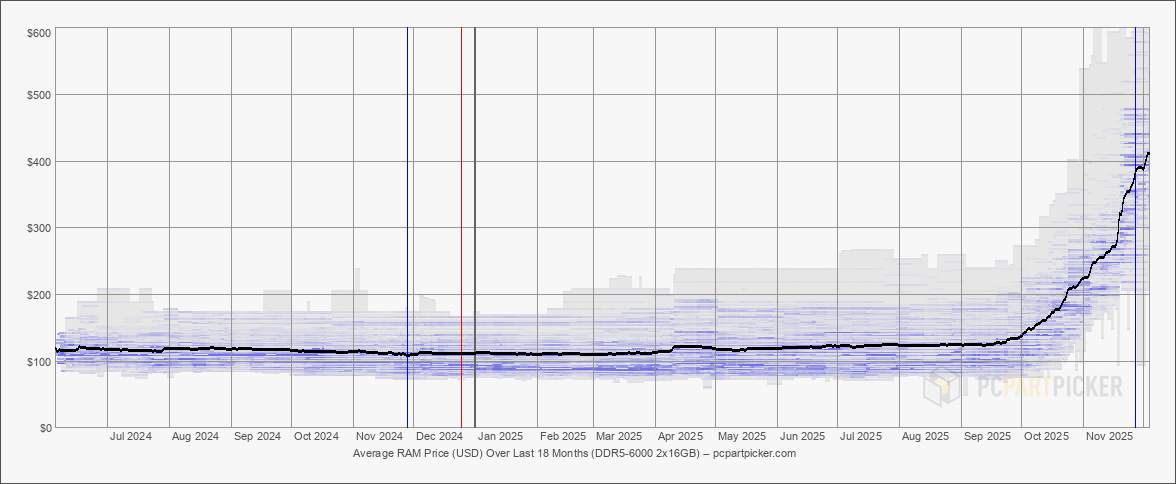
You can see the cost rise of DDR4 here.
Either way, it's going to be a long few years at the least.
Maybe larger makerspaces and companies like Adafruit, RasPi, and Pine should start stockpiling (real) money, and pick themselves up an entire fab full of gear at firesale prices so they can start making their own ram...
...or you could go with FreeBSD. There's even a brand new release that just came out!
Just like SSDs from 2010 have 100.000 writes per bit instead of below 10.000.
CPUs might even follow the same durability pattern but that remains to be seen.
Keep your old machines alive and backed up!
DDR5 is more reliable. Where are you getting this info that DDR3 lasts longer?
DDR5 runs at lower voltages, uses modern processes, and has on-die ECC.
This is already showing up in reduced failure rates for DDR5 fleets: https://ieeexplore.ieee.org/document/11068349
The other comment already covered why comparing CAS latency is misleading. CAS latency is measured in clock cycles. Multiply by the length of a clock cycle to get the CAS delay.
Many things in electrical engineering use ECC on top of less reliable processes to produce a net result that is more reliable on the whole. Everything from hard drives to wireless communication. It's normal.
Bandwith increases, but if you only need a few bytes DDR3 is faster.
Also slower speed means less heat and longer life.
You can feel the speed advantage by just moving the mouse on a DDR3 PC...
https://en.wikipedia.org/wiki/CAS_latency#Memory_timing_exam...
Maybe your old PC used lower-latency GUI software, e.g. uncomposited Xorg instead of Wayland.
Still motion-to-photon latency is really lower on my DDR3 PCs, would be cool to know why.
No it isn't, your computer is doing tons of stuff and the cursor on windows is a hardware feature of the graphics card.
Should I even ask why you think memory bandwidth is the cause of mouse latency?
per cell*
Also, that SSD example is wildly untrue. Especially with the context of available capacity at the time. You CAN get modern SSD's with mind boggling write endurance per cell, AND has multides more cells, resulting in vastly more durable media than what was available pre 2015. The one caveat there to modern stuff being better than older stuff is Optane (the enterprise stuff like the 905P or P5800X, not that memory and SSD combo shitshow that Intel was shoveling out the consumer door). We still haven't reached parity with the 3DXpoint stuff, and it's a damn shame Intel hurt itself in it's confusion and cancelled that, because boy would they and Micron be printing money hand over fist right now if they were still making them. Still, Point being: Not everything is a TLC/QLC 0.3DWPD disposable drive like has become standard in the consumer space. If you want write endurance, capacity, and/or performance, you have more and better options today than ever before (Optane/3DXPoint excepted).
Regarding CPU's, they still follow that durability pattern if you unfuck what Intel and AMD are doing with boosting behavior and limit them to perform with the margins that they used to "back in the day". This is more of a problem on the consumer side (Core/Ryzen) than the enterprise side (Epyc/Xeon). It's also part of why the OC market is dying (save for maybe the XOC market that is having fun with LN2), those CPU's (especially consumer ones) come from the factory with much less margin for pushing things, because they're already close to their limit without exceedingly robust cooling.
I have no idea what the relative durability of RAM is tbh, it's been pretty bulletproof in my experience over the years, or at least bulletproof enough for my usecases that I haven't really noticed a difference. Notable exception is what I see in GPU's, but that is largely heat-death related and often a result of poor QA by the AIB that made it (eg, thermal pads not making contact with the GDDR modules).
Some say they have the opposite experience, mine is ONLY Intel drives, maybe that is why.
X25-E is the diamond peak of SSDs probably forever since the machines to make 45nm SLC are gone.
Intel was very good, and when they partnered with Micron, made objectively the best SSD's ever made (3DXPoint Optanes). I lament that they sold their storage business unit, though of all the potential buyers, SK was probably the best case scenario (they since rebranded that into Solidigm).
The intel X25-E was a great drive, but it is not great by modern standards and in any write-focused workload it is an objectively, provably bad drive by any standard these days. Let's compare it to a Samsung 9100 Pro 8TB which is a premium consumer drive, and a quasi mid level enterprise drive (depends on usecase, it's lacking a lot of important enterprise features such as PLP) that's still a far cry from the cream of the crop, but has an MSRP comparable to the X25-E's at launch
X25-E 64GB vs 9100 Pro 8TB:
MSRP: ~$900 ($14/GB) vs ~$900 ($0.11/GB)
Random Read (IOPS): 35.0k vs 2,200k
Random Write (IOPS): 3.3k vs 2,600k
Sustained/Seq Read (MBps): 250 vs 14,800
Sustained/Seq Write (MBps): 170 vs 13,400
Endurance: >=2PB writes vs >= 4.8 PB writes
In other words, it loses very badly in every metric, including performance and endurance per dollar (in fact, it loses so bad on performance that it still isn't close even if we assume the X25-E is only $50), and we're not even into the high end of what's possible with SSD's/NAND flash today. Hell, the X25-E can't even compare to a Crucial MX500 SATA SSD except on endurance which it only barely beats (2PB for X25-E vs 1.4PB for 4TB). The X25-E's incredibly limited capacity (64GB max) also makes it a non-starter for many people no matter how good the performance might be (but isn't).
Yes, per cell the X25-E is far more durable than a MX500 or 9100 Pro yielding a Disk Write Per Day endurance of about 17DWPD, which is very good. An Intel P4800X however (almost a 10 year old drive itself) had 60DWPD, or more than 3x the endurance when normalized for Capacity, while also blowing it - and nearly every other SSD ever made until very very recently - out of the water on the performance front as well. And let's not forget, not only can you supplement per-cell endurance with having more cells (aka more capacity), but the X25-E's maximum capacity of 64GB makes it a non-starter for the vast majority of use-cases right out of the gate, even if you try to stack them in an array.
For truly high end drives, look at what the Intel P5800X, Micron 9650 MAX, or Solidigm D7-5810 are capable of for example.
Oh, and btw, a lot of those high end drives have SLC as their Transition Flash Layer, sometimes in capacities greater than the X25-E was available in. So the assertion that they don't make SLC isn't true either, we just got better about designing these devices so that we aren't paying over $10/GB anymore.
So no. By todays standards the X25-E is not "the diamond peak". It's the bottom of the barrel and in most cases, non-viable.
Hell, as you admitted that your experience is limited to intel, I'd wager at least one of those drives that failed were probably the 660P's, no? Intel was not immune from making trash either, even if they did also make some good stuff (which for their top tier stuff, was technically was mostly Micron's doing).
I've deployed countless thousands of solid state drives - hell well over a thousand all-flash-arrays - that in aggregate probably now exceeds an exabyte of raw capacity since. This is my job. I've deployed individual systems with more SSD's than you've owned in total from the sound of it. And part of why it's hard to kill those old drives is they are literal orders of magnitude slower, meaning it takes literal orders of magnitude more time to write the same amount of data. That doesn't make them good drives, it makes them near-worthless even when they work, especially considering the capacity limitations that come with it.
I'm not claiming bad drives don't exist, they most certainly do, and would consider over 50% of what's available in the consumer market to fit that bill, but I also have vastly higher standards than most, because if I fuck something up, the cost to fix it is often astronomical. Modern SSD's aren't inherently bad, they can be, but not necessarily so. Just like they aren't inherently phenomenal, they can be, but not necessarily so. But they do exist, at a variety of price points and use-cases.
TL;DR Making uninformed purchasing decisions often leads to bad outcomes.
[0]: For me this is really an important part of working with Claude, the model improves with the time but stay consistent, its "personality" or whatever you want to call it, has been really stable over the past versions, this allows a very smooth transition from version N to N+1.
We actually don't know for certain whether these agreements are binding. If OpenAI gets in a credit crunch we'll soon find out.
What I can think of is that there may be a push toward training for exclusively search-based rewards so that the model isn't required to compress a large proportion of the internet into their weights. But this is likely to be much slower and come with initial performance costs that frontier model developers will not want to incur.
If openAI is spending $500B then someone can get ahead by spending $1B which improves the model by >0.2%
I bet there's a group or three that could improve results a lot more than 0.2% with $1B.
That just gave me an idea! I wonder how useful (and for what) a model would be if it was trained using a two-phase approach:
1) Put the training data through an embedding model to create a giant vector index of the entire Internet.
2) Train a transformer LLM but instead only utilising its weights, it can also do lookups against the index.
Its like a MoE where one (or more) of the experts is a fuzzy google search.
The best thing is that adding up-to-date knowledge won’t require retraining the entire model!
The knowledge compressed into an LLM is a byproduct of training, not a goal. Training on internet data teaches the model to talk at all. The knowledge and ability to speak are intertwined.
How did we get here? What went so wrong?
I'm assuming you wouldn't see it as fine if the corporation was profitable.
> How did we get here?
We've always been there. Not that it makes it right, but that's an issue that is neither simple to fix nor something most law makers are guaranteed to want to fix in the first place.
Nothing in the rules stops you from cornering most markets, and an international companies with enough money can probably corner specific markets if they'd see a matching ROI.
I feel like the implication of what they said was "think of how much worse it would be if they could truly spare no expense on these types of things". If an "unprofitable" company can do this, what could a profitable company of their size do on a whim?
They can't. They know they can't. We all know they can't. But they can just keep abusing the infinite money glitch to price everyone else out, so it doesn't matter.
I already hate OpenAI, you don't have to convince me
2024 production was (according to openai/chatgpt) 120 billion gigabytes. With 8 billion humans that's about 15 GB per person.
For training, their models have a certain number of memory needed to store the parameters, and this memory is touched for every example of every iteration. Big models have 10^12 (>1T )parameters, and with typical values of 10^3 examples per batch, and 10^6 number of iteration. They need ~10^21 memory accesses per run. And they want to do multiple runs.
DDR5 RAM bandwidth is 100G/s = 10^11, Graphics RAM (HBM) is 1T/s = 10^12. By buying the wafer they get to choose which types of memory they get.
10^21 / 10^12 = 10^9s = 30 years of memory access (just to update the model weights), you need to also add a factor 10^1-10^3 to account for the memory access needed for the model computation)
But the good news is that it parallelize extremely well. If you parallelize you 1T parameters, 10^3 times, your run time is brought down to 10^6 s = 12 days. But you need 10^3 *10^12 = 10^15 Bytes of RAM by run for weight update and 10^18 for computation (your 120 billions gigabytes is 10^20, so not so far off).
Are all these memory access technically required : No if you use other algorithms, but more compute and memory is better if money is not a problem.
Is it strategically good to deprive your concurrents from access to memory : Very short-sighted yes.
It's a textbook cornering of the computing market to prevent the emergence of local models, because customers won't be able to buy the minimal RAM necessary to run the models locally even just the inferencing part (not the training). Basically a war on people where little Timmy won't be able to get a RAM stick to play computer games at Xmas.
> if money is not a problem.
Money is a problem, even for them.
For one, if this was about inference, wouldn't the bottleneck be the GPU computation part?
Suppose some some parallelized, distributed task requires 700GB of memory (I don't know if it does or does not) per node to accomplish, and that speed is a concern.
A singular pile of memory that is 700GB is insufficient not because it lacks capacity, but instead because it lacks scalability. That pile is only enough for 1 node.
If more nodes were added to increase speed but they all used that same single 700GB pile, then RAM bandwidth (and latency) gets in the way.
DRAM manufacturers got burned multiple times in the past scaling up production during a price bubble, and it appears they've learned their lesson (to the detriment of the rest of us).
>help ensure U.S. leadership in memory development and manufacturing, underpinning a national supply chain and R&D ecosystem.
It's more political than supply based
The 2027 timeline for the fab is when DDR6 is due to hit market.
But yeah even if that's true I don't know why they wouldn't hedge their bets a bit.
With a bit of luck OpenAI collapses under its own weight sooner than later, otherwise we're screwed for several years.
> The reason for all this, of course, is AI datacenter buildouts.
This bubble can't pop fast enough. I'm curious to see which actually useful AIs remain after the burst, and how expensive they are once the cash-burning subsides.
I look at MS Teams currently using 1.5GB of RAM doing nothing.
Every single one of them makes me feel like the vendor is telling me "we can't be bothered employing half decent developers or giving the developers we have enough time and resources to write decent software, so we're just going to use cheap and inexperience web developers and burn another gigabyte or two of your memory to run what could easily be a sub 100MB native app."
At least now I'll have significant numbers to tell my boss: "Sure, we can continue to use Slack/VSCode/Teams/Figma/Postman/ - but each of those is going to require an additional GB or two of memory on every staff member's computer - which at today's pricing is over $500 in ram per laptop which are all on a 18-24 month replacement cycle. So that's maybe a million dollars a year in hardware budget to run those 5 applications across the whole team. We'll need to ensure we have signoff on that expenditure before we renew our subscriptions for those apps."
Not that I know what's going on in an Electron app heap (because there's no inspection tools afaik), but I'm guessing much of it is compiled code and the rest is images and text layout related.
What? Are you talking about assets? You'd need a considerable amount of very high-res, uncompressed or low-compressed assets to use up 100MB. Not to mention all the software that uses vector icons, which take up a near-zero amount of space in comparison to raster images.
Electron apps always take up a massive amount of space because every separate install is a fully self-contained version of Chromium. No matter how lightweight your app is, Electron will always force a pretty large space overhead.
But window buffers are usually in VRAM, not regular RAM, right? And I assume that their size would be relatively fixed in system and depend on your resolution (though I don't know precisely how they work). I would think that the total memory taken up by window buffers would be relatively constant and unchanging no matter what you have open - everything else is overhead that any given program ordered, which is what we're concerned about.
Luckily, windows aren't always fullscreen and so the memory usage is somewhat up to the user. Unluckily, you often need redundant buffers for parts of the UI tree, even if they're offscreen, eg because of blending or because we want scrolling to work without hitches.
I'm very curious if this AI wave will actually lead to more native apps being made, since the barrier to doing so will be lower.
Surely video calls have a native capture method in Windows/macOS now where you can overlay the controls for fairly cheap resources, and file sharing only needs to consume RAM during the upload process.
What gives with these apps? Like seriously, is it the fact that they need to load a whole browser environment just to run 100mb of JS? If so, why bother shipping an app at all? Just encourage users to allow notifications in the browser for the site and be done with it. No apps to maintain, instant patching on refresh, where's the obvious downside I'm missing?
My hope is that with the growing adoption of Linux that MS takes note...
At home I have Windows, MacOS, Mint, SteamOS, etc.
Why get all that capability for inside a native browser engine? We should reinvent all of it to run as JavaScript!
Of course, it takes quite some time for a fab to go from an idea to mass production. Even in China. Expect prices to drop 2-3 years from now when all the new capacity comes online?
According to my research, these machines can etch around 150 wafers per hour and each wafer can fit around 50 top-of-the-line GPUs. This means we can produce around 7500 AI chips per hour. Sell them for $1k a piece. That's $7.5 million per hour in revenue. Run the thing for 3 days and we recover costs.
I'm sure there's more involved but that sounds like a pretty good ROI to me.
This will get you started: https://youtu.be/B2482h_TNwg
Keep in mind that every wafer makes multiple trips around the fab, and on each trip it visits multiple machines. Broadly, one trip lays down one layer, and you may need 80-100 layers (although I guess DRAM will be fewer). Each layer must be aligned to nanometer precision with previous layers, otherwise the wafer is junk.
Then as others have said, once you finish the wafer, you still need to slice it, test the dies, and then package them.
Plus all the other stuff....
You'll need billions in investment, not millions - good luck!
I drive by a large fab most days of the week. A few breweries I like are down the street from a few small boutique fabs. I got to play with some experimental fab equipment in college. These aren't just some quickly thrown together spaces in any random warehouse.
And it's also ignoring the water manufacturing process, and having the right supply chain to receive and handle these ultra clean discs without introducing lots of gunk into your space.
SK Hynix also has significant memory manufacturing presence in China; or about 40% of the company's entire DRAM capacity.
Of course the problem is we don't see what would be missed by doing this investment. If you put extra people into solving this problem that means less people curing cancer or whatever. (China has a lot of people, but not unlimited)
You need to sell the artisanal DRAM to HiFi hucksters. Get Monster Cable on board to say their cables can only reach peak warmth, punch, and clarity - when using gear with artisanal DRAM. You'll easily sell into that market at $10k per GB...
We could bring it back.
Note that fixing the site won't increase my chances of donating, I'm from the ASML country ;)
Also, you know, there's a whole process you'll need to develop. So prepare to be not making money (but spending tons of it on running the lines) until you have a well tested PDK.
how about a farm of electron microscopes? these should work
https://global.canon/en/technology/nil-2023.html
https://newsletter.semianalysis.com/p/nanoimprint-lithograph...
They'll still probably require a good bit of operator and designer knowledge to work around whatever rough edges exist in the technology to keep yields high, assuming it works. It's still not a "plug it in, feed it blank wafers, press PRINT, and out comes finished chips!" kind of machine some here seem to think exist.
It wouldn't pay off.
Starting a futures exchange on RAM chips, on the other hand...
At least until the supply contracts Sony & Microsoft have signed come up for renewal, at which point they’re going to be getting the short end of the RAM stick too.
In the short term the RAM shortage is going to kill homebrew PC building & small PC builders stone dead - prebuilts from the larger suppliers will be able to outcompete them on price so much that it simply won’t make any sense to buy from anyone except HP, Dell etc etc. Again, this applies only until the supply contracts those big PC firms have signed run out, or possibly only until their suppliers find they can’t source DDR5 ram chips for love nor money, because the fabs are only making HBM chips & so they have to break the contracts themselves.
It’s going to get bumpy.
Allegedly Sony has an agreement for a number of years, but Microsoft does not: https://thegamepost.com/leaker-xbox-series-prices-increase-r...
The fight over RAM supply is going to upend a lot of product markets. Just random happenstance over whether a company decided to lock in supply for a couple of years is going to make or break individual products.
They won't be able to defeat console makers on the short term, but PC gamers will be paying the same price, so for those the value proposition remains unchanged.
Lol, wacky reality if they say "hey we had spare cash so we bought out Micron to get DDR5 for our gaming systems"
If Valve's secrecy is so good that they have (substantially more than) 30-500x cash stashed away in excess of their public valuation estimates, then perhaps I underestimate Valve's secrecy!
More likely, it was an obviously-humorous exaggeration, but I wasn't sure -- I am quite ignorant of the games industry. :)
Apple could probably buy Valve for 30 days of its net income, which is around $9.3B ($306M per day in profit, including weekends)
There’s zero chance that Gaben has squirreled away Four Trillion Dollars in cash.
> So they're shutting down their consumer memory lines, and devoting all production to AI.
Okay this was the missing piece for me. I was wondering why AI demand, which should be mostly HBM, would have such an impact on DDR prices, which I’m quite sure are produced on separate lines. I’d appreciate a citation so I could read more.
NVIDIA started allocating most of the wafer capacity for 50k GPU chips. They are a business, its a logical choice.
Crack heavy oil to light, and turn excess petroleum into solid fuel. As a further refinement, you can put these latter conversions behind pumps, and use the circuit network to only turn the pumps on when the tank storage of the respective reagent is higher than ~80%.
hth, glhf
Because if not, the logistics Collies in SOL could make good use of a person with your talents. :-)
> Foxhole is a massively multiplayer game where
nope, not my cup of tea, but thanks for the "if you like this you might like this" rec :)
https://tomverbeure.github.io/2025/03/12/HP-Laptop-17-RAM-Up...
Perhaps I don't understand something so clarification would be helpful:
I was under the impression that Apple's RAM was on-die, and so baked in during chip manufacturing and not a 'stand alone' SKU that is grafted onto the die. So Apple does not go out to purchase third-party product, but rather self-makes it (via ASML) when the rest of the chip is made (CPU, GPU, I/O controller, etc).
Is this not the case?
https://upload.wikimedia.org/wikipedia/commons/d/df/Mac_Mini...
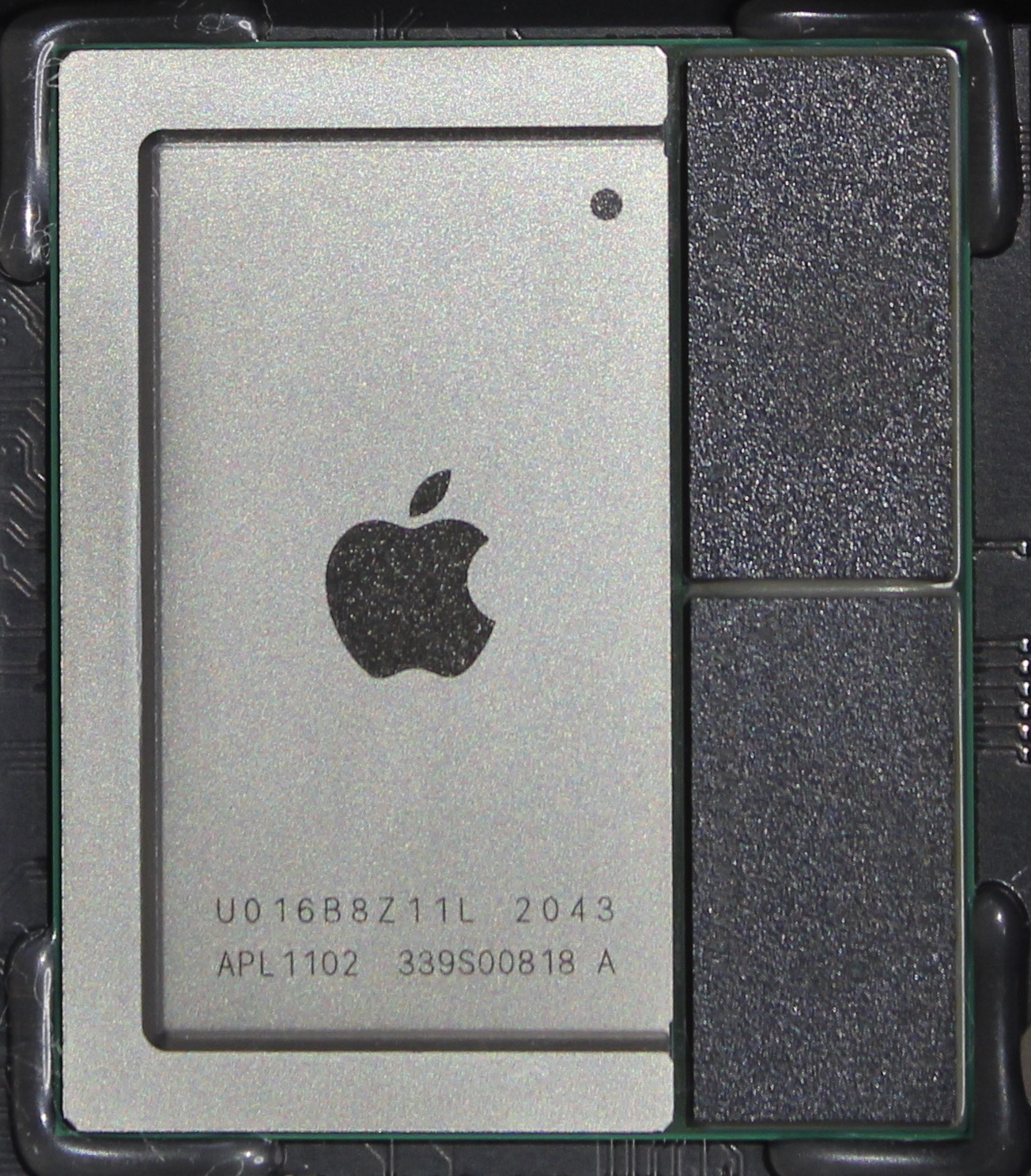
That whole square is the M1 package, Apple's custom die is under the heatspreader on the left, and the two blocks on the right are LPDDR packages stacked on top of the main package.
https://wccftech.com/apple-m2-ultra-soc-delidded-package-siz...
Scaled up, the M2 Ultra is the same deal just with two compute dies and 8 separate memory packages.
Even lower end GPUs are getting more expensive even if they are not really useful for AI. But they still contain <some> chips and ram which is in high demand.
So yes, Apple will likely also have to pay higher priceses when they renew their contracts.
They don't care. They'll pass the cost on to the consumers and not give it a second thought.
It’s been pointed out by others that price is part of Apple's marketing strategy. You can see that in the trash can Mac Pro, which logically should have gotten cheaper over the ridiculous six years it was on sale with near-unchanged specs. But the marketing message was, "we're selling a $3000 computer."
Those fat margins leave them with a nice buffer. Competing products will get more expensive; Apple's will sit still and look even better by comparison.
We are fortunate that Apple picked last year to make 16gb the new floor, though! And I don't think we're going to see base SSDs get any more generous for a very, very long time.
* okay I do remember that Macbook Airs could be had for $999 for a few years, that disappeared for a while, then came back
You don't need a new PC. Just use the old one.
At time time I was messing around with the "badram" patch for Linux.
Also, a great incentive to start writing efficient software. Does Chrome really need 5GB to run a few tabs?
If you have a potentially multi-billion dollar contract, most businesses will do things outside of their standard product offerings to take in that revenue.
FWIW, this was the standard state of affairs of the GPU market for a long while. nVidia and AMD sold the chips they paid someone to produce to integrators like EVGA, PNY, MSI, ZOTAC, GIGABYTE, etc. Cards sold under the AMD or nVidia name directly were usually partnered with one of these companies to actually build the board, place the RAM, design the cooling, etc. From a big picture perspective, it's a pretty recent thing for nVidia to only really deliver finished boards.
On top of this, OpenAI/Sam Altman have been pretty open about making their own AI chips and what not. This might point to them getting closer to actually delivering on that (pure speculation) and wanting to ensure they have other needed supplies like RAM.
how surprised would you be if they announced that they are?
I wouldn't ascribe that much intent. More simply, datacenter builders have bought up the entire supply (and likely future production for some time), hence the supply shortfall.
This is a very simple supply-and-demand situation, nothing nefarious about it.
They’re not doing that, because it benefits them not to.
jokes aside, if the AI demand actually materializes, somebody will look at the above calculation and say 'we're doing it in 12 months' with a completely straight face - incumbents' margin will be the upstart's opportunity.
I've been a huge advocate for local, open, generative AI as the best resistance to massive take-over by large corporations controlling all of this content creation. But even as it is (or "was" I should say), running decent models at home is prohibitively expensive for most people.
Micron has already decided to just eliminate the Crucial brand (as mentioned in the post). It feels like if this continues, once our nice home PCs start to break, we won't be able to repair them.
The extreme version of this is that even dumb terminals (which still require some ram) will be as expensive as laptops today. In this world, our entire computing experience is connecting a dumb terminal to a ChatGPT interface where the only way we can interact with anything is through "agents" and prompts.
In this world, OpenAI is not overvalued, and there is no bubble because the large LLM companies become computing.
But again, I think this is mostly a dystopian sci-fi fiction... but it does sit a bit too close to the realm of possible for my tastes.
My kids use personal computing devices for school, but their primary platform (just like their friends) is locked-down phones. Combining that usage pattern with business incentives to lock users into walled gardens, I kind of worry we are backing into the destruction of personal computing.
RAM being plentiful and cheap led to a lot of software development being very RAM-unaware, allowing the inefficiencies of programs to be mostly obfuscated from the user. If RAM prices continue rising, the semi-apocalytic consumer fiction you've spun here would require that developers not change their behaviors when it comes to software they write. There will be an equillibrium in the market that still allows the entry of consumer PC's it will just mean devices people buy will have less available RAM than is typical. The demand will eventually match up to the change in supply as is typical of supply/demand issues and not continuously rise into an infinite horizon.
The goal shouldn’t be to eliminate one side or the other, but to bridge the gap separating them. Let vscode.dev handle the most common cases, but preserve vscode.exe for the uncommon yet critical ones.
I am much more worried looking at these ridiculous prices on newegg that memory will be dirt cheap 3 years from now because the economy has imploded from this mass stupidity.
I was blown away by Gemini 3 at first but now from using it I have ran into all the dumb things it does because it is a large language model.
What I notice getting shorter is the time between the frontier model making me feel I will have no job prospects in the future to the model reminding me that LLMs are fundamentally flawed.
It is because I want to believe in AGI. I love the holy shit moment of a new model, it is so exciting. I don't want to face the reality that we have made an enormous mistake. I want to believe OpenAI will take over computing because the alternative of some kind of Great AI winter bubble burst would be such a horrible experience to go through.
It's not a lot, but it's enough for a dumb terminal.
I remember when the crypto miners rented a plane to deliver their precious GPUs.
1 person has all the money and all the power and everyone else is bankrupt forever and sad.
If Crucial screws up by closing their consumer business they won’t feel any pain from it because the idea of new competitors entering the space is basically impossible.
If not, what would these AI companies do with the huge supply of hardware they're going to want to get rid of? I think a secondary market is sure to appear.
These are not the old CPU servers of yesterday.
Then you'd have to deal with noise from a literal wall of fans, or build a separate high capacity water cooling system (and still deal with dumping that heat somewhere).
I’ve heard stories about people convincing their utility to install three-phase service drops in their homes, but usually it’s not an option.
Anyways, 320A continuous load at 240V single-phase is 76.8kW, if you assume 25kW per server (20 kW for server, 5kW for cooling), you can run (3) servers and 15 tons of cooling and still have just enough left for one 120V 15A circuit to charge your phone and power a light.
In general, I can't but help think it feels like something we will remember in the future as a marker of the peak of the LLM bubble.
Fun times.
https://news.ycombinator.com/item?id=46142100#46143535
Had Samsung known SK Hynix was about to commit a similar chunk of supply — or vice-versa — the pricing and terms would have likely been different. It’s entirely conceivable they wouldn’t have both agreed to supply such a substantial part of global supply if they had known more...but at the end of the day - OpenAI did succeed in keeping the circles tight, locking down the NDAs, and leveraging the fact that these companies assumed the other wasn’t giving up this much wafer volume simultaneously…in order to make a surgical strike on the global RAM supply chain..
> As of late 2025, 900,000 finished 300 mm 3D NAND memory wafers (typical high-volume inventory for a major memory maker) are worth roughly $9 billion and occupy about 104–105 million cubic inches when properly warehoused in FOUPs. → Economic value ≈ $85–90 per warehoused cubic inch.
It seems once you amass a certain amount of wealth, you just get automatically bailed out from your mistakes
> The Hunts lost over a billion dollars through this incident, but the family fortunes survived. They pledged most of their assets, including their stake in Placid Oil, as collateral for the rescue loan package they obtained. However, the value of their assets (mainly holdings in oil, sugar, and real estate) declined steadily during the 1980s, and their estimated net wealth declined from $5 billion in 1980 to less than $1 billion in 1988.
Always good advice.
https://www.techpowerup.com/339178/ddr6-memory-arrives-in-20...
So the supply side won't get better until about 2028.
I suppose you could hope for an AI crash bad enough to wipe out OpenAI, but unless it happens within the next few months, it may still be too late to profitably restore the DDR5 production lines now being converted to HBM, even if the broader economy doesn't tank:
https://www.reuters.com/markets/europe/if-ai-is-bubble-econo...
Perhaps not coincidentally, that Reuters article was published the same day OpenAI announced that it had cornered an estimated 40% of the world's DRAM production:
https://openai.com/index/samsung-and-sk-join-stargate/
https://www.tomshardware.com/pc-components/dram/openais-star...
I don't think there is a conspiracy or price fixing going on here. Demand for high profit margin memory is insatiable (at least until 2027 maybe beyond) and by the time extra capacity comes online and the memory crunch eases the minor memory players will have captured such a large part of the legacy/consumer market that it makes little sense for the big 3 to get involved anymore.
Add to that scars from overbuilding capacity during previous super memory super cycles and you end up with this perfect storm.
Wonder what would happen if it really takes a dive. The impact on the SF tech scene will be brutal. Maybe I'll go escape on a sailboat for 3 years or something.
Anyway, tangential, but something I think about occasionally.
The thing is it's also not a conventional looking bubble: what we're seeing here is cashed up companies ploughing money into the only thing in their core business they could find to do so with, rather then a lot of over exuberant public trading and debt financing.
Crazy times.
LE should investigate as this concerns us all. However, I really don't have faith this current administration would criminally investigate this. Maybe the next one will, if there's going to be one.
But what will happen when people are priced out from the circus?
2. Resell wafers at huge markup to competitors
3. Profit
edit: this is a joke
Now you can't even fit a browser doing nothing into that memory...
No. They bought the wafers for HBM. The only thing thats going to get cheap when openai implodes are server stuff for homelab bros. The RAM manufacturers are using their production capacity to produce HBM for openai.
Let's be honest here - the projects I'm going to do in 2026, I bought the parts for those back in 2024. But this is definitely going to make me put off some projects that I might have finally gotten around to in 2028.
You can go 16GB if you go native and throw some assembly in the mix. Use old school scripting languages. Debloat browsers.
It has been long delayed.
But it doesn't matter either way, because both 16 and 32GB have what, doubled, tripled? It's nuts. Even if you say "just buy less memory", now is a horrible time to be building a system.
Visit any news site or any Fandom wiki and then check eg Firefox about:memory. It'll be a lot.
And for security reasons, different tabs can't easily share resources like you might expect them to.
SSD’s are also up. Hell I am seeing refurbished enterprise HDD’s at 2x right now. It’s sharp increases basically across the board except for CPU’s/GPU’s.
Every PC build basically just cranked up $400-$600 easily, and that’s not accounting for the impact of inflation over the last few years weakening everyone’s wallets. The $1600 machine I spec’d out for my buddy 5 weeks ago to buy parts for this Black Friday now runs $2k even.
You can achieve a lot by learning Klong and reading the intro on statistics. And xargs to paralelize stuff. Oh, and vidir to edit directories at crazy speeds with any editor, even nano or gedit if you like them.
if it gets really bad though the superscalers will guarantee them enough business years out to make the investment worth it
More rot economy. Customers are such a drag. Lets just sell to other companies for billion dollar deals at once. These AI companies have bottomless wallets. No one has thought of this before we will totally get rich.
So it's the Bitcoin craze all over again. Sigh. The bubble will eventually collapse, it has to - but the markets can stay irrational longer than you can stay solvent... or, to use a more appropriate comparison, have a working computer.
I for myself? I hope once this bubble collapses, we see actual punishments again. Too-large-to-fail companies broken up, people getting prosecuted for the wash trading masquerading itself as "legitimate investments" in the entire bubble (that more looks like the genetic family table of the infamously incestuous Habsburg family), greedy executives jailed or, at least where national security is impacted due to chip shortages, permanently gotten rid of. I'm sick and tired of large companies being able to just get away with gobbling up everything, killing off the economy at large, they are not just parasites - they are a cancer, killing its host society.
If an RTX 5000 series price topped out at historical prices no one would need hosted AI
Then it came to be that models were on a path to run well enough loaded into RAM... uh oh
This is in line with ISPs long ago banning running personal services and the long held desire to sell dumb thin clients that must work with a central service
Web developers fell for confidence games of old elders hook line and sinker. Nothing but the insane ego and vanity of some tech oligarchs driving this. They cannot appear weak. Vain aura farming, projection of strength.
This https://cdna.pcpartpicker.com/static/forever/images/trends/2... will happen to every class of thing (once it hits energy, everything is downstream of energy).
If the argument is that prices will skyrocket simply because of long-term AI demand, I think that ignores the fact that manufacturing vastly more products will stabilize prices up to the point that raw materials start to become significantly more expensive, and is strongly incentivized over the ~10-year timeframe for IC manufacturers.
The value of AGI/ASI is not only defined by its practical use, It is also bounded by the purchasing power of potential consumers.
If humans aren’t worth paying, those humans won’t be paying anyone either. No business can function without customers, no matter how good the product.
not trying to argue, just curious.
Unbounded increases in complexity lead to diminishing returns on energy investment and increased system fragility which both contribute to an increased likelihood of collapse as solutions to old problems generate new problems faster than new solutions can be created since energy that should be dedicated to new solutions is needed to maintain the layers of complexity generated by the layers of previous solutions.