Previous threads we've done: https://news.ycombinator.com/submitted?id=proberts.
Is there really nothing native citizens like me can do to get our family here outside waiting in a generic line with everyone else in the world?
But I assume nobody actually purposefully presses the button; only sometimes doing so by accident.
I work for an American company and I am based in Europe. I visit the US for work every now and then. I heard a lot of horror stories regarding border entries. If I am ever in a situation where the border police asks for access to my personal phone and pin code, what are my options? Can I refuse and what happens then?
If you're on American soil they can just detain you. Or worse.
If you ever want nightmares, read the story of Maher Arar.
isn't the right move here: wipe your phone, travel to destination, then restore from cloud backup? in the middle, you can let them inspect your wiped phone.
Wipe it, let them inspect it, sell it, and buy a new one.
Good luck getting anyone close to this to go on the record about it though given such things normally come with corporate or government gag orders.
There are hundreds of privileged vendor binary blobs on most flagship devices not even Google gets source code to though so supply chain attacks should be assumed.
Sure, the NSA can probably pull this off. Thing is, the NSA probably does not need to do this at immigration.
I seriously doubt that this is a realistic problem if your threat model is anything less than "The NSA is very interested in me". In that case I don't see how you could trust any phone, regardless of it having been in the hands of border officials or not.
Sources: https://www.aclu.org/know-your-rights/what-do-when-encounter...
https://www.aclunc.org/our-work/know-your-rights/know-your-r...
That doesn't mean they can't deny you entry. It means you might win a court case some day.
ICE cannot legally arrest people who are citizens for no reason, and yet they have done exactly that 30% of the time by their own admission.
"Knowing your rights" is meaningless if the public chooses to vote for people who don't care about those rights, and celebrate when you do not get your rights.
It doesn't matter what the paper says, it matters what CBP feels like doing, and what their management lets them get away with. The constitution is just a magic circle we all agree to play in, and isn't real if enough people disregard it.
If the border agent doesn't want you to come into the country, you are fucked. Nobody's job is to get between that agent and you and ensure the border agent follows the law on the paper, and the border agent will not go to jail or even lose their job for completely ignoring the law.
You are seriously inconvenienced, but assuming your paperwork is in order, you will be allowed into the US. This isn't just against US law, it's a violation of international law to render a person stateless.
This ignores the real point, which is that while you cannot be refused entry to the United States, you can be arrested at the border. ICE these days has mastered the art of making people's detainment so uncomfortable that even those with a right to be in this country end up deciding to leave.
Never comply with such nonsense.
Where are you getting that statistic (honest question)?
https://www.dhs.gov/news/2025/12/05/despite-medias-claims-ic...
Why would ICE leave the number as low as "70%" if they could be higher? Every illegal alien is a criminal as far as the law is concerned. Every illegal alien arrested is "charged with a crime". Otherwise ICE is openly stating to its supporters that they arrest illegal aliens and then release them, something their supporters are vocally against, and the administration believes and claims to be a serious problem.
Meanwhile, the Cato Institute a libertarian think tank, claims they have been leaked far worse data https://www.cato.org/blog/5-ice-detainees-have-violent-convi...
A direct reading of ICE's claims (that seem to be contrary to information obtained through FOIA?) is that 70% of the people they arrest are criminals, which by their own definitions, would imply 30% of the people they arrest are not illegally here, but that's reading between the lines and it's hard to lend any credence to anything said by an administration that treats public statements as a fun gaslighting game.
But essentially, if ICE COULD claim everyone they arrest is an illegal alien (and literally a criminal they are legally allowed to arrest and deport), why wouldn't they?
Flag my claim if appropriate.
> 70% of ICE arrests are of criminal illegal aliens charged with or convicted of crimes in the U.S.
I believe the claim here is that 70% of the people ICE arrests have been charged with or convicted of crimes other than being present in the USA illegally. I don't think this is at all meant to imply that 30% of arrests are of people who are present in the USA legally. I think it's just sloppy writing.
As the other commenter wrote, ICE is saying that 70% of arrests have a criminal conviction, implying something other than just being in the country illegally. First, many illegal aliens (e.g. those who overstay their visas) have not committed any criminal offense - overstaying a visa is a civil charge.
Yes, I do admit there is wiggle room for ICE to make it sound like all the people they are arresting are rapists and murderers (crossing the border illegally is itself a criminal offense), and as you point out, the Cato institute and many others have pointed out that high percentages of those deported don't have other criminal convictions. And given how much wide reporting there's been about how the administration is dissatisfied with the pace of deportations, it's clear there is pressure and incentive for ICE to deport as many people as possible.
So you can make all those valid arguments. Falsely stating (i.e. "making up" or "lying") that 30% of ICE arrests are citizens with no convictions doesn't help your point.
In short, an unfortunately very wide field of people for ICE to chew through without touching any citizens (even if one takes the most uncharitable interpretation, i.e. only 70% of arrests have been of unlawfully present individuals)
They can immediately arrest you, however.
There’s many points you could make about the United States and immigration, but I don’t think this is one of them.
This is obviously a general statement about any nation, comparing the US to its peers.
In the context of the conversation it is clearly an argument that “we don’t have to let you in, we can require whatever we want, including trampling on your rights as an individual”, which is unamerican.
That doesn't sound relevant.
Nobody said that they were obliged to admit you, they complained that the reasons for declining admittance were unfair. Unless you think "no obligation to admit" means carte blanche to decline for any reason, and to treat you however they like?
If so, then that is unreasonable. It is a much stronger condition than "I don't have to let you in".
It is exactly the same as "I don't have to let you in".
For example, I do not have an obligation to let people into my house. I can choose to let them in or decline them entry. But there are certain preconditions I cannot apply. I cannot, for example, say "you may come into my house only if you murder my neighbour". That's because I'm legally bound not to induce people to commit murder. It would obviously be disingenuous to say this means I have an "obligation to admit" them.
It's the same with immigration. They actually are legally bound in certain ways - an immigration official can't assault you for instance. It's not hard to imagine them being legally bound not to search people's phones. That doesn't mean "they have to admit people".
Of course I can say that. I can say "you can't come into my house if you're black" too. The point is that it's unethical. It would be unethical for me to search your phone before you entered my house, too. This is not complicated, I'm not sure why you're having trouble understanding it.
How is that a relevant argument?
The United States does have some rides about what border agents can and can not do. They can not sucker punch you, for example. They can request to see the contents of your phone and if you refuse they can choose to refuse you admittance into the country.
It’s not a question of fairness.
For what it’s worth I’m very much in favor of immigration and people visiting the United States, but this country and all others have the right to admit or not admit whomever they choose.
I actually expected to leave and have my right to come back not dependent on GC status (which expires after 6 months), but due to family have stayed so far. by the by - I'm a citizen of that dangerous country bordering the US - Canada.
https://www.cbsa-asfc.gc.ca/travel-voyage/edd-ean-eng.html
https://www.theguardian.com/world/2022/jan/18/returning-trav...
Progressive utopias indeed
Of course, if you just don’t want anyone with intelligence or dignity to visit the country, this is great policy.
> You are within your rights to say no
Given that you don't have a right to enter, if you say no (which you are within your rights to do), and you are denied entry, then nothing wrong has happened.
If you believe that they shouldn't make entry conditional on something, then you are asserting a right to enter. That's what "right" means.
If someone comes up to me and asks for food, I am not obliged to give it to them.
If I say to them, "I will give you food, on the condition that I can punch you in the face", and they decline to be punched in the face, do you really believe "nothing wrong has happened"? That I, applying an unethical condition, did nothing wrong?
If someone else says "You must not make punching someone in the face a precondition of giving them food", does that create a "right to food"? Of course not.
Your analogy does seem workable, though - let's examine:
> If someone comes up to me and asks for food, I am not obliged to give it to them.
Yes! 100% agree. They probably have a right to ask for food in countries that protect free speech, but they have no right to have requests fulfilled.
> If I say to them, "I will give you food, on the condition that I can punch you in the face", and they decline to be punched in the face,
Sounds great. You have the right to say no. You did say no basically, but you did make a counteroffer. (This is arguably also especially true due to free speech, though that's unrelated to our points.) Your exact counteroffer doesn't seem relevant to me, it could also just be that you'll give it for $50, or $1,000,000 and nothing changes.
He thinks it's a bad offer and gets none of your food.
> "nothing wrong has happened"?
I do think nothing wrong has happened! Is it only because you used food, which a necessity, that you think it's wrong? What if it's a PS5? Would this be ok if the asker is seeking a free PS5? Visiting a foreign country is much more like a PS5 than it is a potato.
> If someone else says "You must not make punching someone in the face a precondition of giving them food", does that create a "right to food"? Of course not.
That is the worst policy I could imagine since it's vague and undefined. Can one ask for a kick to the groin? An elbow to the funny bone? If you did the policymaker's job correctly you'd need to make the policy like "No one may deny a request for food/PS5s" -- that exactly creates a right to food/PS5s. Or you could make the policy "No one may deny a request for food/PS5s but one may require compensation, which may only be less than $50 in US Currency. Compensation in the form of a service or a trade may not be required."
That creates a right to pay $50 or less for food/PS5s.
The whole reason we have those types of employment and public accommodation laws is a special case though. In terms of employment, we prefer this to a world where black people or women can't get jobs, because jobs are necessary, or can't enter half the establishments because people witnessed that Jim Crow was a shitty and shameful situation. And I do stipulate that that doesn't mean the same as "all women have the right to a job at my company upon demand."
But why don't we also have laws criminalizing things like refusing to be friends with $SKIN_COLOR people? I think it's because it's only in those specific realms like employment and public accommodation where we have created rights. The right to shop in a place that is open to the general public is a right Black people got from a law. And the right of people to be considered for a job without regard to their membership in certain protected classes is something the Equal Employment Opportunity Act of 1972 created. There is no right of foreigners without a green card to enter in the first place - CBP can completely legally say no to anyone, so no 'counteroffer' of conditional admittance could be inappropriate. The only exception I can think of is misconduct of the officer, e.g. 'I'll admit you if you give me $10,000' or a more unsavory favor. But with that already being illegal, I don't think it is too relevant here.
Not just that, at least in my understanding of American political theory. It's because of the existing right to freedom of association. If it is criminal to refuse association, that association becomes compulsory, and thus not free.
> why don't we also have laws criminalizing things like refusing to be friends with $SKIN_COLOR people?
Some combination of "it would be impossible to enforce" and "laws about who can be friends with who sounds kind of crazy".
> There is no right of foreigners without a green card to enter in the first place
There is no right of black people (or any people) to get a job, either. It simply does not follow that "no counteroffer ... could be inappropriate". This is sort of my point - all the law says is "if you would offer this job to person X, only on the condition that they were white rather than black, then you must offer them the job anyway". Please note that I am not arguing about what the law says - I am arguing that the law is unethical.
Now, you say getting a job is somehow more "necessary" than, say, being friends with someone. I would argue also it's more "objective" in the sense that a job is a job, it would be silly for someone to try to argue "well, I can choose not to be friends with black people, so why can't I choose not to hire them?". This would be disingenuous - hiring people is not similar to being friends with them. So, given you agree this kind of law is ok for jobs and not ok for people's friendships, which one do you think is more similar to immigration?
Yes, of course nothing wrong has happened. The other party decided that the food was not worth a punch in the face. The other party is no worse off than if you had made no offer. The other party is no worse off than if you had responded to "may I have some food please" with "no".
Downthread:
> It is routine and unproblematic for laws to exist that prohibit "you can't enter this bar if you're black" or "I won't hire you because you're a woman".
This is completely irrelevant. "I will give you food, on the condition that you change your immutable characteristics" is incoherent. "You can't enter the country because you didn't submit to this violation of your privacy" is a) targeted at someone who definitionally doesn't have those constitutional protections in the US and b) not an expression of any kind of identity-group prejudice.
This is a very strange failure of reading comprehension. I think you're trying to write "I will only give you food if you're white." Are you trying to say this sentence is incoherent? I admit that if you say this sentence to a black person, it is logically equivalent to "I will give you food if you change your immutable characteristics". But they are not logically equivalent in general, so your gotcha doesn't apply to my argument.
About your actual argument: a) it is obvious they don't have constitutional protections, I am not arguing about the law, this is an ethical point; b) identity-group prejudice is not the only kind of unethical behaviour. Since you mention prejudice, I think you proved my point - if the ethical standard was "nobody is materially worse off" then this kind of prejudice would just be irrelevant. If the US had a "whites only" immigration policy that would be A-OK with you, they have no obligation to let people in. If that's your ethical standard, I have nothing more to say.
No. I am exactly pointing out why your example, which would be analogous to "I will only give you food if you're white", is not comparable to "I will give you food, on the condition that I can punch you in the face".
Anyway, you are still missing the point. You cannot cause harm to someone by offering a bad option. These are not the same kind of statement. The race-based one is not an offer. It does not involve any possibility of food being given to the black person, because the black person cannot become white. It is not comparable to the offer to be punched in the face, because the offer to be punched in the face is an offer.
> If that's your ethical standard, I have nothing more to say.
The failure of reading comprehension is yours.
This is not an example of "being offered something unreasonable, being given free reign to decline the offer".
> You just don't care about this particular harm.
This is both incorrect and insulting.
We're talking about a non-citizen on a visitor visa and there is just simply no legal right to enter if the port of entry official don't like their answers or behavior. They can't say "you have to let me in, it's my right".
“Rights” aren’t the point. I have a right to refuse entry to a police officer without a warrant, but if an officer puts me in the position of having to explicitly exercise that right, we should be disappointed in them and their chief, not me.
Peter might have good insights on whether the relevant case law has changed since 2017 though.
So your "burner phone" needs to be your primary phone, which is something that is hard to go back in time to fix.
People with no social media presence at all have been denied entry.
1) only bring burner devices
2) have your devices travel separately using some courier service
Yeah, they can still request your social media profiles and whatnot. You are not particularly likely to be denied entry because you don't have your normal devices with you, this is not very uncommon these days.
Of course it's better to be able to say that your employer requires you to do this, so it's probably good to ask your boss to write up such a policy. Otherwise "why?" could be a pretty uncomfortable question.
I went through CBP twice in the span of 20 hours. I was granted entry once and denied the second time. The second time, I had to sign some electronic pad and later a form (I-275) was given to me. Did I have the option not to sign? And is this contradictory decision in span of 20 hours legally OK?
Below are some more details:
At Toronto Pearson (Terminal 3) on December 1-2, 2025, I went through CBP twice and the first time I was granted entry and second time denied. I am a dual Canadian-Iranian citizen. On day one I was given a detailed biographical form, questioned repeatedly about my purpose of travel (Conference), employment, etc and especially about any Iranian military service. I provided old passports and a university transcript showing that I have not been in Iran since 2019 and prior to that I was studying in the university. They also explicitly questioned me about a prior incident in which Canadian police claimed an explosive trace ("Tetryl") on me, which I disputed as an error. CBP took my belongings (backpack, watch, wallet, phone), conducted a body inspection in another room (through search, hands inside my pants followed by groin search) took my fingerprints multiple times and took my phone after requiring the pass code and it was out of my possession for about an hour. After several hours they told me I was "negative" but by then my flight had departed. I was given only a piece of paper with CBP stamp. Since there was no flight for my airline for the rest of the day, I was brought back to the Canadian side. The day after, I went through CBP again and when I showed them their paper with stamp I was told "we are not going to take your word for it" and the full process happened again (although no body check or phone check this time). A different officer then stated that my documents were not sufficient to prove I had not done military service in Iran and that I now needed an official exemption letter or something similar from Iranian authorities. He added that I should have been "advised differently" the night before. Finally, my picture was taken and I was asked to sign on a pad twice. Only afterward did they print and hand me a form (I-275) showing a withdrawal of my application. I was escorted back to the Canadian side. Did I have the option not to sign? If in future I decide to visit US is this going to be held against me? I can provide more details or the form if necessary.
Does the government have any direct link to meta re what accounts people actually have. I’m surprised people aren’t up in arms about this, I guess it affects mostly visitors and immigrants but the fact that the government needs to see your activity on a private company’s web app is wild to me.
If they ask you "well, do you use any social media?" You'd presumably have to answer with HN, which maybe doesn't sound all that great :)
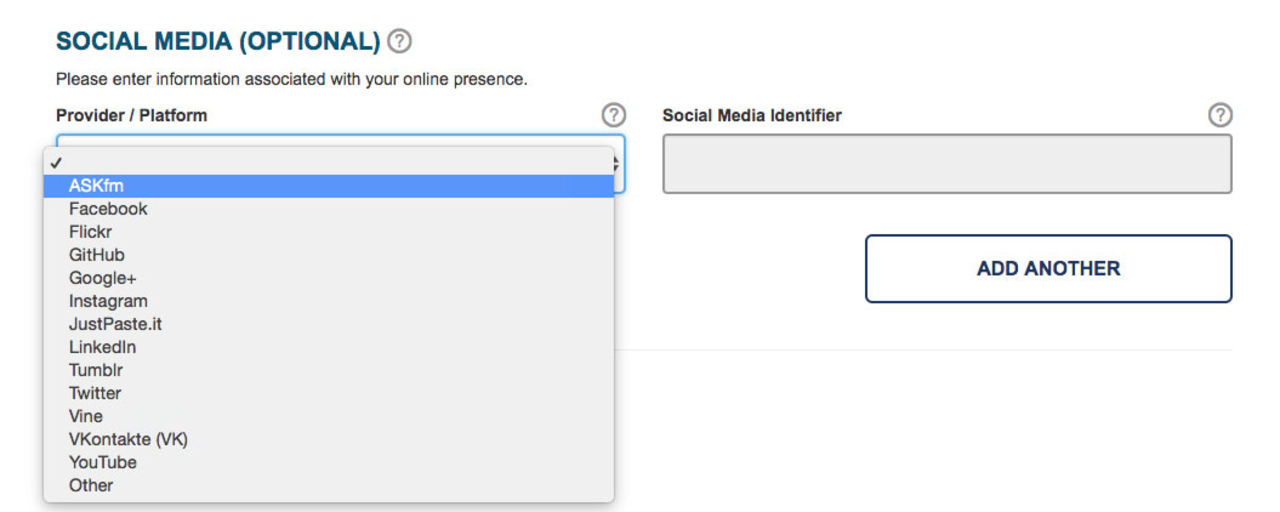
I mean, some US govt immigration forms asking for your social media usernames include pastebin sites like "justpaste.it". See for example: https://static.feber.se/article_images/42/10/92/421092_1280....
Knowing that, it's crystal clear HN falls strictly within that definition of "social media", although it might not be as clear if you don't know what that particular site is.
Googling 'site:gov "justpaste.it"' also brings endless results of government documents mentioning the site in the context of terrorism.
I somewhat doubt US immigration authorities thwarted any would-be terrorists by asking for their justpaste.it username, but what do I know, perhaps this was an important breakthrough in the global war on terror.
It's pretty easy to think it's harmless if you live in a country where that viewpoint is not uncommon.
If you're putting terrorism related content on justpaste.it, you're probably pretty deep into the whole thing.
And who says that asking for your password is to gain entry?
Do you have a concrete example story that illustrates this?
Time waster.
https://www.dw.com/en/german-nationals-us-immigration-detain...
I suspect it would be important that any funds never reached you, so you couldn't simply receive money then donate that amount. Playing a charity gig where the receipts go directly to the charity would likely be fine, streaming/Spotify revenue I don't know, acting in a movie might be out of the question if it's being professionally shot because the producer might have insurance or other requirements that only paid performers and crew can be on set, etc.
However the practical answer is ask. Some visas like the J1 allow this - even consulting, provided it meets a bunch of criteria and relevant people sign off. It's not a trivial process, but it's not outright forbidden.
I'm a US citizen and my girlfriend is Iranian. She's been in the states for 7 years, first on a student visa then applied for her green card 1.5 yrs ago on NIW, currently "pending status change".
She's a jeweler and metal artist and owns a jewelry brand in the US. Never had any legal problems in the US, and nothing in her background of social media that would be a detriment to her review process.
Curious about your thoughts on the outlook for green card processing for Iranian citizens in general, given the administration's recent movements.
In her specific situation, would marriage provide a more robust chance of having her GC application approved? Is it even possible to re-apply for the GC while she's in the current "pending status change" state?
Since overseas workers are still subject to 15-year amortizations I'm wondering if people are getting pulled in from Canada.
> Applicants for U.S. nonimmigrant visas (NIV) should schedule their visa interview appointments at the U.S. Embassy or Consulate in their country of nationality or residence
> Applicants must be able to demonstrate residence in the country where they are applying, if the place of application is based on their residency.
What sort of proof is required to demonstrate residence? What about cases where an applicant legally has residency in a particular country (e.g. PR card or work visa) but in practice lives in the US as an H-1B/TN/L-1/O-1/etc. worker or H-4/TD/L-2/O-3/etc. dependant? Especially for the dual intent visas?
I'm currently living in the US on TN status and am married to an American. Have you heard of anyone on TN status having difficulty applying for a green card? And do you have any sense of what the wait times currently are, particularly how long until you can get a travel authorization?
https://www.nytimes.com/2025/11/26/us/trump-green-card-inter...
That was tolerated previously.
It does appear that these arrests have stopped since the NYT article was written.
They have a green card interview because they married an American. But you can’t get an adjustment of status if you are in violation of your current visa terms.
This is both right and wrong. Congress passed a law ages ago that grants forgiveness to overstaying spouses once the greencard is issued. The AOS process is allowed.
The hole however is the AOS does not extend your authorized stay if you were out of status when it was filed. So this leaves one vulnerable to the ICE arrests.
However, your AOS can still be processed even when arrested because of the forgiveness granted by law, so it just becomes an issue of having a good lawyer to get a judge to intervene.
Subsection (a) allows the “Attorney General, in his discretion” to grant an adjustment of status.
Subsection (c) categorically denies adjustment of status under certain conditions, including where someone has violated the terms of their visa. This takes away the Attorney General’s discretion to grant an adjustment. The adjustment must be denied.
Subsection (e) then makes subsection (c) inapplicable where the immigrant enters into a bona fide marriage during a legal proceeding regarding their immigrant status. It’s not correct to call this a “forgiveness,” because it doesn’t guarantee you any sort of legal status. Instead, it takes away what would otherwise be a categorical bar against an adjustment of status. That puts you back under subsection (a), where the decision is made by the “Attorney General, in his discretion.” The law says the Attorney can grant you the adjustment of status, not that he must. Under the law, the Attorney General can still categorically deny any adjustments under those circumstances.
What’s happening here is that these people were here on tourist visas or completely illegally. Then at some point they married a U.S. citizen and filed a PERM application. But that filing doesn’t protect them from deportation for their original illegal status.
There's no PERM process in family based adjustment of status. You're confusing FB AOS with EB AOS.
Subsection (d) allows the attorney general to grant an AOS notwithstanding subsection (c) where an immigrant enters j to a bona fide marriage during proceedings regarding their immigration status. But under subsection (a) the AOS is entirely at the “discretion” of the Attorney General.
Indeed, section 1255 doesn’t grant anyone legal status. It contains various provisions where an AOS must be denied. Then, it allows but does not require the Attorney General to grant an AOS under other circumstances.
My understanding is that their time spent on the company before YC accepts them is the biggest risk factor?
The entire premise of your question is misaligned with the intention of the H1-B visa. Yes, everyone abuses its intent, but that isn't justification for more people to find more ways to abuse it. The abuse of that visa (and other visas) is why folks just want it abolished outright. I guess the purpose of a system is what it does, but it was sold to the American electorate as a way for companies to get access to talent that they simply cannot find domestically.
Trying to use the H1-B to hire a very specific person instead of any person with the skillset needed for the role would be in contradiction with the labor market test (LMT) needed for PERM status.
An H1-B can only work for the employer on the I-129 petition. There are some forms of passive income allowed but to placing shares in a trust and having an unpaid board seat just seems like an attempt to cheat the process because ultimately the goal is for her to work for this startup. Doing what your proposing puts a target on her head where anyone that is anti-H-1B can report her to USCIS and get her deported.
Moving home, working remotely and then applying for an L-1 seems like the correct approach here for what you're trying to do.
The first two options make sense but this latter option sounds like a risk. As I understand it, she can't earn any active income from this startup unless see has an I-129 for it. A share grant counts as income.
I mean, yeah you can work on a side project in your spare time that could become a business, but the moment employment and active income enters the picture that becomes something else.
However they keep flip flopping between me needing a B1 and me just using my ESTA for the training, and their communication hasn't been the most straight forward. Which visa do I need to get to enter the US for the training?
> attend short-term training (you may not be paid by any source in the United States with the exception of expenses incidental to your stay)
"source in the US" might be problematic if you're paid by the US company directly and not a UK arm. You'd have to take those days as unpaid, except for a per diem? If you're paid in pounds by a UK source, ought to be fine.
I would confidently say you do not need a C visa. That's for immediate transit (like you have to change airports or something, and you would use an ESTA anyway). A D visa is for people like airline crew who have to stay and have to work whilst there (like getting an aircraft ready for international departure from a US airport). If you needed that, your company ought to know.
In your view, who are the winners and losers of the recent H1B changes? And any changes on your perspective for YC harboring international talent in SF Bay Area?
A TN visa/status holder that applies for a EB Green Card by filing form I-485 is considered to have shown immigrant intent and will no longer be granted TN status in the future.
Is this bar permanent or would an applicant who failed to obtain a Green Card or surrendered it in the future be able to seek TN visa/status provided they could prove strong links to Mexico/Canada?
Many of the absurdities of the US immigration system exist for good reasons and it would be great to understand the nuances.
- Paper-free overhaul of the entire immigration system.
- Green Card recapture [0].
- Country of Birth caps abolished for Green Cards. Impossible to justify this as it doesn't serve the intended purpose since AC21 was passed.
- EAD/AP premium processing - so many livelihoods ruined and immigration journeys derailed because people can't get work authorization or cannot travel.
- TD holders granted working rights incident of status same as L2S.
Now for the not-so-popular suggestions...
- Diversity Lottery - there's bipartisan support to cancel the program and it's really hard to justify bringing almost 55k with a min of high school education into the country.
- Removal of F2B, F3, F4 family based categories to move inline with other developed nations immigration systems such as Canada [1].
[0] - https://www.fwd.us/news/green-card-recapture
[1] - https://www.canada.ca/en/immigration-refugees-citizenship/se...
You are saying that since, for example, Indians can remain indeterminately as long as they are employed, they are de facto kind of like in a green card situation already, therefore country caps don't make sense?
That would mean then that every other country wait will go up for over a decade, with all the backlog that India has (1.2M vs 140k EB green cards per year).
There is no downside for them to screw everyone equally. However, if they make immigration easier or make it simpler, a bunch of them won’t be reelected as their bases would hate that.
I’m all in for simplifying the process and what not, but congress taking action I think is very likely to screw things more than they currently are.
>but congress taking action I think is very likely to screw things more than they currently are
Congress' inaction and paralysis is the reason we find ourselves in this morass. Congress has abdicated its responsibility and ceded power to the executive.
I'd brave it out and stick to your guns.
After all, facts are facts.
If an i-131 is pending, would you advise that person to return briefly to USA before their 1 year date of exit (ensuring that they are never out of USA for greater than 1 year prior to approved i-131)?
Or does a reentry permit allow them to remain out of country for longer than that even if pending (presuming it gets approved)?
There is some uncertainty about whether Auer deference survives after Loper Bright.
What impacts are you seeing as a result of the $100K H-1B fee which took effect on 9/21/25?
Assuming a US startup is considering engineering hires outside the United States, how does one currently assess the likelihood of getting them a visa to work in the USA? And what timeline and cost would be involved?
OR should I just close it and try the normal route? Thanks in advance!
For anyone who has one US citizen parent and one non-citizen parent, where the citizen parent has passed before the child applicant for naturalization reaches 18 years of age, resulting in the applicant applying for and receiving naturalization as an adult, can that same currently naturalized citizen also obtain natural born citizenship status through the deceased citizen parent and would it be advisable?
I am planning to move to San Francisco to join the startup ecosystem. Regarding the H-1B visa, what does the current process and timeline look like for a new applicant? Given the lottery constraints, are there specific 'red flags' or common mistakes I should avoid when looking for a sponsor?
The educational institution sent the student's home address some tax form that he had to file by April 15, but the former student forgot to do that.
The question is: would the student have problems getting a U.S. visa as a tourist and entering the U.S. several years after that? If yes, how could that be fixed? Thanks in advance.
But as PRoberts said, a non-citizen spouse can't enter on a tourist visa with the intention to change status. A spouse can visit, but then change their mind while in the US.
But CBP is well aware of people trying to shortcut the process this way, so it can be very challenging convincing CBP your non-citizen spouse intends to leave. But it can be done showing a job, property or other elements that would require someone to go back.
should it be d3 or i601?
Curious how the statistics/success rates are looking?
Do you think there are risks involved with leaving (and hence returning to) the country on a Green Card?
A few I registered a company in Delaware as a foreign company for SaaS business.
I have been unable to complete an organization certificate for my website.
Unfortunately I could not get one since my legal phone is not the way to reach me and they tell me that they cannot change that phone to reach me according to my legal representatives in Delaware.
I need some kind of certificate of good standing or being able to have a verifiable phone and/or email to reach me in a "reliable" way from a third party source.
How could I proceed for this, since I am not knowledgeable of the law in Delaware. Probably I need an attorney and I would be happy if I can be recommended one that could emit such verification.
Do you think H1B visa holders looking to move to a Green Card (in coordination with their employer) should be concerned about rejected applications or other issues?
I do understand that performative victimhood is much easier as it does not require much intellectual honesty.
I assume it means TN visas are dead in six months if the written notice clause is respected.
Is the zombie CUSFTA now out of dormancy? Can we now use the TC visa? If CUSFTA dies as well, what are the other options and how long does it take to process?
... but what about when non-US citizens leave the US?
For example, as a Canadian, if I'm down in the US and, on my way back up to Canada, a US border officer requests access to my phone and I decline... what happens then?
How can an European Senior SWE land a job, let’s say, SF and have some kind of guarantee regarding the visa before flying into the US.
The 100K cost for the H-1B is so absurd that it crushes any hope of me ever participating in Silicon Valley or any other tech hub in the US. Is the tech alive or are companies just relocating to EU/others?
You are a sample of '1' and you don't get to invalidate other people's experiences based on your own. The only reason you do not notice, given that it is true is because you would either rather have it not be true or because you are actively working not to notice.
Do you know of the fable of a goose that laid a golden egg once a day?
You are proposing to kill the goose to see if you can get multiple golden eggs at once.
> country with an identity
Like it or not, the identity is 'land of opportunities' and not 'land of anglo-saxons who emigrated before ~1850'
Did you drop out of middle school?
America saw the highest rate of immigration in history between ~1910-1960. A majority of the scientists and engineers in the Apollo program were immigrants or children of immigrants.
> Why is it only ever white nations that are expected to let everyone else in?
They are not, have you considered moving to Russia?
How would you justify it's you should get the work/money, not imigrant worker? The fact your parents immigrated earlier than they should justify it in your opinion?
The fact that I'm American justifies it. If Americans flooded into say, Somalia, bought up all the houses, took up all the jobs etc, you'd be horrifically offended.
Americans have no where else to go. This is my home and I will not abandon it. You can't just drop 50 million extra workers into a country and expect people to just take it.
It's like saying you are white male and it justifies higher salary.
Also if you struggle to compete with immigrants who usually have no network, English is not their native language, have many other disadvantages - you are doing something wrong or are not competitive in the first place.
The fact is you should not fight against imigration, you should fight for decent payment for it and same rights
We are incredibly atomized in the west, foreigners always have more closely knit networks. They always help each other out. People who make the arguments you're making are almost always foreigners. You have no say in the affairs of my nation. You should leave.