The paper notes:
>It is important to note that MP products often contain elevated levels of nucleic acids, constituting ~8% of the dry weight [17], which necessitates consideration when assessing their suitability for human consumption. To address this, a heat treatment process is employed at the end of fermentation that reduces the nucleic acid content in the fermented biomass to below 0.75/100 g, while simultaneously deactivating protease activity and F. venenatum biomass. However, this procedure has been observed to induce cell membrane leakage and a substantial loss of biomass, as evidenced in the Quorn production process [17], which also utilizes F. venenatum as the MP producer. Our experimental trials have encountered similar challenges, achieving a biomass yield of merely ~35%, and observed that heating process increased the relative protein and chitin content (Figure 2D,E), which may be related to the effect of membrane leakage, while the intracellular protein of the FCPD engineered strain was less likely to be lost to the extracellular. Thus, concentrating the fermentation broth to enhance protein and amino acids content in successive steps to produce a highly nutritious water-soluble fertilizer appears to be an effective strategy for adding value to the process (Figure 1).
The challenges of developing economic single cell protein products, that are suitable for human consumption, are described in chapter 3 here:
https://www.researchgate.net/profile/Martin-Hofrichter-2/pub...
There have been other attempts to use genetically-modified fungi (Trichoderma) for protein production, where they secrete in the cultivation medium a water-soluble animal protein, e.g. a cow whey protein or chicken egg white protein.
Then, through filtration and ultrafiltration, the desired protein is separated from the fungal cells and the cultivation medium, producing a protein powder in the same way how one makes whey protein concentrate or milk protein concentrate.
If done correctly this method produces only healthy protein without contaminants.
However, searching right now online if there has been any progress with this, I see that against a startup company that has already produced such whey protein powder from a fungal culture there is a lawsuit that alleges that they have not separated properly the whey protein and that what they have sold contained more fungal protein of uncertain quality and safety than the good whey protein that they claimed to sell.
Even if that company might be guilty of trying to exploit the technology before being perfected, the principle is sound and there is no doubt that this can be done, producing pure high-quality protein.
I actually use whey protein concentrate to provide a significant fraction of my protein consumption, so I hope that its production from fungi will succeed in a not too distant future.
Trichoderma is among the fungi that secrete enzymes in their environment, so the genetic modification that replaced its enzyme with whey protein or egg albumin is much simpler than the many modifications described in the parent article in order to make the whole cells more palatable, without really achieving this.
For producing a protein powder that can be used as an ingredient in cooking food from vegetable sources, the approach used with Trichoderma is sufficient. The techniques used in the parent article are justified because they do not want to make a healthy food, but they want to make a meat imitation. For myself, enhancing the quality of vegetable food is a much more important goal than attempting to simulate meat, but at least in USA it is likely that the second goal might make more money.
I've had their product as protein powder and in an ice cream that contained it.
Sounds like par for the course in the VC-backed startup world
Honest question, what does "animal protein" mean here in regards to it being produced by a fungi? is it that it's the same as as one from a cow at the molecular level?
So the cow lactoglobulin or chicken ovalbumin produced by the fungus is chemically identical to that from the protein powders that are currently made from cow milk or whey or from chicken egg white.
That means that such fungus-produced protein has an optimal amino acid profile, unlike the natural fungal proteins and if it forms a part of the daily protein intake (e.g. around a third) it can compensate the inadequate amino acid profiles of vegetable proteins.
For about 4 years I have eaten only vegetable proteins, but this created some constraints in what I could eat that were too inconvenient, so eventually I gave up. While now most of my protein intake remains of vegetable origin, I use some whey protein powder in the cooking of certain foods, to enhance their protein content, which has enabled me to make much more varied choices in the menu. Therefore I would know how to use such a product from fungi, if it would become widely available. There are a few startups in this domain, both in USA and in Europe, but for now their target is mostly in selling to big industrial producers of food, not at retail.
I think it is _fascinating_ how we can modulate these amazing biological machines to do all kinds of tricks.
I wish we had a better effect discovery process, something akin to alphafold where the space can be explored and defined beyond wait-and-see.
DNA, evolution, etc. is insanely powerful and you are kind of reverse-engineering and tweaking it to get different outcomes, but like you point out it is very slow. We just need to live for like 10,000 years and then a lifetimes work would become more exciting.
https://www.orcasciences.com/articles/food-without-agricultu...
Be an ultra-vegan; don't even kill microorganisms.
https://www.sciencealert.com/massive-study-reveals-where-gou...
If we fixed it, nobody would get gout.
I kinda wonder sometimes why medicine doesn't try to fix some of these species level genetic problems more broadly or more quickly. There's this enzyme every other mammal produces, why isn't there a fast track to engineering a micro-organ to produce it or inject an engineered version in gout patients (I did some research and yes people are somewhat doing these things... slowly)
Why can't I, a healthy adult, be genetically engineered to start producing my own Vitamin C like every other mammal?
e.g the amount of backlash thought emporium got when he genetically engineered himself to remove lactose intolerance: https://www.youtube.com/watch?v=J3FcbFqSoQY
Risky, but it's his body!
Evidence to the contrary - fishing during free time.
I didn't have a flare up until my late 20s but it finally explained the very slight ache in my big toe. After the first one, the second and third happened within a year. I stopped drinking almost entirely aside from some gin a few times a year.
I reduced various food consumption with no change. Whisky/beer will cripple me if I have more than one of either. After some research, vegan marathon runners are even plagued by this.
I cut out all drinking and went vegetarian after a gout diagnosis and still had flare ups. I never drink sugary drinks or eat fast food, and yet doctors would constantly recommend cutting these out and “lifestyle changes”.
Allopurinol is the only thing keeping me from being bedridden on days I can feel a flare up.
I lament the time I lost living without it!
I wish you all the luck in fixing these problems and would be fascinated to see the outcomes… However, this notion that these changes would be cost free is a mistaken one.
Mutants with these characteristics have certainly existed over evolutionary time… Our version outcompeted them.
Evolution also isn't smart. Have so much of something in your diet and you'll tend to lose the ability to manufacture it because there's little evolutionary pressure to maintain it. If you're a VitaminCless mutant you don't die and your children survive just fine and suddenly this becomes common in the species.
It didn't get lost because it was advantageous for it to be gone, it just wasn't important enough to get maintained.
In this case the gene encoding L-gulonolactone_oxidase is broken, and that's the last step in the process. That gene catalyzes something into a substance which decays into vitamin C.
ex vivo gene therapy.
Because the technology to do so doesn't exist yet.
We're at the point where we're trying to fix only most severe conditions, conditions for which there are no other treatment options.
> Therapeutically, recombinant urate oxidase (like rasburicase or pegylated urate oxidase) is used as a medication to rapidly lower uric acid levels, treating tumor lysis syndrome, hyperuricemia, and gout, especially when other treatments fail or are contraindicated.
Wikipedia:
> It has been proposed that the loss of urate oxidase gene expression has been advantageous to hominoids, since uric acid is a powerful antioxidant and scavenger of singlet oxygen and radicals. Its presence provides the body with protection from oxidative damage, thus prolonging life and decreasing age-specific cancer rates.[15]
> Children with non-Hodgkin's lymphoma (NHL), specifically with Burkitt's lymphoma and B-cell acute lymphoblastic leukemia (B-ALL), often experience tumor lysis syndrome (TLS), which occurs when breakdown of tumor cells by chemotherapy releases uric acid and cause the formation of uric acid crystals in the renal tubules and collecting ducts. This can lead to kidney failure and even death. Studies suggest that patients at a high risk of developing TLS may benefit from the administration of urate oxidase.[17] However, humans lack the subsequent enzyme HIU hydroxylase in the pathway to degrade uric acid to allantoin, so long-term urate oxidase therapy could potentially have harmful effects because of toxic effects of HIU.[18]
> Higher uric acid levels have also been associated with epilepsy. However, it was found in mouse models that disrupting urate oxidase actually decreases brain excitability and susceptibility to seizures.[19]
> Graft-versus-host disease (GVHD) is often a side effect of allogeneic hematopoietic stem cell transplantation (HSCT), driven by donor T cells destroying host tissue. Uric acid has been shown to increase T cell response, so clinical trials have shown that urate oxidase can be administered to decrease uric acid levels in the patient and subsequently decrease the likelihood of GVHD.[20]
> Urate oxidase is formulated as a protein drug (rasburicase) for the treatment of acute hyperuricemia in patients receiving chemotherapy. A PEGylated form of urate oxidase, pegloticase, was FDA approved in 2010 for the treatment of chronic gout in adult patients refractory to "conventional therapy".[21]
As a general rule though, you can effectively treat/prevent gout by significantly increasing consumption of water and by replacing proteins with cereal grains (or fruits and vegetables or vegetable fats). These are inexpensive, fairly safe solutions.
[1] https://en.wikipedia.org/wiki/Fusarium_venenatum
[2] https://eathealthy365.com/quorn-vs-meat-the-2025-environment...
Many farmers don't have the financial means to redesign their entire pipeline to move from birds to fungus. "farming" is in the name but I also suspect there is nothing in common between raising chicken in cages and mushrooms in sterile containers in term of know-how, maintenance, &c.
And the farmers who do grow their own feed are probably smaller operations targeting higher quality meat than factory-farmed chicken, so they’re not the ones that vat-grown meat-substitutes would be competing with.
But considering the simplicity of the product, I assume any brand will be very similar.
That's a pretty substantial backyard operation.
They would probably need more pasture in monoculture hellholes that have cornfields for 100km in each direction.
I'm guessing that the more you do to get them forage the better the meat and eggs will be, for instance larger pasture and making sure your other animals leave plenty of dung around.
At least where I live, you can't have chickens in quite the same way our great-grandparents had. You need to comply with veterinary regulation for one, and for good reasons.
12 weeks is incorrect, you can buy the same Cornish crosses that the big farms use. So they can be ready in as little as 6-7 weeks but I usually stretch it to 8 or 9; my time to process them is fixed so I might as well get a little bit more meat for my efforts.
I use a chicken tractor that is big enough to let me hold about 33 at a time.
So it’s an operation that needs to run for about half the year. If you time it right, you can work around vacations and stuff. Daily operations are actually pretty minimal in terms of time spent, but you do lose three weekends a year to process them if you don’t outsource that.
All of that to say: I’m not sure if I want to agree with your characterization. It’s less of a time commitment than you think. But there is a substantial cost to it all: capital costs are notable and the cost of feed and birds is such that you basically break even against high-end organic products for sale. You’re always going to look at the Costco chicken and wonder why you are doing it. I treat it as a “touch grass” hobby that kinda breaks even.
No real point, just excited to have something to say about this haha
It depends. My friend's dad has chickens and the meat is tough and grey-dark, very much not like the supermarket white and soft meat. Also the meat tastes of... chicken; I guess. And you can see even the bones are significantly harder (I can't snap them with my fingers like the supermarket chickens' bones). I always assumed this is because of the way they're raised, allowed to roam freely (within an enclosure, but it's a big one) and feed on scraps and everything they can forage for, in addition to grain.
What does your chickens' meat look and taste like? If it's the same as supermarket chicken then, I don't know, but if it's the other kind then it's definitely worth it. Although it takes a couple hours cooking to soften it :)
Breeds optimized to egg-laying are an entirely separate category, and they don't produce much meat, and the meat is… different, as you described. Apparently some hybrid breeds are also available for backyard meat+egg co-production. I don't know what their meat is like.
People didn't really eat that much chicken meat before the 70s, at least in the West. Wouldn't have been even possible to consume this much chicken meat, before these fast-growing breeds and industrial-scale farms.
But I will say, when you buy chicken at the grocery store, the quality can vary. Mine has always been good.
Heh. Over here (UK and the rest of Europe I reckon) the kids love chicken thighs. Acquired tastes eh?
Note that in the scenario I was responding to, they are arguing for input-neutral chickens, so they can't just buy in feed, and have all the complications of maintaining their feed source as well
Average household probably isn't going to produce enough food scraps to feed 25+ chickens (we've done it in the past, but we had a restaurant kitchen to supply the food scraps)
If I understand this right, this would even in the EU now be allowed to be sold without the GMO label.
not in a meaningful way, no. the probability that a new mutation you want will occur is much much lower than the probability you can breed offspring without a gene that's already in the bloodline.
"The first modification, eliminating a gene for chitin synthase, resulted in thinner fungal cell walls."
This also has an enormous potential benefit of reducing avian flu and other zoonotic bird diseases.
How?
Although it's theoretically possible for a disease to infect both fungus and animals, because the biology is so different, the risk is greatly, greatly reduced.
In addition, it may be possible to reduce the use of treatments such as antibiotics which, in their currently mass application to farmed animals, could directly lead to the development of antibiotic resistant in diseases which affect humans and animals.
I mean, industrial slaughter isn't a pretty process, even in better plants, which most aren't, but where they come to wipe out the barn, they're not putting animal welfare first.
for humans, does shellfish allergy (tropomyosin and other proteins) diagnosis imply chitin allergy?
It might be some Big Meat conspiracy to combat these upstarts, but there's also reasonable data indicating that less processing results in better health outcomes.
We want causal correlations. Someone decided that instead they wanted to divide food into categoried in this specific way, and then rank categories. And I don't think all of them were naive about what they were doing. I've read Merchants of Doubt, I don't give harmful industries the benefit of doubt when it comes to things like this.
Edit to add: I think it’s also clear from this that there isn’t anything like the scientific consensus you believe there is on this issue.
So there's no debate that ultra processed foods affect health, there's only debate on whether the category itself is good enough. And if you go deeper into the subject, it becomes pretty obvious that the Nova system is a pretty bad model. But it's a simple model that can be easily communicated to Doomscroll Sally. The better models we have haven't caught on anywhere near as well.
"The participants in this debate agree that food processing vitally affects human health, and that the extent of food processing significantly affects diet quality and health outcomes. They disagree on the significance of ultra-processing, as defined within the Nova food classification system."
Is my point. There’s a lot of correlation but whole classification system is poorly designed and mechanisms are not really explained. The whole idea of labelling foods as ultra processed as a proxy for bad seems poorly conceived. If I was to go further I’d say it has a whiff of naturalistic fallacy about it.
It why people ultra process foods - to make them more tasty and addictive by processing in more fats, salts and sugars. Take soda for example. They added acidic CO2 bubbles so they can add more sugar .
The problem with the term ultra processed has, it bags in huge amounts of different foods and classifies them all bad.
But "hyperpalatable" also misleading in that heavy processing of unhealthy food often just makes things a lot more storable but only a little less tasty (e.g. sweet baked goods).
For "ultra-processed", not only is the choice of classes to divide food into suspect, but they're gerrymandering those classes too. Much fried food isn't especially processed. Extract the oil, fry the vegetable in it, basically two steps. Certainly fewer steps than say, rye bread.
From what I've seen, the studies of ultra-processed food find excuses to count many processing steps for obviously unhealthy food, and fewer for benign ones.
  * it frequently removes the fiber and structure, making it faster to eat, and easier to over consume.
  * it frequently adds sugar, salt, etc., not just making it easier to over consume, but with a payload that itself does extra damage.
  * simply changing the form of food, without changing the contents, itself can have serious nutritional consequences [0].
[0] https://www.cambridge.org/core/journals/british-journal-of-n...
This is a very specific definition of "ultraprocessed" that many people don't associate with the term at all. Most people are trying to avoid the strange chemicals and fillers used to market food (like color and shine), to preserve food (so it can last longer on the shelf/warehouse and travel farther), or fill food (to replace expensive fats, starches and sugars with cheap fats, starches and sugars, or even to add indigestible elements for bulk and texture.) We have no idea of a lot of the long-term effects of some of this stuff, and much of it has never been tested for safety, just assumed to be safe.
Other people are trying to tell people to eat healthy food. This is your camp. You don't have to "ultraprocess" things to dump sugar into them. You can just dump sugar into them. I'm a home cook who doesn't really eat much processed food at all, but I certainly eat a lot of fats, salt, and sugar. I can tell you exactly how much. I put it in because I like it. I'm not interested in anybody's suggestion that I cut it other than my doctor. It's a public morals crusade disguised as a health crusade. "Ultraprocessing" often comes in when you dump some strange chemical in to disguise the lack of butter, the lack of a real sugar, or to lower salt content.
But with the other stuff, I hate that it's all lumped together in an "ultraprocessed" category. Each of the types of processing that is done on food is different, each should be justified on its own merits, the process should be public, and things that are notable should be labeled so people who want to avoid them can. Lobbyists fight in order not to label things, and not to have to test things.
I also don't mean to be overcritical about people who want people to eat healthier, but I believe that it undermines the fight to not have unknown dangers in food to turn it into an orthorexia crusade.
This is a huge disadvantage. Not every farmer is a biological research institute.
This really looks like an attempt to get investors to come back and push the stock price.
Given how fucked up astronauts who spends just a few month in space come back to earth I think we have dozens if not hundreds of other things to solve before even considering food. Your bones, muscles, eyes, circulatory system, &c. are not made for anything other than good ol earth
Details are a bit vague but it seems like it's viable.
Jell-o (gello?) is a good example, nothing tastes like it naturally. Why aren't there tasty food that are original in terms of taste and texture but good for health and the environment? I suppose part of the struggle is that food is entrenched into culture so much. burgers and bbq are inextricable from july 4th and memorial day for example.
Jell-O actually proves this rather than refuting it. It succeeds because it hits that hardwired sweet preference, not because it invented some novel taste dimension. A truly new taste that doesn’t map onto the existing five basics would likely register as “off” rather than delicious. Your brain wouldn’t know what to do with it, nutritionally speaking.
So you’d have to either work within those existing taste channels while creating novel combinations and textures, or somehow condition people to associate genuinely new sensations with safety and reward. The latter is slow going. We’re quite literally built to be suspicious of unfamiliar foods.
We have five taste receptors, so it's it's actually impossible to get something that doesn't map unto those five. Instead, what we call the taste of food, and what GP was referring to, is actually the smell of food, or more commonly, its aroma, which we can detect both from the outside by sniffing it with our noses, and while it is in our mouths via molecules wafting up to our respiratory tract.
Unlike the simplicity of taste, we have a huge array of smell receptors, with most of them having much more indirect associations, if any, with any specific survival need. It's very much possible, and in fact quite common, to synthesize novel smells/aromas which don't resemble any natural food.
Slightly unrelated, but what I find very cool is thinking about your taste sense as a hyper-sensitive molecule detector. Individual aromas are just the signal your brain generates for different kinds of molecules, and it's very good at that. That's why at wine tastings, for example, people come up with all these elaborate terms for specific aromas—it's a way to name the molecule composition.
A good example might be one that came up recently (on "Tasting History") is musk, which tastes of and has the bouquet of laundry detergent, or basil (which if you eat it plain and in isolation has a bizarre chemical flavor and bouquet), etc.
At first. If the food has nutrients that are important to the brain, it will recognize that in the future. There are animal experiment confirming this.
We don't link a sensation initially, until our mind associates it with feeling good in some way. Then we like it.
There are also a wide variety of textures that are heavily industrialised. If you go to some fine dining restaurants, you'll find smells and colours which you simply cannot replicate at home - let alone make from scratch.
Most synthetic meat and fish is really just a flavour carrier for whatever sauce people like. I've had imitation chicken, shrimp, beef, crab, etc. They all taste great - but that's mostly because the sauces are the same as their meaty counterparts.
Do you mean processing ingredients with the goal to take cheap ingredients and make a product as hyper-palatable as possible? That would generally be called "ultra-processed food"; you're not going to find a Doritos chip in nature.
Do you mean developing completely completely new flavors via chemical synthesis? I don't think there's much possibility there. Our senses have evolved to detect compounds found in nature, so it's unlikely a synthetic compound can produce a flavor completely unlike anything found in nature.
Also, I think you're overestimating jelly. Gelatine is just a breakdown product of collagen. Boil animal connective tissue, purify the gelatine, add sugar and flavoring and set it into a gel. It's really only a few of techniques removed from nature. If you want to say it's not found in nature, then fair enough, but neither is a medium-rare steak.
The technology is based on some naturally occurring proteins from fruit native to West Africa, but I'd say the idea of sweet things that are good for you is pretty novel!
I guess for casual buyers having a familiar reference point is just crucial.
Remember the target audience - people would rather drink and die from raw milk than get a shot for a completely preventable sickness.
I'm fine with GMOs, a lot of produce would be pretty inedible without it.
It's a lot more natural then what we're doing here.
We have been using these as healthy, nutritious food sources for eons. I'm fine with people creating alternatives and making them available, but far too many people want to see the former disappear because they're misled by bad science and hysteria.
CO2 is not really a 'sustainability' problem for food production, because food production and consumption is steady state.[1] Methane is somewhat of a problem (Because it's a potent greenhouse gas that is not part of the food chain, but does eventually break down), but also eventually reaches a steady state, where you add emit it as quickly as it breaks down.
The bigger sustainability problem for food production comes from non-steady-state, non-reversible actions. Burning down a rainforest to permanently turn it into pasture[1]. Overfarming a plot of land, and exhausting all the nutrients from it.
----
[1] Using fossil-fuel diesel-powered machinery to grow, harvest, and transport food, however, is not steady-state. That is a sustainability issue for food production. Fortunately, it's a very small part of overall human GHG emissions.
[2] Do enough of that, and this is irreversible - you can't ever turn that pasture back into rainforest, because you need existing rainforest to bootstrap new rainforest.
... let's start on tearing down bullshit AI datacenters.
Oh no, a billion Nvidia cards are envronmentally friendly, you say, better to lazer-focus on the cow farts?
In contrast, all data centers (not just AI) currently use less than 1.5% of all electricity, making up less than 0.3% of global emissions [2]. Although recent increases in data center electricity usage is lamentable, even in the short term future, much of this can and more importantly _will_ be low-carbon energy, and the ratio should continue to improve with time.
A 1% reduction in livestock emissions is therefore about the same as a 50% reduction in data center emissions.
[1]: https://thebreakthrough.org/issues/food-agriculture-environm...
[2]: https://www.carbon-direct.com/insights/understanding-the-car...
Minimizing cow farts is simply a better focus.
It's a bit extreme to refer to that "climate" summit "guests" as cattle, but I won't deny it gave me a chuckle.
>the inhumane conditions in which the cattle are raised
Gosh, that's sad. One way to go about it is to vote with your hard-earned and only buy meat from the Ethically Raised in the Swiss Alps Cows that look quite happy on the photos then.
In a discussion about genetically modified fungus as a meat substitute?
While billions of Asians would farm and devour everything they can get their teeth on.
It certainly does not look very nice, are you relating this to the "Ethically Raised in the Swiss Alps Cows" in the comment you replied to?
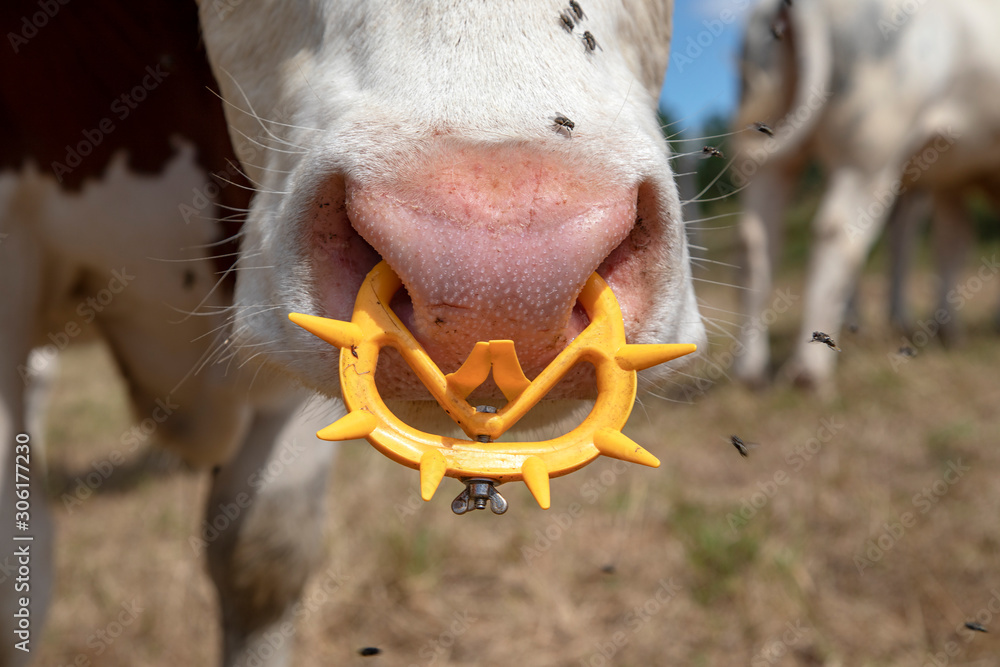
In truth, they just take the calves away from the mothers after a short while, ship them out to the abbatoir. There is no benefit to them being in the same enclosure with a spiky nose ring, it seems that this must have a different purpose than the one you mentioned.
Now? Now meat's mostly a problem, not a good thing. Even if you ignore every ethical argument, regardless of if your concerns are your own health or the environment, meat's not good.
Data centres… well, I think this is a bubble, I also want it to be a bubble for various reasons, but the AI running on them today is in fact already useful.
Even if current AI wasn't at all useful (despite it having about half to one quarter of the market size as meat already), it does so at a cost orders of magnitude lower environmental harm than meat. Convincing half of the population to have "meat-free Mondays" (so, reducing consumption by 1/14th) would do more than switching off all the AI DCs, given the estimates from Greenpeace for AI https://www.greenpeace.de/publikationen/20250514-greenpeace-... and Our World In Data's estimates for livestock and manure https://ourworldindata.org/ghg-emissions-by-sector
I'd like to see meat consumption to something like half to a quarter of its current level rather than eliminate it outright.
Thanks for the quip. Does this come from a Big AI talking points memo?
Judging by the ridiculous and absolutely non-sequitur "one quarter of the market size" phrase, yeah, I think so.
It comes from the evidence I linked you to.
Which includes, to repeat, *Greenpeace*.
Also to repeat: I think this is a bubble, I also want it to be a bubble for various reasons.
As in, I do not buy into Big AI's talking points about how this is "it", and we're on a path to radical AI-based abundance. Not yet. Plus I think it would be bad even if we were on that track at this point, so I want it to be "not it".
> ridiculous
The global meat market is around 1.5 trillion USD, give or take. That is literally the value of meat, which like all things in a free economic sector can be measured in money.
You may also notice from me saying that AI is 0.5-0.25 of that, that I'm not using "Market Cap" of AI in this comparison. Market cap != market size. This is about what revenue AI and meat gets per year.
If you want to do this for ethical reasons, which you should, then just eat vegetables. They taste way better. You just have to recalibrate your senses to deal with the higher levels of flavour.
But if people really want "chicken nuggets" for some reason then there's no reason it should have to involve animals at all, so this is a good thing, I guess.
There are plenty of vegetarian meals (or vegan ones, though that's harder). It's just that we have relegated most of them to side dishes, entres or breakfast because meat is too popular as a main dish. But this is a very recent phenomenon
But you can't make any money selling hash browns as veggie food, it's much more profitable to sell fake meat
I am so thankful of advances that let me eat something my brain enjoys. I get the best of both worlds - no animal harmed in the process.
Why do vegs have to neg on other vegs for what they eat? I hate that. To each their own. I encourage everyone to be vegetarian to support animal rights, but I also would never tell them that their cravings aren't real or how to go about doing it.
It's not a "neg", it's my opinion. I don't think you need to crave meat, you are just lacking the proper cuisine that would satisfy you completely. Try Gobi 65 and you'll never crave "spicy chicken wings" again. I feel like people go veggie by just removing meat from a cuisine that is centred around it. Imagine British food without meat: nothing and mash, nothing and chips, roast nothing... mmm... delicious. You need to completely change. There's nothing "missing" from a vegetarian Indian meal.