It’s been a real pleasure getting back into Ruby after so many years in typescript, python, and rust.
Happy to see the update. Real shame about the haters here, the Ruby community is a supportive and positive bunch that has shipped real products while others seem to worship at the altar of computer science alone… that’s about as counter snarky as I want to be here
an opinionated man for an opinionated language. seems fitting.
He says "In 2000, more than sixty percent of the city were native Brits. By 2024, that had dropped to about a third", and as supporting evidence, he links to https://en.wikipedia.org/wiki/Ethnic_groups_in_London, where we see that 63% of London's population is born in the UK (native), which clearly contradicts his own point. But he's not referring to that, he's referring to the "White British" ethnic category. So he's using a made up, white nationalist definition of "native Brit".
In the same blogpost, he also praised Tommy Robbinson, far-right activist and violent criminal.
He hasn't clarified or apologized for those statements, or the other racist dogwhistles in the blogpost.
If this isn't enough, just consider the fact that many rails contributors have quit because of him. Most famously when he got mad that people at his company complained about a racist list of "funny names" [2]. He and his co-founder literally decided to "ban political discussions" because people complained about how he handled this, which lead to a third of his employees quitting in protest.
[1] https://world.hey.com/dhh/as-i-remember-london-e7d38e64
[2] https://www.platformer.news/-what-really-happened-at-basecam...
They aren't native american of course. That's a silly dishonest argument based on wordplay.
Speaking from experience (recently we rebuilt https://raku.org), I am sure that they will come back and optimize, but tbh this is not the priority with a new site where the hits will top out at ~ 10k / hour.
I am no great fan of animations, simpler is better imho - and I have resisted requests to add a sandbox to the Raku site since https://glot.io/new/raku does such a good job anyway... but I think Ruby is likely to appeal to a wider audience via a cool design vibe, whereas Raku is still in the early adopter / geek phase of adoption.
btw Ruby is a fantastic language!
You don't need to "come back and optimize" if you don't start with needing a progress indicator for a "transform: scale" animation to display a single static download link. The number of hits is not relevant.
Neither do you need to do three separate fetch requests for static plain text examples that you then laboriously dump into the DOM by creating dummy elements, putting content in there, then looking up and cloning `code` tags to then dump those code tags on the page.
The website looks cool to me, makes me want to try Ruby.
That said, it's cool seeing some of those samples, because they're honestly not really what I expected. For example, I didn't expect the list subtraction to work at a set operation, so seeing that example gives me a feel for what sort of things I can do with Ruby code.
I don't know the exact numbers, but the figures show you lose a high percentage of viewers with each click. So if you have 100 people who view the first page, 10 of them might click the link to the second page, and only 1 of them might click the link to the third page. If having customers view the running code is crucial, you'd want it on the very first page, above the fold.
Low bandwidth, minimal in an artistic way.
I wish less sites would try to make them look like a wordpress from the early twenty aughts.
What if I told you that you don't need javascript?
It is part of what distinguishes actually good web devs from move fast and break everything kind of people.
I guess I thought of noscript due to other cases I had recently, where I noscript-ed a whole workflow and displayed elements, that should never appear, when JS is running.
Knowing ruby I can tell that the relaxed approach to the website does not correspond with sophistication in the language itself. If I wouldn't know ruby, that would be a put off for me, thinking that if they don't want to convince me tech-wise by their site, it might be similarly annoying to deep-dive into the language.
care to elaborate?
- images: none are visible above the fold - all should be lazy loaded (like it is done with all conference images) and the pragdave.jpeg one does not need to be that large;
- JS: navigation toggle, including chevron rotation can be done in CSS using :has combined with checkbox/radio input. Similarly for header-navigation and theme-toggle (here combined with cookie store). Then toc.js - seems like something easy to do in the backend. Hero-animation - I haven't looked much through it but seems like at least some parts can be done in CSS;
- CSS/tailwind - well it would probably take less typing to do it just in CSS, the site does not seem to be that much componentized to benefit from tailwind.
The theme toggle has three states. How do you model this with a checkbox?
(Also, technically, alternative stylesheets can be defined in HTML, except every browser except Firefox removed it: https://developer.mozilla.org/en-US/docs/Web/HTML/Reference/...)
Good question, especially since the Ruby site already does this by default. Perhaps the argument is that one of the two color schemes may be designed so poorly that the user may want to manually switch to the other one.
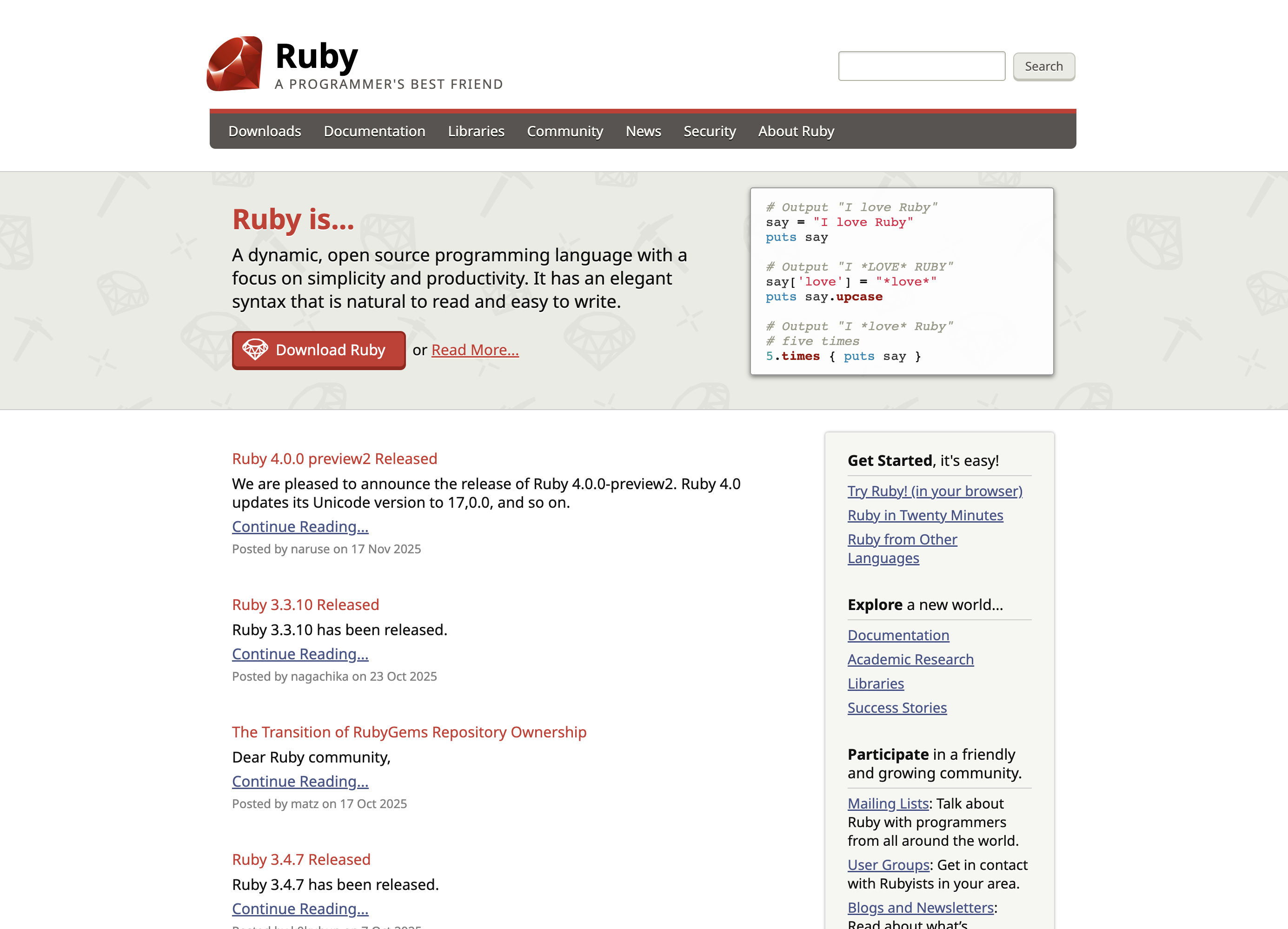
ruby-lang.com stood out with a text in a big font:
Ruby is...
Followed by a paragraph about what makes Ruby special. I think that was an exceptionally simple and natural way of introducing something as complex as a programming language.
For reference this is the old one, which is much better: https://www.ruby-lang.org/images/about/screenshot-ruby-lang-... From: https://www.ruby-lang.org/en/about/website/
The old one was better because it said something about what the language is and how it benefits the user. "Best friend" is not descriptive. "dynamic language with minimal syntax that is easy to read and write" at least tells me something about Ruby, its priorities, and value proposition. I'm very concerned about a language that claims it wants to be my friend.
[1] https://github.com/ruby/www.ruby-lang.org/graphs/contributor...
What does it do exactly? It just fetches[1] to another part of site and retrieves static text[2] to be displayed. This part could've been kept as part of the html, no need for this artificial loading. It's not a webapp, it's a website.
1. https://www.ruby-lang.org/javascripts/try-ruby-examples.js
2. https://www.ruby-lang.org/en/examples/i_love_ruby
In this day and age, it is possible to have an appealing, responsive, lightweight website with no JS (maybe except for darkmode toggle).
The homepage loads 9.7kB of JS. Navigating to every single link in the main nav results in no additional JS being loaded.
The site is fine.
Right, but I do not think this is the case here
But you can have a button that saves your state when you enable javascript, and doesn't save your state (but still works) when you disable javascript.
edit: I think it is possible to save your state on the second click. So the UX is: you have 3 options with a slide. You click one of them, the page theme changes, and the option icon becomes a padlock. You click on it again, and the option is saved.
It seems to be a limitation that without javascript a single click can't change a switch and do something else--make a request to set a cookie. But you can do changing style on first click, then setting a cookie on the second. Here's a demo (written by Claude) (it doesn't work without server, just the HTML part) https://jsfiddle.net/r134vgo7/3/
> Why the target audience of the ruby, probably primary web developers, whould do that?
In my experience, it's mostly web developers who care about this in the first place.
  - https://glot.io/snippets/he42jpfm27
  - https://glot.io/snippets/he42trx6w6
  - https://glot.io/snippets/he434b6ryj
It does reflect what the language creators pay attention to. Way back when, when I was undecided between learning Python or Ruby, after visiting countless resources I noticed Ruby websites in general looked way nicer and clearer than Python websites, so I picked Ruby. Now, years of experience with both languages later, I have zero doubt that to me that was the right choice at the time. I would’ve been frustrated with Python to no end.
I no longer need either language regularly, but given the choice again I would not hesitate to go for Ruby.
All that said, I do agree with some other comments on the thread regarding the disappointing reliance on JavaScript here. Should just be static.
Comparing to Python, where virtualenv is de facto default, and pyls works by default, the experience with Ruby is not that great.
New website looks like a website for a startup project that will be closed in 2 years.
Sometimes it's nice to just let people rest and get on with life.
i agree it's not a great look.
Hopefully the website will keep getting regularly updated and tweaked (software, is a living organism!), instead of being frozen in amber for a decade like the last version!
Why would you want someone known for political hijinx and hateful speech as your face? How is that supposed to draw in new people?
It seems this site doesn't work so well without JS.
I like the design and content. Being able to immediately try a language online is huge
But there has to be a way to load that content in a progressive manner. Loading a static version first and then hydrating the content if you need interactive actions
1. Code examples are fetched via JS instead of being in the HTML. They're static text - there's zero reason for this.
2. The "0%" loading spinner blocks everything. It's literally just displaying a download button and some text.
3. With JS disabled, you get nothing. A language website should be the poster child for progressive enhancement.
The irony is that Ruby itself has always emphasized developer happiness and doing things "the right way." This site feels like it was built with the modern JS framework mindset rather than the Ruby philosophy.
Still, huge improvement over the 2005-era design. Just wish they'd optimized it properly.
Is the design debate public? I'd imagine it would make great reading.
https://web.archive.org/web/20251113164224/https://www.ruby-...
Why you might ask? - Omakase Stack - high level is good for business processes - modern concepts without JS ecosystem churn - great testing capabilities - great ecosystem - highly effective stack for LLMs (conventions)
Is it fast in Benchmark Games - not by any means. Will you be able to finish projects and make money with it? Absolutely.
Also, apart from a quote from David Heinemeier Hansson the home page doesn’t even mention that ruby is a programming language.
For comparison, the following all mention that above the fold, with a short phrase indicating what you would want to use the language.
- https://www.python.org/ has “Python is a programming language that lets you work quickly and integrate systems more effectively. Learn More”
- https://www.perl.org/ has “Perl is a highly capable, feature-rich programming language with over 37 years of development”
- https://www.php.net/ has “A popular general-purpose scripting language that is especially suited to web development. Fast, flexible and pragmatic, PHP powers everything from your blog to the most popular websites in the world.”
- https://www.swift.org/ has “Swift is the powerful, flexible, multiplatform programming language. Fast. Expressive. Safe.”
Same for absolutely static code examples that take a few seconds to load and shift the content away.
Why?
Unfortunately, most people today probably don't care about what you're talking about. (I do, but I've decided not to comment on it anymore, because it would probably drive me crazy :)
The designer fail to target their audience.
It's C/C++ developers that typically prefer a no-fluff approach.
One of the reasons Next.js is attractive to me, is exactly they have rediscovered why so many of us have stayed with SSR.
Hmm. We can agree to disagree on the definition of fluff.
Additionally, Next.js should only be used when SaaS product vendor doesn't allow for any other option, which sadly is the case when making themselves sellable to magpie developers, while riding VC money until the IPO takes off.
I rather deliver, than do yak shaving, but at least can deliver only HTML and CSS if I chose to.
This is bit too much to ask. Just check the source it is swollen with Tailwind.
> flex-shrink-0 transition-transform duration-300 hover:scale-105 w-[160px] h-[144px] 2xl:w-[200px] 2xl:h-[180px]
just to avoid CSS, not sure they would bother with CSS animation.
Ruby have YJIT, which is a production ready JIT compiler that generates native machine code. But it requires enabling via flag "--yjit" rather than running by default.
Why? I think it's primarily to avoid build time dependencies on Rust and prevent unexpected overhead for users. This keeps binary light and avoids forcing Rust installation on users, especially for those who run interpreter only, where YJIT adds no value.
Note that including YJIT also bloat binaries by 5 to 10MB (Rust static lib + code cache structures) for source builds and complicates cross compilation since Rust targets vary by architecture (focus x86-64 and arm64, not all platforms).
Also, Rails 7.1+ enables YJIT by default, so JIT (to native code) in Ruby is being utilized when actually needed.
The current experimental JIT is ZJIT. And the fastest Ruby JIT Runtime is TruffleRuby. ( I wish JRuby gets more love )