But the idea that you go 55 minutes just because of policy; and skip 15 stations is crazy to me. Again with the assumptions that it can safely stop somewhere for 5m and I’m pretty sure the answer is yes.
I have fond memories of train stopping close to my house for various random reasons and I’d just get out so I don’t have to walk back from the station. The modern world where everything is “safety issue” and “someone else’s problem” is where we lost our ways, and it’s never coming back.
As a French, the culture shock was brutal and I never really got around that work attitude. I went through a similar issue back when I used to take a regional train in France, and the crew swiftly adapted by bending rules to accommodate a difficult situation caused by bad weather. I'm not sure this could happen today, but it was a thing 10 years ago, we used to trust the operators back then.
It's always some magical higher power preventing you from doing the sensible thing. One favourite excuse is insurance liability. We can't do the sensible thing, because the insurance wouldn't pay if something bad were to happen, even though the odds of something bad happening are virtually nil.
You can also observe this in German politics. "Oh, we absolutely cannot do <common sense thing> because the rules won't allow it." Well, you could change the rules, but then you would have to take some actual responsibility, and we can't have that.
Bad faith actors and cultural dysfunction can break pretty much anything no matter how well thought out it might be.
U.S. politics today in a nutshell.
People need to be given timely information, communication channels, and authority to straighten things out when they go awry. That's good for safety!
You need to make the people best positioned to notice something is stupid responsible enough to make them say no fuck you because otherwise every oversight and edge case will be substantially more likely to cause harm because they have less skin in the game.
See also: Cops getting "paid vacations" for bad stuff.
Worse. You can't even take responsibility even if you want to, that's usually against the rules too.
My actual favorite part of German work culture is that meetings always have an agenda, that part is a delight when doing business with German customers.
(this is what happened to OP)
... Yep.
It's for similar reasons why everyone is up at the crack of dawn frantically shovelling snow outside their homes.
Rather spoils the fun of towing the kids to school on a sled when every 5 meters there's a perfectly swept bit you have to drag it across.
That kind of explains why they tried to pull it of at Nuremberg. And why some nazis that weren't sentenced internationally got good jobs in post-war Germany. For Germans they weren't really at fault if they were just following procedures.
Rheinhard gehlen and everyone around him is a something that could have been prevented.
And so many high class nazis where in such good positions because they where experts on anticommunism. For the americans and brits it was "safer" to give positions to exnsdap officiers then people from the SPD(socialists)
Gehlen kicked even the only high ranking spd member in secret service out
for god sake they even hired klaus barbie. that guy had entertainment partys where the guests could torture jews homosexualls etc... and he killed most of french opposition. Got hired from the bnd and cia as expert on anticommunism
Germany didnt change much..
fuck we even voted a full member of the nsdap as chancelor. Kurt kiesinger. Yes we had two Nazi chancellors!!
honestly the only reason the denazification was shit was because most people at power at that time where kind of nazis.
edit:// btw the DDR had somehow solved the problem and didnt had as much nazis in high position.
But what this episode also highlights is the opposite of this in the form of the American approach that is much more flexible and willing to bend the rules if necessary. Rightfully, the Allies could and probably should have brought everyone to justice, but they realised that a lot of the Nazi scientists were extremely valuable assets that they needed to get a leg up on the Soviets. So rather than execute them or put them in prison and throw away the key, they recruited them.
At the end of WW2 a strong West Germany to oppose the USSR was more important than punishing some middle manager and the quickest way to get the West German state together was to use a lot of the existing bureaucracy.
The system runs beyond its limits and consequently the culture collapses because the people inside learn they have no agency.
The German rail network is quite good on paper, with dense and high frequency connections even to relatively remote locations.
But keeping that functional (particularly with constantly rising demand) requires far more investment than it receives.
All the examples of great rail systems (France, Switzerland, Japan) are both simpler in network structure and invest more relative to their passenger load.
If you look at an org chart of the DB these days, the most fascinating part is that DB consists of almost 600 separate corporate entities that are all supposed to invoice each other.
Speaking with insiders, it appears that when the privatization happened, the new corporate structure took what was essentially every mid-size branch of the org chart and created a separate corporate entity, with cross-invoicing for what would normally normal intra-company cooperation. I think the (misguided) goal was to obtain some form of accountability inside a large organisation that had been state-funded and not good at internal accounting.
This fragmentation lead to insane inflexibility, as each of the 600 entities has a separate PnL and is loathe to do anything that doesn’t look good on their books.
Add to this a history of incompetent leadership (Mehdorn, who also ran AirBerlin into the ground, and who was also responsible for the disastrous BER airport build-out), repeated rounds of cost-cutting that prioritized “efficiency” over “resiliency of the network” etc. etc.
DB is currently undergoing a massive corporate restructuring to simplify the 600+ entity structure, but there has been a massive loss of expertise, underinvestment in infrastructure, poor IT (if you see a job ad for a Windows NT4 admin, it’s likely DB), etc. etc. — it’ll take a decade or more to dig the org out of the hole it is in.
Which brings up an interesting question: How do you structure something with a large piece of infrastructure like a rail network in a way that could benefit from the market forces of competition and innovation?
A rail network is near to a natural monopoly. You can build overlapping rail networks, but it's complex and interconnecting instead of overlapping would usually offer better transportation outcomes and there's a lot less gauge diversity so interconnection is more likely than overlap.
All that to say, you can't really get market forces on the rails. Rails compete with other modes of transit, but roads and oceans and rivers and air aren't driven by market forces either.
Transit by rail does compete in the market for transit across modes. You can have multiple transportation companies running on the same rails, and have some market forces, but capacity constraints make it difficult to have significant competition.
In the case of a national train system, you may want to create a national entity to develop, coordinate, and make the physical trains and support technologies. You would create regional or metro entities to control the train network for their local area including the train stations. They coordinate with each other via negotiated contracts. Any edge cases or emergency falls under the purview of the owning entity. For example, the national entity controls the switch from diesel locomotives to the newest engine. The local authority is responsible for repairing the lines after a natural disaster.
If an entity is egregiously incompetent or failing, the national regulatory authority, with support of the majority of all the different train entities, takes control and reforms it.
Not, that "insight" again. Yes it was privatized and yes it is still completely owned by the state. "Privatization" is a term of art (in German) that refers to the corporate structure not the ownership. There are also public corporations in Germany, that are fully owned by random people: e.V. = registered association.
For Switzerland does this account for the almost double salaries or only absolute spending?
If you spend 1€ in Switzerland I imagine you get much less work output than for 1€ in Germany.
I have no idea if this is actually the case, but you have to take that into account or Switzerland would not be as successful as it is. Higher incomes have historically been a symptom of productivity (and while median incomes and productivity have decoupled, especially in the angosphere, it is still usually correlated).
If I go to Zürich I get a burger for 30Fr that I can get in Southern Germany for 15€ and in Berlin for 8€. That is with roughly the same quality.
I'd say past productivity leads to network effects and investments in one area that boost local salaries and decouples them quite strongly from current productivity.
My previous company had a per-dollar extremely unproductive location in silicon valley. The people there weren't at fault. You don't magically become more productive because you live next to SF.
Like surely it’s easier to run a railway network when compared to the insane complexity to safely operate an airport and all the work that goes into plane maintenance and pilot training and so on.
The upshot is that trains are a lot costlier than most believe think and most railway routes require state subsidies (with goods transport usually being an exception), whereas air traffic works so well it can be taxed heavily.
Airlines are subject to market competition since any competitor around the globe can spot a poorly run route and buy their planes into those slots. If they can execute more efficiently than you, they can afford to lower prices (or increase the level of service) more than you, and thus put you out of business.
Trains do not work this way. No amount of investment can overcome the cushy institutional-rot, laziness, and demotivation that inevitably results from being a monopoly, as most train routes are not subject to competitive forces due to the real world constraints of the infrastructure needed.
Planes are faster, and there is actual competition keeping prices down. There is no competition on railroads, no accountability, no nothing. More importantly, railroads have to be managed centrally to work. And this makes them overwhelmingly complex, resulting in an ever-growing bureaucracy.
Air travel is decentralized, and while individual airports (cue: BER) can get screwed up, it doesn't cascade through the whole system.
We just need to add a bit of carbon pricing to reflect the true price of flights.
I have seen this systemic problem in other domains I worked in. The problems are very similar, and at the end of the day I can somewhat relate to the workers attitude of "why should I lean out of the window if I get punished anyway". But in some cases the workers are unfireable and oftentimes it is exactly that attitude that let the management get away with the terrible working conditions (most of the times more psychological than physical abuse) so it feeds into each other.
> The new ICE's speed is actually lower than previous generations.
While not the fastest ICE, the new ICE-L (assuming you refer to it) with a top speed of 230km/h, is not actually slower than what it is supposed to replace on most routes: InterCity trains, topping out at 200km/h.
ICE-L, btw, was planned to be a IC train, but just like before with IC-T/ICE-T (same top speed of 230km/h), and IC X (ICE 4), DB management has a tendency to decide next-to-last minute, that new vehicles must earn money and thus get rebranded ICE, which is both more prestigious and (at least in a fictional world without "Sparpreis") pricey.
TL;DR: This would be outrageous if ICE-L was to replace ICE 3 (neo; 320km/h +) services - but it is not.
So to me, there doesn’t seem to be a panacea except to hold the services accountable in some way.
The government is the most efficient and effective at big capital spending and with what I would call static operations. Competitive private entities are the best at delivering value on the front-end.
Monopolist/cartel private entites combine the rapacious nature of rent seeking with the lazy inefficiency of bureaucracy to great a giant ball of failure. Effective privatization requires either creating a framework for a robust competitive landscape OR tight, effective regulatory control. There's no universal correct answer.
If competition is in place and companies can win or lose, they will move mountains to yield marginal gain. If you let them get fat & lazy, you will need to move a mountain to do anthing -- even make more money!
... in the short term, happily screwing over society at large and possibly even themselves in the medium to long term. Perverse incentives are everywhere.
And everybody has the same "market" price.
A good example: Here in North America I'll jaywalk without a thought if there's no traffic. In Germany, you'll get grandmothers calling you a child-killer for setting a bad example if you did the same.
Another example: Both France and Germany spend roughly the same amount (in raw Euros) on their militaries. France (which ALSO spends and develops a lot of their own kit) has a functional and effective military, including the only non-American nuclear aircraft carriers, and a bunch of nuclear attack and ballistic submarines and it's own nuclear deterrent. Germany is barely able to maintain their much smaller infrastructure because of its ineffective bureaucracy (there was a scandal a few years ago where over 80% of their euro fighters were combat ineffective due to lack of maintenance).
Yeah, some Bavarian villagers can be hylariously weird. I, personally, have jaywalked all my life growing up in East and West Germany, and I only got "the lecture" twice: once in deeply pious Bavaria, and once in... Spain. Both involved the rolemodel-shaming routine as kids were to be seen, but only one came with a small fine attached.
> "Here in North America I'll jaywalk without a thought if there's no traffic."
Most likely not a POC and not from NY or Washington D.C., I see (I'm reporting for a friend). Ah, anecdotes. The spice of life!
This varies wildly in Germany. In Hamburg, at 7 - 9 in the morning near schools or kindergartens with kids around, many people are following good traffic behavior. At 9 on a university campus, or at 9 at night no one really cares.
Showing kids good example is good. What you mean is showing them bounderies. Getting shit drunk in front of kids and telling them how much fun it is but they cant do it is behaving like a child
My child learned early that the police and the law don't care whether it is good or bad, and you can't make a decision solely based on whether it is against the rules/law or not. They will arrest good people for bad reasons just as easily as they will arrest bad people for good reasons.
One example I have used for my children is that of people that have been arrested for feeding the homeless. Or people arrested for "poaching" animals on their own land so they can feed their family. These things are against the law, but that doesn't mean that they are wrong, and they might even be necessary for life.
Jaywalking is an example of something that might be necessary. Sometimes for instance the button is broke, and you can't even activate the pedestrian right of way. Showing it's OK to cross when there are no cars is an example of a good example. Showing it's ok to cross if only the pedestrian sign is on is a bad example, because it's not the light that protects you, and it teaches you to rely on something far less reliable than visual confirmation -- at best it is a secondary source of information.
I document German bureaucracy for a living. I cannot stress enough how "vibes-based" the entire thing is. Half the job is convincing bureaucrats that you're either overprepared or litigious to be worth the trouble.
Neither absurdity nor "German philosophy", but just stock-standard safety and security culture in action. Or more specifically in this case: generelle and objektspezifische Dienstanweisungen (general and location-specific administrative instructions or regulations) [1]. You don't follow them, it's you who's on the hook. :)
And when was the last time anyone here visited a railway control centre in a metropolitan area? Yeah.
https://www.youtube.com/watch?v=B3EBs7sCOzo
What really ought to bother people more than it does is that within just about any white western country/culture you can run the same comparison with "decently well off" being the german side and "everyone else" being the english side.
The gate people tried to tell us it was impossible to be there without tickets, as if we were somehow collectively hiding them and a bit of persuasion would convince us to find the non-existent tickets! Not one person found they had a ticket, despite this allegedly being impossible.
you summarized my 5+ year experience living in Germany with one sentence in a way that I have never found the words for - thank you, really, thank you
I feel that in Germany, the original intent of the many rules, processes, and procedures has been lost. Employees are trained to operate such that every situation is governed by a rule/process/procedure, and their job is to look up the situation in a massive leather-bound book of branching rules, see which rule applies in the given situation, and then… apply the rule. But, they will do this only if they assess that helping you falls under their job’s responsibilities. Sometimes your situation is neat and clean, and was what the rule-writers thought about when they wrote the rules. Sometimes, not.
TLDR: if you have an edge case in the German bureaucratic system (forms at the doctor’s office, Deutsche Bahn travel troubles, closing a bank account), you are f***
It seeps in everywhere too, with almost all aspects.
Day-to-day with restaurants, cafe, shops. Almost all interaction feels like it's actively checked if it's in their process or job description. Shop staffs are typically disengaged and can't really help you with anything outside the normal process.
Healthcare, both receptionist and doctors. You can see the rushed service because they are only compensated for limited amount of time by the state insurance. This took me a while to figure out; the process really defines what treatment you get, with what equipments, as well as the duration, and they have to do their best with the constraints put by the process.
An example: with Wurzelkanalbehandlung, the process says (at least back then) only 1 hour of Laborkosten can be compensated by the state insurance. This means if the dentist took more than 1 hour to work on you, that would be done at their personal loss, and thus the incentive to rush the procedure.
Going private helps (they tend to be more relaxed after the mention of of Privatzahler, and gives you access to newer equipments not yet acknowledged by the state insurance processes), but you still have to research, find, and pick the right practice.
Bureaucracy, administrative. You often have to deal with clerks that just go "I just work here", the rules says this and there's nothing I can do, throws hand in the air. Goodbye, next person please!
In day-to-day work, I can also see it. New hires tend to be more into the work, and questions things, but the system does push everyone to just follow the process and not do anything more. I've seen my colleagues slowly shift into this mode, delivering what is outlined, nothing more, not questioning the intent behind the work (or at least, doing it much less than before, because the system does not incentivise that).
But I'm interested in how Germans perceive Americans in reverse? If shop staff went out of their way to help them find a product, shoot the breeze, or recommend a lunch spot, would Germans tend to see this as being overzealous? Would it cause embarrassment, or be a pleasant surprise? Just curious.
It turns out, people everywhere want the same things, in the end. They just go about them differently.
In Germany, it often helps frame it as both of you trying to work with the rules together; as a framework to build within and on, rather than a cage to hold you in.
Doesn't always work. Nothing works all the time, (especially if the other person is having a bad day themselves and just wants it to be over). But if it helps even once eh?
In france they Busdrivers let me out between stops if I ask them before.
Germany is crazy rule obsessed. they also have the crazy mentality that if you put it into rule problem is solved xD
When you get on the bus there's a big sign stating the rules of riding the bus which include strictly stopping at designated bus stops ONLY and threatening fines. For the rest of the day I watched every bus driver stop anywhere they like if a person hailed the bus, allowing people to get in while waiting in red traffic lights, and if you talked to the driver he'd drop you off anywhere you wanted as long it's possible. Those drivers make nothing from this so they are doing it because this is life and also because there's no real enforcement against it. Also you can get in through the exit doors and leave through the entry doors, whatever you like.
I decided I feel ok about this and don't want it to change
Fourth world: Parts of the developed world that have collapsed past third-world conditions because industrial safety nets have simultaneously withered from neglect/underfunding, and are being overwhelmed by demand, but where pre-modern societal structures don’t exist as backstops anymore.
This is what this story reminds me of.
it's impossible to build on what Third World means or add lore like Fourth World when the definition is on a shaky and now non-existent foundation, while much of the unaffiliated world is highly developed now.
IIRC Wikipedia says the term was coined ca. 1950s, so it could be argued that the USSR's decline was already factored into the term.
What? The Soviets got the bomb in 1949 and launched Sputnik in 1957. That makes no sense.
I think most of America would be fucked as most people don't know to how to do anything but their job plus buy things with money from their job. The top 25% of handy people might be able to change their own oil and that is it (not that they can't learn more, but it takes time).
Most of America would be substantially less fucked than the slice of mostly officer workers who mostly have enough money that "spend money rather than upskill or barter" is their default mode of operation you see via HN.
The developed world does have decaying infrastructure but moving it between the private and state sector has caused problems. As has lockdown and other international policies. Our local government's main interest seems to be in shutting streets off and designing bad cycle infrastructure that is little use to cyclists (I am one by the way). It is letting our streets fall to pieces and spending lots of money erecting physical blocks.
It's progress, taken to its extreme. From a certain point of view it's effectively the same as collapse.
I feel the same. It is easier to hide behind rules, regulations, bureaucracy etc. Not saying we should stop following rules, but using a bit of common sense and having a bit of compassion would go a long way.
I also remember reading about a train that Japanese railways kept running, just for one kid, she took the train to school. They kept it running until she finished school, just for her (I know, someone is going to point out the inefficiency, cost etc about this story, but that is a separate conversation). I suppose stories like these are going to become rarer and rarer as time goes by, as everything has to be "efficient" and everyone has to follow some "rules".
https://en.wikipedia.org/wiki/Ky%C5%AB-Shirataki_Station#In_...
I suppose it would be slightly inconvenient to her to change habits, as well as a bad precedent. Still, hard to accept there was no additional factor involved in the decision.
I'm from Bangladesh, and the attitude you're describing is one reason why the country is poor and a mess! Deviating from the schedule for the sake of a single person is completely insane and maddeningly inefficient. It's classic third-world mentality. In a good country, the system would never tolerate such deviations. In a really good country, someone wouldn't even ask for such accommodation for themselves, because it would be shameful to inconvenience others even slightly for one's own sake.
Did the individuals and industries that truly drove fabulous innovation and development in the first world REALLY do it from a mindset of "it would be shameful to inconvenience others even slightly for one's own sake"? There are an awful lot of stories of rulebreaking out there... "The Wild Wild West" turned into some of the richest parts of the world, that name doesn't suggest that a society needs to follow the rules to the point of extreme shame to avoid staying poor.
I think it's a "busy tracks" problem in general, which yeah, is a problem in Europe in general. You can't just stop a train in the middle of some track, there are a bunch of other trains coming too, who can't just pass unless you get to a place where that is possible, which isn't everywhere.
None the less, the rest of what you say is true of Sweden, but I don't think it's the reason a train refuses to stop on some train tracks.
Curious to hear what strategy you've learned over time.
"In a developing country nothing works but everything is possible. In a developed country everything works but nothing is possible"
In Lord of the Rings, fellowship of the ring when Gandalf arrives in Shire and Sam runs to meet him he says, "you're late!" to which Gandalf replies, "Deutsche Bahn is never late but arrives precisely when it means to".
"I'm going to manufacture precision optics at competitive prices, right here, and I'm gonna tool up a factory to do it" is bold but believable in Houston or Dallas. It's a fucking joke in Trenton or Newark.
Likewise there's a whole bunch of ex-soviet 'stans and random east asian countries where such a statement is far more believable than middle easter, african and latin american ones that are of comparable GDP.
This situation seems pretty unusual, even for the DB. A regional express train should have many more stops than that. It sounds a bit like they switched the train to a direct connection to the final stop because they switched to the other side of the rhine (so you can't make any of the other planned stops anyway).
The major mistake here was not making the stop in Troisdorf. At the point where they missed that they should have planned the earliest usable stop for the passengers that needed to leave there.
I would also assume that there is no safe way for the conductor to halt at any earlier stop. A safe halt would need to be planned at a higher level.
If they got off at the next stop after troisdorf they could take the local bus back to Troisdorf (ten minute wait worst-case).
At later stations they could get on the train in the opposite direction (30 min wait worst-case).
OK, so you disgorge however many people, at what age, with or without babies in ipushchairs or people in wheelchairs, onto the tracks, and they avoid the passing 100mph trains, they then walk along in the dark and rain for a few miles looking for a gap in the fence?
Sure, just a "bit" of an issue.
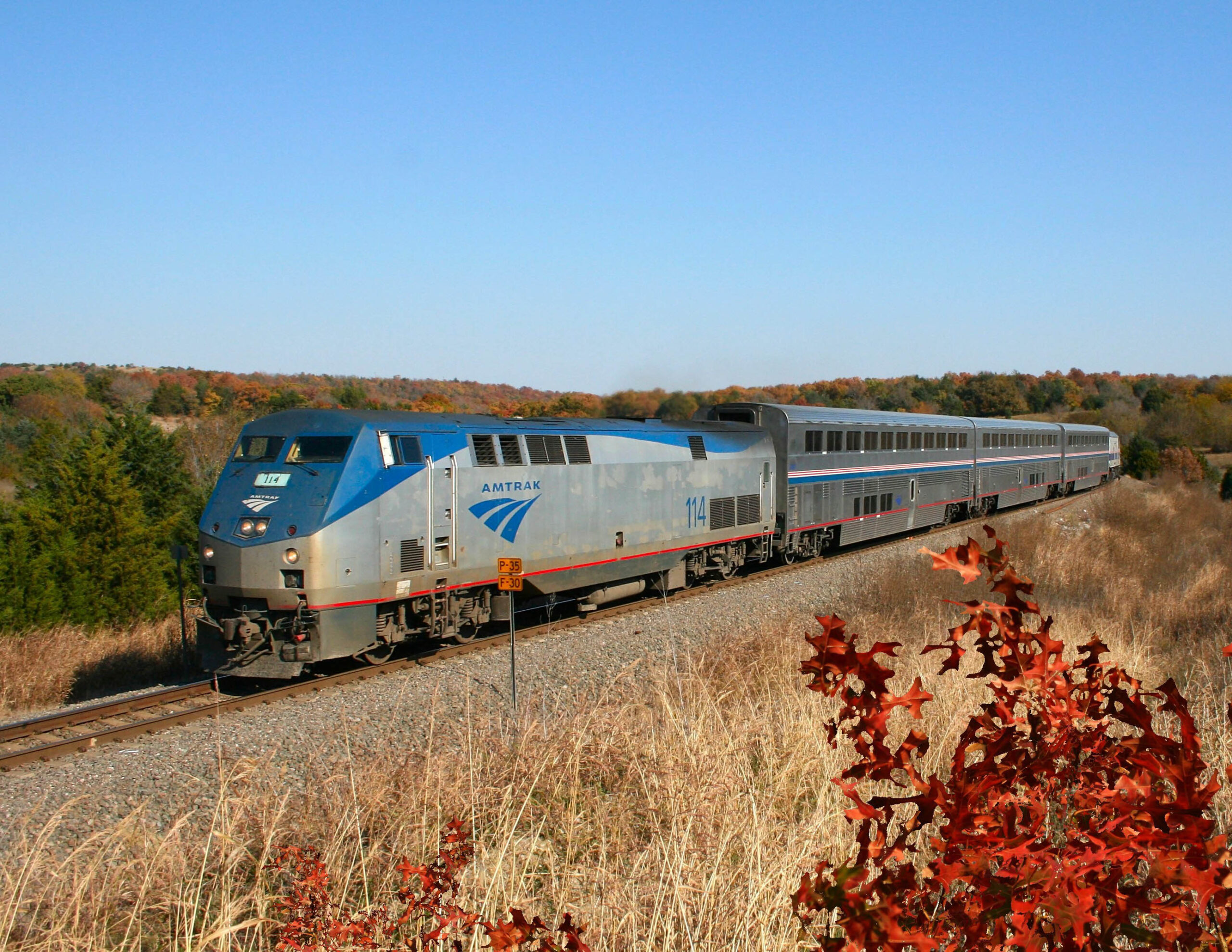
Every car has a metal step that will be placed in front of the door by the attendant.
Edit: Oh, except for a few lines on the East Coast where the trains are only single–level. Those are 48” above the top of track.
https://media.amtrak.com/wp-content/uploads/2024/07/Autumn-1...
Up top are seats and maybe a lounge, below are bedrooms, bathrooms, and storage. There's a spiral staircase to change levels.
The locomotive has steps right outside the wheels with handrails.
While Iran is not a third-world country per se, you'd be surprised how many times the bus driver would stop at random locations closer to passengers' destinations as well as bus stations.
There's more flexibility in day-to-day life of Iranians; people are expected to follow the rules but there's also this ancient concept of "morovvat" in the culture which encourages self-sacrifice for the betterment of others. Ask any tourist who's traveled to Iran and they tell you about the hospitality of Iranian people; e.g., you ask someone how to get to a place and they literally pause whatever they were doing and walk you to that place so you don't get lost!
It's strange how the image of Iran has been stained by the theocratic government (which Iranians protest against many times...).
I wonder if there's a country somewhere with the right balance.
If they weren't able to announce the train would stop at one station, why do you think they'll be able to do that at another?
I'm pretty sure train conductors aren't allowed to just stop somewhere unscheduled for good reasons, there's always a train behind and in front of them with no buffer.
Of course doing this can have ripple effects on other services, and if a common factor has severely delayed dozens of different trains, the central control room might not have enough staff to deal with dozens of unscheduled stop requests.
Since we don't know "the other side of the story", we can't really tell. All people here see is the "I got kidnapped". If the story was written from the control room person's perspective, they might write a fascinating story about how they single-handedly avoided 17 trains being late by sending one train on a detour.
Would be awesome if there was someone on HN that knows if DB actually has the capacity to run a scheduling algorithm for their network within a few minutes, repeatedly, for many different trains at a moments notice. What kind of infra do they have for that, what do they use? With a large, interconnected, network that's tightly scheduled already that can't be easy.
OP was also unlucky in that he was on a regional train. They prioritize long distance trains usually as a regional train can more easily wait on a lower speed limit track somewhere than a fast long distance train on a potentially shared single track bottleneck.
(For longer “technical” delays, keep an eye out for emergency vehicles without their sirens on.)
The message out of 2020 and 2021, is that the big people know what they're doing and we don't.
Thankfully it seems to be waning slightly.
that is sadly exactly how most people operate now. Somebody gives legitimate critique to an issue? simply tone police them and you can claim all they say is [ism] or hate speech and therefore not even worth engaging with.
This is a figment of living in a culture where being right but distasteful in a variety of poorly defined but broadly similar ways effectively makes you wrong. Toward the other end of the spectrum is stuff like "I don't care if he's a card carrying nazi he builds good rockets" and other stuff like that.
When every useful idiot is screeching about statistical optimization you lose any optimization for anything that isn't measured or isn't optimized for.
Like it's not hard to imagine the breathless comments on HN about how trains should never(TM) stop without a platform if they'd have stopped the train on both sides and some old lady tripped and fell and broke her nose on the rail.
It reminds me of letting a child that's too young to not be stupid pick it's own dinner and it picks of candy then to the surprise of nobody with a brain it's cranky later despite being calorically satisfied by the numbers.
>The modern world where everything is “safety issue” and “someone else’s problem” is where we lost our ways, and it’s never coming back.
It'll come back if there's something bad enough that happens to kick society back to a point where "lol we ain't got the spare resources for that shut up and go away" becomes an acceptable way to deal with the peddlers of these things. But anything that gets us that far won't be pretty.
Yes. That is a good reason to not stop without a platform. But I tell you one even better. Look at the layout of the Troisdorf station. There are tracks with platforms, and there are through tracks. The trough tracks are surrounded by live tracks on both sides. If the train stops there, unlocks the doors, and somehow coaxes the people to climb down those people are immediately on a live track. To get off of it they have to cross the track and climb up a raised platform. And who knows when is a train coming on that track. The risk here is not breaking the nose of one old lady (which by the way, can easily kill an old person) but forcing hundreds of passengers into a meat grinder. But go on with your snark.
Dumping people on the tracks is not the solution here. Going beyond the station and stopping there (which is always safe in the "other trains are not going to run into yours" sense, that is what signals are for) then letting the signallers set the points for you to reverse back into the station is the solution.
This is unfortunately exactly an example of the type of take I was complaining about.
Just let the people who are actually there and can actually see the situation use some judgement.
Arbitrarily halting traffic on an arbitrary section of track isn't something the parties involved don't know how to do. It's something that happens somewhere in the rail network every day for some reason or another. It's a supported function. I trust them to be able to invoke it.
Okay. But we are beyond that. The people who were there handled the situation and we both seem to agree that they didn't handle it well. We just seem to disagree how they should have handled it differently.
Your proposal is that they should have dumped people on the tracks. My proposal is that they should have done more to get the train next to a platform.
> This is unfortunately exactly an example of the type of take I was complaining about
Tell me where do you disagree. Have you looked at the track layout of the station? Have you looked at images of the platforms?
They ("ze germans" broadly speaking) should've handed this 300yr ago by not heading down a path (in their defense it probably wasn't obvious) to a culture that create obvious failures by following rules to the point of absurdity.
The train is just an example, and unfortunately there's no control train. If not the train then the absurd and trivially avoidable failure will be something else.
In Germany there's also the issue that the powerful car makers are always lobbying the government to budget cut public transport.
By the way, I can remember the state run British Rail and that was bad too. Neither nationalisation nor private operators have done well with British trains over the past fifty years.
There has been some popular demand for Cornish devolution, but Whitehall is only prepared to entertain it within some greater south west region.
There is also some devo to councils.
A "one under" (likely suicide) plus signal problems (which can be basically anything) meant I was delayed by over an hour home from Yorkshire on Saturday, but that also means it was effectively free.
During the Great Financial Crisis astute observers pointed to the loss of local bankers for most transactions as a component of the multifaceted structural causes. When you have your mortgage through the bank down the street, you're much less likely to mail them the keys instead of paying your bill, especially if you have to see the banker in the grocery store etc.
What did we do about this? Of course we didn't learn anything - we actually further consolidated banking.
The same is true of train service, traffic etiquette, and political discourse. The tragedy of the commons is exacerbated by moving away from local community.
"I built it with my hands. Straightened old nails to put the sheathing on. Rafters are wired to the stringers with baling wire. It's mine. I built it. You bump it down — I'll be in the window with a rifle. You even come to close and I'll pot you like a rabbit."
"It's not me. There's nothing I can do. I'll lose my job if I don't do it. And look — suppose you kill me? They'll just hang you, but long before your hung there will be another guy on the tractor, and he'll bump the house down. You're not killing the right guy."
"That's so," the tenant said. "Who gave you orders? I'll go after him. He's the one to kill."
"You're wrong. He got his orders from the bank. The bank told them: "Clear those people out or it's your job."
"Well, there's a president of the bank. There's a Board of Directors. I'll fill up the magazine of the rifle and go into the bank."
The driver said: "Fellow was telling me the bank gets orders from the East. The orders were: "Make the land show profit or we'll close you up."
"But where does it stop? Who can we shoot? I don't aim to starve to death before I kill the man that's starving me."
"I don't know. Maybe there's nobody to shoot. Maybe the thing isn't man at all. Maybe, like you said, the property's doing it. Anyway I told you my orders."
It's way cheaper to not wrong people or to not walk up so close to that line than it is to secure the full stack and pay everyone what you'd need to pay them to compensate them for the risk of being the unlucky guy who gets scalped on livestream or whatever form sloppy retribution takes.
Conductor radioed ahead and the train heading the other way stopped when we passed it and the passenger was transferred over.
They didn’t have to do that, but it was nice.
They’ve also hired a cab for a station miss that was their fault.
In many places without rigid rule enforcement, that kind of flexibility can actually feel more humane in practice, even if the overall system is worse. What frustrates me in the US (and sometimes in Europe) isn't rules themselves, but how aggressively and impersonally they're enforced in very ordinary situations.
For example, a friend of mine in New York casually crossed a line at a small PlayStation event and was stopped by a bodyguard as if he were bypassing airport immigration. I had a similar experience at a small event, maybe 300 people, where I tried to cross a line to get coffee and was abruptly blocked by security (they were just preparing the snacks).
Compared to more informal cultures, this kind of hyper enforcement can feel oddly hostile, especially when it's disconnected from any real safety concern.
In 3rd world countries it might be acceptable for people to jump out of 5-foot high carriages onto live tracks with trains running at 100mph for convenience, but not in Germany
Where she started to go a little weird is she thought anyone who had an idea had the right to just go do that, and society can go hang (she grew up suffering the worst Sovietism could serve up, her concept of community was damaged as a result). Unfortunately, her ideas are now held close to the hearts of some of the most powerful people on Earth, who are also going a little weird.
I'm actually OK with experts deciding that a particular policy is the right way to keep people safe. What I'm not OK with is using the policy as a prop to avoid independent thought or agility. I'd rather that instead of a procedure or a policy, people were taught a way of thinking about the World.
"We're not allowed to stop at the next station because we're not registered to do so", is a statement made in deference to a policy regardless of whether it makes sense or not. "We need to spend a few minutes making sure we're registered at the next station before we go any further" complies with the policy, but is a person taking ownership of resolving the problem, and comes from a place of empathy for the passengers on board. We need more of the latter, but unfortunately the Randian version we're now getting is "We'll stop or carry on wherever the driver feels like because he is sat at the controls so there's nothing anybody can do about that".
You were supposed to take the last exit, to be on the local road instead of the highway. No, we cannot let you off on the highway. We are not allowed to stop here. There are no stops. We wait for another exit. Sorry.
I can neither confirm nor deny, I may have done it to get to/from the grocery store from near my house when I didn't have money for a car.
Google Maps - No idea Citymapper - what? English announcement - nien.
Thanks to an old lady, who told me that i needed to switch coaches to go the airport. Madre mia!!
We were so lucky that we'd decided to go to the airport much earlier than we needed.
And don't get me started on the ticketing machines not accepting Visa, Mastercard, or Amex at the central station in Munchen. Or the web ticketing interface which was at least as annoying as the train to use.
As opposed to... swiping the card?
Are there really cards out there that exclusively support that?
EMV has multiple options. Many countries (including the US) chose the signature option for credit cards for convenience and use PINs only with debit cards. Before contactless payment apps became common, that was a major source of friction when using American credit cards in Europe.
Also chip-and-pin is mostly not enabled with American credit cards or card payment terminals
There are also gift cards that are credit cards. Or, really, debit cards. See “open-loop cards” at https://www.bitsaboutmoney.com/archive/more-than-you-want-to...
Later, in the train, when I asked the conductor to buy a ticket with my Girocard, he said "That's not a commonly used payment method" and asked for VISA, or cash (not having any to provide change, obviously).
What language do you expect the Germans to use?
This is the norm around the world, especially with complicated situations like a train splitting in two.
If third party apps don't show that information that's on their part. Usually it's also said after departure inside the train by the conductor, though maybe just on long distance trains.
I once had a bit of Schadenfrunde while travelling in Netherlands, having the conductor telling us to switch trains in Dutch, and all my German fellow travellers wondering what it was all about.
The point was that even in international trains inside Germany, announcements related to trains problems are only done in German.
I speak it fluently, including some variations, however most travellers do not.
I also remember there used to be ticket machines in NRW only in German, about 20 years ago.
The damn narcissistic entitlement and rotten mentality of some people.
The Dutch seem to understand German better, but my Dutch friends credit that more to education and exposure.
I speak both some German and some Dutch (as nth languages, I can understand them fine but speaking is hit and miss) and sometimes I don't notice which is which and answer in the wrong language, to me they're almost the same language with a different accent. I translate the German into some Frenglish mess for my Flemish friends to help them understand and it works great.
You have to "adjust your ears" a bit but I think if you know German and English then you can understand Dutch just fine if it's not slang.
A similar thing has caused the tension between the germanic and Romance languages that followed the Roman border line N to S that separates Europe.
i grew up in austria and in the north of germany so i got an early appreciation for understanding dialects. yet learning dutch took me a few months of staying in the netherlands. on the other hand when i visited luxemburg people were shocked that i could understand them when they spoke amongst each other
If the EU were a serious and legitimate institution, there would be an effort to implement reforms that nudge English, Dutch, and present day German all towards better mutual intelligibility, NOT diversion from each other through perversion and "simplification", or what seems to be a pollution and destruction of the current German and Dutch language through what at least Germans have a term for, "Verdenglichung", i.e., the portmanteau of German (De..) and English, prefixed with "ver...", meaning the transformation or application of.
The EU makes travel between EU countries as easy as travel between US states. You can just get on a train from Germany to Spain without any prior planning.
I am fluent in several European languages and dialects, human languages is second nature alongside learning programming languages.
As for entitlement, the expectations on international trains crossing borders aren't the same as local trains, which I left out from the comment, it was an ICE after crew change.
But I don't think DB is unique in this weirdness.
Back in the UK, I think something similar happens on routes going past Gatwick; I've only heard English announcements on that train despite the airport being one of the ones serving London.
Plus, one time I was on a work trip to Liverpool (via London), and somewhere around Nottingham or Crewe a fellow passenger asked me when we'd be getting to "Liverpool Street": https://www.google.com/maps/dir/Liverpool+Street+Station,+Lo...
There's also the way my first leg home from university was Aberystwyth to Birmingham New Street, but the train regularly terminated early (Shrewsbury? Or was it Wolverhampton?) to game the rules.
The problem with UK announcements is that they are piped to multiple places in the station, which is all hard surfaces and produces lots of reverberation and echo. This often makes them hard to understand even for natives. Also there are some stations with really terrible old speakers , such as horn speakers.
If I had to guess, French, German, or Spanish, in that order. But it may well be that e.g. Heathrow has a lot more Arabic, Stansted gets a lot more German, and Gatwick gets a lot more French, Luton gets the Spanish tourists, and City is mostly business trips or something.
You're correct about the acoustics, but foam panels are a thing that can be installed (or not) independently of this.
It was partially on me because there are assigned seats and carriages, but I was late and had to jump in the train. But still no vocal announcement of "cars x to y go to z, the others go to w".
Now, the train itself was two trains connected together, and at the next stop we literally had to run like 100 meters or so to make it on time to enter the front part, because there was engine near the end/stop.
Not sure would the 2nd half of the train depart, but it was super stressful experience.
It's not that complicated.
Train splitting is quite acceptable when the customer service is alright.
This is the one benefit of living in an overly-litigious country that has news media which can pick up on a story like this. They’d rather have the masses suffer to avoid the legal fees and bad press, so instead of sacrificing a train, they’d make everyone’s lives worse overall.
I’m not arguing for utilitarianism, though. Ir allows dictators to thrive.
The preferred way to get to the airport is via S8 (not S1). Idk how one could push/guide people more to take this one. S8 does not split and it definitely has announcements in english. They also prioritize keeping S8 running above anything else.
I'd also recommend buying tickets via app, not via ticket machines.
That is indicated on the platform screens before getting on the train. It tells you which part of the train goes where so you know which wagon to take.
I found it also not very intuitive first time I took it. But hey, when travelling there’s always local peculiarities to take care of ;)
A train that splits, on the way to the airport where there will be a lot of non-german speaking people, and for some reason only shows it on the platform is insane.
Having a train that splits on that route is already bad enough, but you HAVE to emphasize it on the train.
I know that I need to pay attention to this, because I've grown up with DB pulling all sorts of fucked up shit, but we should not accept that this is reasonable.
Vienna (S-Bahn S7 4.40 EUR vs. City Airport Train 24.90 EUR)
While with the Stockholm one, the public transport option is cheap but a little bit more complicated (there are convenient medium priced options too), the Vienna one is really just branding and a non-obvious exit to the train station.
Many people use them out of ignorance, expense accounts or they have the disposable income not to care.
im.surprised this not to be the case in Munich??
You’d think so but you’d be surprised how un-joined-up things can be.
Now, at least, the announcements are also in English, which frankly is very positive - that DB are improving anything noticeable. (And to be clear, Bavaria/Germany are absolutely not given to accommodating non-German speakers, like, ever.)
Also, I believe you were trying to write "nein". But why would you expect an English announcement in Germany on a German train? Google Maps? What does that have to do with that; it's an unofficial and only like an 80% solution.
If I went to the Ukraine, I would either pick up some Ukrainian or take some who did.
Also people are forgetting that railway announcements both at the station and inside the carriage are usually a complete incomprehensible trash tier. I honestly can't decipher half of the words in the Ukrainian or Russian announcements. Imagine needing to do that in the foreign language.
In my opinion it is way past time that EU has officially adopted English as a standard language for all communications. Especially with the crazies preparing for invasion right at the border.
While I speak 5 languages and try to learn some basic words of the local languages of any country I visit out of courtesy (how to say hello, bye, thank you, ask where are the toilets, etc), I wouldn't expect any traveller to know enough to understand this kind of specificities in any country they visit.
Not nearly as much as people on the internet seem to think. In large parts of Europe, speaking english will get you absolutely nowhere.
You're also assuming the tourists themselves are all fluent in English, which is another issue. In some parts of Germany, many of their tourists are likely to speak French or Polish as a primary language, not to mention Mandarin etc from further afield.
There are train connections to Scandinavia, so let's add Swedish, Danish and Finnish.
Also Dutch and Polish to accommodate the other adjacent countries.
Imagine you're in charge of the train network. You have to pay for the announcements on trains. You can't reasonanbly pay 10 announcements because that's silly and expensive. If you add any language other than German, which are you going to add?
It's not hard to be pragmatic.
For example, the UK Gatwick Express train makes announcements in English, French, German and Spanish.
The Thameslink service (which also happens to travel on the same tracks and also happens to stop at Gatwick Airport) makes announcements in English only.
I wouldn't expect local or regional trains in Europe to make announcements other than in that country's native language – except perhaps where it's a service designed for airport connections or similar international travel.
Given the demographics? Turkish or arab
Don't forget French though! I wouldn't make the assumption that travelling French people would have enough grasp of English or German to understand the announcements.
My comment is mostly a poke at the two assumptions: that non-English speaking countries should universally support English-speaking travellers, and that English is the predominant (and only other) language which should be supported.
We should be happy there is a language that has emerged for people to communicate globally without borders, and support it’s role as the worlds second language rather than work to re-fracture how people communicate
> "I’m baffled that any other language would be considered"
For local/regional trains, I wouldn't expect any language other than German.
For international trains, we should have all languages of all traversed countries and English. So for example a train from Paris to Frankfurt should have announcements in French, German and English (and it is actually the case for that train, I already rode it).
But for example, the Berlin - Warsaw train has only English announcements besides the local language depending on the country the train is in (so no Polish when it is in Germany, and no German when it is in Poland), I consider this to be wrong. It should have announcements in Polish, German and English for the whole route.
There are cases where in Belgium you will see signs in 4 languages (Dutch, French, Flemish and English)
Also if you ever travel in Japan, they have signs, especially on trains, all in, Japanese, Chinese, Korean and English all in one. (usually rotating signage). So the precedent is there to do it on mass transit but :shrug:.
Point is, when your customer base is logically needing more language options, it should be considered.
An English announcement wouldn't hurt but we don't have them on our trains here either.
That they’re the de facto languages of the EU? No, this is just factually not true. The vast majority of EU citizens speak no German at all.
That's not even slightly true, where in god's name did you get this idea?
> French level of racism
Racism really ??? As a Parisian I'll struggle to make tourists feel unpleasant but I assure you there's absolutely nothing to do with race. French from outside the capital get the same treatment, they just happen to understand our insults.
This isn't an english-speaking-forum, its an international one. That is the reason English is being spoken.
I get why the French is still angry about this issue and refuses to speak English, since it isn't French that is considered the international language, but English.
I wouldn't expect a French to understand this though.
If you go to a country which does not speak your language and you expect everyone to know yours, then that is a colonial mentality.
But I have long wondered whether many European languages will end up in the same state as Welsh or Basque or Sorbian. Icelandic is already much of the way there. Will Dutch and even German go the same way?
It is chauvinistic and colonial-minded to expect everyone to speak your language in their country. Not to mention arrogant.
More seriously, I suspect that
> Since the exit of the United Kingdom from the EU in 2020, the government of France has encouraged greater use of French as a working language
will hasten the move to English in official proceedings. Almost 44% of the population understand it already, and it’s unclear why the teens of the EU who already speak near-perfect English would want to learn French other than for recreation.
Trains splitting in half are rare enough that THAT is what needs to be described.
The US equivalent is the empire builder which splits in Spokane (I believe) but it’s much more old fashioned and you have a tag above your seat showing your destination- if you somehow end up on the wrong car the conductor will wake you up and move you to the right one.
A similar one that can catch you (and has caught me) are express elevators or the two-story ones which mean you only can stop at even or odd floors depending on where you got on.
Seriously? That unpopular? Lmfao.
This kind of thing captures older adults who know everything and have never heard of a trainset split.
I made a similar mistake years ago in NY - I assumed that the impressive subway system could get me to the airport, but you transfer onto a bus that gives you a VERY detailed tour of some neighborhoods.
I would have mentioned running away at age 13 with no destination in mind but I never left the country.
What did you do once you arrived in Budapest? Did you do your research or did you get scammed by the taxi mafia as well?
(regular announcements oftentimes won't be in Hungarian until you are in Hungary, that depends on the train origin, but I would only expect local+English)
You will be perfectly fine staying in Budapest with just English; you can learn hello, please, and thank you to be polite. This goes for most bigger European cities, outside of France I guess.
French people are quite friendly if you don’t exhibit all the worst symptoms of stereotypical tourists.
Perfectly understanding rapidly-spoken German explaining something esoteric about the splitting of a train is magnitudes, years of study beyond casual traveller level.
As a German I disagree with this. Europe is a single market, we want to have people getting around crossing borders at all times to get stuff done. It pays to make things easier.
If you're going for a three-weeks leisure trip, sure, learn how to say hi and thank-you.
1. Brussel-Noord
2. Brussel-Centraal
3. Brussel-Zuid
So here we were, not speaking the language, rushing for a train that we were at risk of being late for, and not having a clear idea of the actual stop to get off of.
And the people on the train? Totally unhelpful. "Eurostar"? Shrug. "Train to London?" Blank looks.
Anyway we winged it and made it, but still a damn stupid set up if you want to be welcoming to tourists (and their money).
In conversation, midi also means noon (e.g. used as "meet me at noon"), which for my brain correlates more with central than south, given the context of a day.
Not a linguist, so what do I know, maybe someone else can chime in.
BTW, Ukrainian shares the same logic, but it also calls the north "midnight" (північ). Meanwhile, Armenian calls the east and west "sun exit" and "sun entrance" (արևելք, արևմուտք) respectively.
And if you went to smoke with your bag and disappeared, well, they never saw it.
The more bureaucratic an organization becomes, the more inhuman it becomes. An unwillingness to bend rules when the circumstance rationally calls for it is extremely dangerous. One might think that Germans in particular would be highly tuned to this problem, but no. They still put following orders first. Typical.
Overhead electrification is a long term goal for the non-Metro UK rail network but it is a long way off.
The other method is an electric train with a diesel generator car.
Only when I checked the passenger reservation list, I found this was train from yesterday, late by 23:50 hours.
(for the curious... No, I could not get my reserved birth and had to travel on unreserved ticket, but at least I reached destination on my planned time.)
I asked locals what is going on, turns out that all trains were late, and this train departed from the platform already marked for Bonn! “You should watch what train number you board on DB, not trust sign on platform!” locals helpfully advised me.
Living in the Netherlands (not native Dutch) I will now rather fly than take a train if it means that I can avoid using DB.
For contrast, tomorrow morning I am heading from the Netherlands to Paris with a train (non DB), and don't really expect anything but a pleasant and smooth journey.
You cannot add a stop if the rails are single track and the next train is just behind you.
If you do said train will be delayed, will not be able to switch tracks at its final destination ( since it has a hard slot for that) and errors cascade.
It’s the best possible train system, given how little was invested …
What people don’t write clickbaity blog posts about is how in general things work very well. I’m currently sitting on a train from Nuremberg to Berlin and it takes less than three hours, it’s on time, quiet and just a good experience. This trip used to take five hours but then the high speed rail track got completed and cut the time by two hours. Wonderful!
So probably they need to add more parallel tracks, unused most of the time.
The main reason for this is lack of competition for DB in Germany. I used to date a guy who works at infra department in DB and based on what he told me, I couldn't believe how inefficient and massively complicated DB is. They have internal departments which acts as separate entities to mimic competition and each department has to place bids among each other to get contracts (more bureaucracy) but then they have an IT department and no matter how cheap or good outside IT providers are they must get the service from internal IT department (so much for competition).
At this point DB needs a complete overhaul and let go of so much dead weight to make it working again and unfortunately German politicians are just throwing more money at every problem hoping they would magically solve themselves rather than fixing the actual structural problems.
I can't recall that this happened to me. The "lucky" scenario is when the connecting train is even more late so you can still catch it.
Ironically, Russian trains (even over distances of thousands of kilometres) are usually almost perfectly on time.
Germany's DB seems to fill the same niche as other companies there, like Telekom: semi-private companies living off old state-built infrastructure that they're now incapable of (or unwilling to?) maintain.
Who knows if it was better in the nationalised days, but it sure needs some unification and central governance without a profit motive today.
I do. I was there. It wasn't.
I was around but not a heavy rail user in the nationalised days though the stories back then were quite reminiscent of the current DB stories.
Same here, with a big German semiconductor player you all know. The IT department has to battle the non-it departments and external contractors for internal software dev jobs. It's a made up game, costing 70% of our work time (just the beurocracy).
This is one of those issues I keep mulling about; it seems train operators (and airliners for that matter) tend to avoid being technically specific about operation problems, and just say "problems" and - if they are kind - where the problem is. And I cannot decide whether this is the wrong or right approach: how much information is too much? The argument is that travellers don't care why the train cannot move or why it is delayed, they just want to know when the next train is.
The problem - however - is that train operators come off looking like idiots, when they really aren't. As an example, the S-trains around Copenhagen have recently switched to a CBTC signal system, which has increased punctuality to 97% (below 3 minutes, cancelled trains counted). At cold temperatures, railway points (or switches, if you will) might become inoperable, as their mechanism freeze (of course, there are systems to prevent this, but can occur anyway). This happened this November on the S-train lines, but the announcement was "signal failure"; which meant the train operator (DSB) (and the railway owner (Banedanmark)) kind of looked a bit stupid, since the whole point of CBTC was to eliminate signal failures entirely (in fact, if you're being pedantic, since CBTC has _no_ signals, there technically cannot be any signal failures), and had promised as much.
But - then again - travellers really just wanted to know what the next train was, but I still think train operators are doing themselves a disservice by being oblique about the actual problem. Particularly when a problem lasts for several days, "technical problems" just makes people think their engineers are incompetent, when in reality they have no idea about the severity of the problem (because it is not communicated).
I may of course be biased here, since I have a high interest in how trains operate, but friends of mine - whose interest is far lessen compared to mine - are also frustrated by these opaque messages; and I think the reason is a strong sense of lack of control - since (assuming one made it to the station on time) up until this point, the passenger have done everything right, and yet the system failed, and now they are not privy as to why.
After the incident they will determine what's the least expensive lie they can plausibly give (perhaps the weather will change fast enough that you can blame the weather, perhaps you can't lie about an equipment failure when everyone in the airport sees you swap out the airplane). If they tell the passengers the truth at the time they risk being held to that later.
Deutsche Bahn does not think this is true and neither do I. If this was ever the thinking, they've performed or read studies and changed their mind
You can very clearly hear the drilled setup "<delay info> grund dafür ist <error category>" rigidly being regurgitated every. single. time. a delay is announced. The middle words are (per my understanding) a formal way to say "because of" and it's not something you will hear in daily life, so I presume it's the output of a committee and corporate requires them to say this, no matter if they know anything more than "the signal is red". Whether they know or not, the detail is always at a level that sounds like malicious compliance. I'd rather they say "we don't know" or say nothing at all. And if they do know, I'd hope they make up a new sentence like "someone was spotted on the crossing up ahead after the barriers closed. Someone is checking the cameras to make sure it won't come to a collision" but we instead get the robotic "we have come to a stop on the grounds of person on track". It mimics their training samples and what colleagues got into the habit of saying so I guess they think it's good like this, but is not actually helpful
Idk what creates this useless information culture, but they clearly know that passengers do want this information
To be honest, I don't care about excuses. Yes, problems happen, but this is systemic. Does it help me if I know the train tracks are broken yet again? It does not. The reasons (excuses) they bring up ring hollow. I don't feel that drivers or station staff would appear stupid if they don't tell. They are victims, too.
It is therefore a beat practice to generally avoid mention suicide, because mentioning suicide means prompting people to think about suicide and in some cases that means prompting people to consider suicide. This is known as the Werther effect, you can look that up if you'd like to know more.
It's usually reported (briefly) in the local news.
I find it stupid, it is what it is, just say it. This double speak serves no purpose.
Just explain what's wrong. Arm passengers with the best info you can give them. And figure out a way to let people disembark close to where they need to be.
DB has become a complete joke. I've had to travel to and through Germany several times these past couple of years, and almost always there's a problem.
I once paid 80 euro for a taxi from Essen to Dusseldorf because they cancelled the train that would connect to the last ICE to Amsterdam. When I got to Dusseldorf on time, the ICE arrived at a different platform than announced. I only noticed that because some people were suddenly leaving the platform. I warned a few people who still hadn't noticed it. I bet a lot of people still managed to miss that train after all the trouble making it to Dusseldorf.
It's also funny considering how here in South America we look at Germany trains (and Switzerland trains) as always on time, and the best train system, etc. But I am sure if this happens here it would be on the cover of newspapers.
That's very outdated, DB has been terrible for a long time though. Switzerland is still the best though. Here are some stats for 2025:
https://chuuchuu.com/2025wrapped
Since you have to scroll down quite a bit to get the list of most reliable European trains (with percentage on time):
1. Switzerland 97.8%
2. The Netherlands 93.9%
3. Belgium 88.6%
4. Austria 82.2%
5. France 79.7%
6. Italy 62.0%
7. Germany 58.5%
(Not sure why these are the only countries in the list.)
Also in Germany, a train that did not even arrive does not count as too late.
There is also a concept of the "Pofalla-Wende", which is when a train is so late that it just does a 180 and drives back, to mitigate that the delay doesn't carry over to the train's next route. Of course, that means that it skips the stations at the end of the route.
If you look at France for example, 80% of trains are not punctual but the "total delays" is actually on the low range, France being on the large side with lots of lines, I would say that it shows that the delays (20% of the time) are actual shorts.
https://media.viarail.ca/en/press-releases/2025/q1-2025-time...
[1] https://www.acm.nl/en/publications/acm-rail-monitor-netherla...
They also spend far more per capita on their train system.
All that and afaik they still manage to connect all important places.
In many countries the train comes when it comes and goes when it can, regardless of any fictional like schedules.
“Please mind the gap between the timetable and reality.”
It's not like countries outside Europe can't make trains run on time. Japan's are even more punctual than Switzerland's.
In Northern Europe the percentage is even higher. In the Netherlands there are almost as many people who speak it as there are Dutch speakers.
Taking into account people from other EU countries who are there on business plus tourists there is a good chance that if only one language was to be used for train announcements more people on the train would understand if it was in English then if it was in Dutch.
If we follow your line Dutch will go the same way as Welsh or Basque.
Or maybe that is just me having grown to understand dutch and flemish as a cyclocross rider and spectator.
But, for example, Rotterdam or Utrecht are already a lot less likely to be announced in english.
This is not true at all.
The shareholders set the targets and since the shareholder is the government they can set any target they want: profitability, more trains, cheaper tickets etc..
If the shareholder wants to inject 10% every year in stead of taking a profit they are absolutely free to do so.
I am sure the state could try to do _something_ about it, but I am also sure that a very strong car lobby here in Germany is working against that. BTW, the road network, which I would consider to conceptually be the same kind of infrastructure as the rail network, is to my understanding mostly built and maintained by state organizations, so it is possible to do it that way.
I guess it is also harder to market "let's subsidize this private company with tax payer money so they can continue to offer mediocre service" to voters, compared to "let's use tax payer money to build and maintain one-of-a-kind critical infrastructure from which everyone (with a car, which due to the less-than-great alternatives is a lot of people) can profit".
Again, having it organized as a private company adds indirection, diffuses power and responsibility, and adds a certain more or less implicit expectation of what private companies are supposed to do. That's my main issue with it. Private companies aren't supposed to run critical infrastructure as a monopoly for profit. It's the states job to provide and maintain critical infrastructure in the interest of all.
Again, if the shareholders decide this is the reason: yes.
But shareholders can just as easily set other targets or incentives.
>I guess it is also harder to market "let's subsidize this private company with tax payer money so they can continue to offer mediocre service" to voters,
The government owns DB AG, it is not a private company. It is a public company.
It is a private company, as in it is a legal entity under private law. This is in contrast to a "öffentlich-rechtliches Unternehmen" (I don't know if this even has a proper translation or equivalent in other jurisdictions). There is more than two options here, it can be both privatized and public according to your definition.
Not true. Shareholder primacy is not as huge as in Delaware.
And in the end it's the government that owns all shares and thus can decide how much profit the company should make.
This was already the case around 2015.
Just don't count on them that they bring you to your destination in a timely manner.
When taking an international train from Germany to Switzerland, don't count on it that it will run through to the final destination.
SBB (Swiss National Railways) started to block German trains if their delay is more than 15 minutes (so, basically every DB train) and won't allow the train on their network.
This is only peripherically educational. Constantly delayed DB trains completely fouled up the scheduling on the extremely dense Swiss network. So they just won't allow it anymore.
On a sidenote: In 2024 SBB trains were 93.2% punctual. Connectivity punctuality (where you have to catch a connecting train) was 98.7%. A train is counted as punctual if the delay is less than 3 minutes (half the German figure).
I could make out a bit of what the driver said, but not enough to be sure of the detail, which is what really mattered. I expected to miss my flight, but just made it in the end.
Germany is the country where I found the highest number of people not being able to speak English, even people working in accomodation!
French people probably know English but they refuse to speak it; Italians don't know English that well, but they try their best using rolling R's and gestures.
(I'm a bit ironic)
It's true of Switzerland and probably Austria. Germany is famous for having infrastructure issues that will take some time to resolve.
Eg see https://chuuchuu.com/2025wrapped for some stats
(And tbf I'm ok waiting 30min, with Taktfahrplan how much you wait is usually max 1h and often much shorter, my experience in other countries is often hours of delays in case of trouble)
Yes, obviously. And that hurts statistics. That's like killing sick cattle to be able to say that 100% of yours are healthy.
So, attracting the international workforce to come Germany vs being able to fully utilise them are completely different ballparks..
Immigrants with fewer opportunities are more likely to try to learn the language and integrate. When a country is offering them something they can't find anywhere else, it makes more sense to go through all that effort. Even knowing that they will probably never fully fit in.
Why would anyone choose to work their ass off for this corrupt regime and pay 50% in taxes?
Other commenters have already set the record straight, pointing out that these are clearly not in the same cluster.
See also https://www.thelocal.de/20250430/switzerland-suspends-deutsc...
Pay-walled, but the title says it all: "Switzerland suspends Deutsche Bahn trains due to chronic delays". DB is so unreliable that it impacts the networks of neighboring countries.
If it's anything like the UK, the staff have incredibly secure jobs and recently secured some good changes to their working conditions/pay. It's probably not in their contract to announce in other languages, so they do exactly what their contract says
Even if the job is actually opened to basically everyone (and that’s pretty nice), you have to be in perfect physical and psychological shape with pretty strict tests, you have to be intellectually apt enough to follow the training which is pretty intense. You have to accept work conditions such as not knowing your work hours until the day before. You have to accept sleeping who knows where at least 2 times a week. You have to accept having only one weekend off per month.
So what happens is that when you have that much filters and you still want to hire train drivers, you can’t afford to expect your drivers to know another language on top of all of the rest.
Most of the time they do what they can to deal with issues.
I don’t feel like there are too much issues it’s just they are extremely bad at communicating issues when they happen.
Sometimes the train is not there when it should but on the screen it just disappears as if it passed. Most of the time it’s just 2-5 minutes late but you can’t know. Maybe it’s just late. Maybe the traffic is stopped. Who knows.
I just dont understand how they don’t have people whose job is just writing messages for the information screens.
What is worse is that in my region, they have a pretty decent community managers for live information but they only post information in twitter because why not. So they already have the people doing this work but those people are saying different things than what the screen shows. Just let them write things on the screens :D
They do have very good pay (drivers can earn as much as some airline pilots) and a very good pension scheme on top of that.
In the end of the 90s with neoliberalism being very popular, it was decided to privatize the trains. The effect was only minimal investments in the infrastructure and a gradual rotting away of the train network. Now we a reaping what we have sown.
The enshitification of the German trains was done on purpose so they don't compete with cars.
Swiss railway is seen as the ideal DB should strive for, but fact is that Switzerland invests more than double per capita into its rail infrastructure. German stinginess now compounded over decades, and that's not the fault of management.
Blacklist everyone who was involved above a certain rank. Put together an entirely new structure. The only real way to get rid of this kind of rot is to make the consequences of dysfunction hit.
Unfortunately, the DB first got hit by Thatcherite neoliberalism in the early 90s that led to "unprofitable" things like switches, railyards or lesser-used routes to be torn down and the real estate sold off (to prepare for a privatization that THANK GOD never happened), and then we got 16 years of Conservative traffic/infrastructure ministers whose job priority was to funnel money to Bavarian highways [1], not towards railways.
Unfortunately, while the left wing loves to prune its ranks in purity tests (partially because its voters demand accountability), the Conservatives have a solid "better dead than red" voter base.
[1] https://www.merkur.de/politik/csu-parteitag-bayern-markus-so...
I've been told that the UK is worse, but I don't have much experience with it outside of Eurostar.
I've had the last train out of central London for the night cancelled at about 1am and you can just message the train company on social media and they'll pay £100+ to get you a taxi all the way to somewhere like Cambridge.
Also, not sure how it is in other countries, but in the UK, everything is entirely open data. You can go to a site like https://map.signalbox.io/ to see a live map of every train in the UK, and sites like Realtime Trains let you get all the details about every train (eg. https://www.realtimetrains.co.uk/search/simple/gb-nr:KGX)
And some operators love to ignore their obligations
Our protections are good on paper but in reality quite poor. London is of course better than the rest of the country though.
I don't consider having to message a faceless social media team on "X" to get a taxi refunded good customer service at all. And they are definitely pushing for you to pay first and then get a refund, which is not in the spirit of the contract. My mother doesn't have "X" and wouldn't know where to start
On the plus side: local journeys are great. Delay Repay means you get up to 100% of your ticket back if you're delayed. If you cannot make the last train due to delays, they're obligated to get your home by bus or even by taxi. Train stock is (in my area at least) new and very comfortable. Views are good!
Ticket prices vary a lot and are unpredictable. I have not a last minute ticket from London to the midlands for just over £20, but they can be a lot more (several times as much?) for the same journey even booking ahead.
I definitely prefer the train to driving if I am going long distance by myself, but if its multiple people the car becomes a lot cheaper.
Local services in cities are pretty good. I never owned a car in London, nor in Manchester until I had a child.
DB is state owned, yes ... but it's run like a private company. It's basically the classic "privatize profits, socialize losses" - done as a yearly routine.
Not even remotely exaggerating, it's incredibly corrupt.
I do think they’re working on improving these conditions. But I wish they did more to communicate that. Where is the big marketing campaign explaining how they got there, apologizing, and explaining how they will do better?
losses get pushed to be picked up by the state/taxes.
That's why it's privatize profits, socialize losses.
But there has just been a leadership change, maybe things will improve..
No matter whether the train operators and the network operator are private or a state monopoly, all decisions about major upgrades and new lines are made and funded by the government. The network operator just deals with the maintenance.
Nationalisation(or sometimes privatisation!) is seemingly seen by many as panacea, but it won't help you if your network runs at 150% capacity every day.
50% of operators are now state owned
Not that it's a guarantee for things to get better...
Long range trains from, say, London to Manchester are often overcrowded and ridiculously priced.
Season ticket prices are under 20p/mile into London
Nationalisation will likely break this and increase costs for all but the richest. For the last decade the public have been clamouring for “simplification” because they couldn’t understand the restriction codes. Now it’s being rolled out they are of course seeing price rises and complaining “not like that!”
False, as per my other comment
I agree with your other points though
I bet that UK trains "win" by being far more expensive than German trains, along with absurdly complex pricing. If you choose the wrong ticket you could also "win" a criminal conviction!
Don't worry though! We're currently building the most expensive bit of high speed rail in Europe, that won't even go into the centre of our capital city [edit: apparently it will now, see reply], or further north than the Midlands. Passengers who have the audacity to want to travel further north will have to transit over to the old tracks, creating even further capacity problems.
All of this is entirely avoidable, if the government just took a few common sense measures, but sadly it doesn't seem to be anyone's priority.
Latest punctuality figures for UK are 84.8% and DE 88.1%. Making an assumption on distribution I’d guess UK comes out slightly better.
Of note, DE long distance stats are pretty bad!
UK: https://dataportal.orr.gov.uk/media/ebmnxxih/performance-sta... DE: https://zbir.deutschebahn.com/2024/en/interim-group-manageme...
In all 4 cases the train was delayed in Germany - the longest by 4 hours, one by a mere 30 minutes.
Is Euston not the centre? Where all the other trains from the north-west come into, and literally on the same road as Kings Cross St Pancras? Plus Old Oak Common is going to be an interchange with the Elizabeth Line.
People also miss the fact that a big reason why HS2 is being built is to take load off of the West Coast Main Line, which is running at full capacity at the moment. There's no room to run additional services. Even though some unfortunate compromises have been made, this will still massively benefit parts of the North because they'll be able to get more frequent services once the line is no longer clogged up by trains from London.
Largest most expensive jobs programme in Europe perhaps more accurately... lots of pigs' snouts in the trough.
25km each way is 680 miles a month.
From my example, that's ~794 miles (corrected) a month, £255, £0.32/mile. Not as expensive as some other routes but still can be as as high as 12% of your take-home wage given the low salaries in that city.
Moving onto London... /under/ 20p a mile? Which route is that??
Just some random examples I picked:
Alton to Waterloo: £529, 1786 miles, £0.29/mile.
Guildford to Waterloo: £453/mo - 1140 miles a month, £0.39/mile.
Gravesend to London Bridge: £436/mo, 836 miles a month, £0.52/mile.
Brentwood to Liverpool St: £336/mo, 706 miles a month, £0.47/mile.
St Albans to Thameslink: £440/mo, 756 miles a month, £0.58/mile.
(Mileages from https://www.scotrail.co.uk/carbon-calculator )
Alton to Waterloo is £5520 a year, 50 miles each way or 23,000 miles a year, 24p per mile.
The only thing I can agree is the "speaking only in german as if it was the lingua franca of the world". Germany is part of the EU. The EU has 24 langueages. You should at least speak in English. And no, my mother language is not english but spanish.
They get stopped for speeding near their home in Florida, the police arrest them, take them to the county jail where they are stuck without bond waiting for extradition to the county where the warrant was issued. You might wait a few weeks in a cell, then you can spend another five weeks stuck in the back of a van, pissing into a cup while they drive you 3000 miles to Seattle, stopping at 25 other jails on the way. Only for Seattle to give you a court date and kick you out of the door with nothing except the clothes on your back. Except it's 40°F and you were arrested in a t-shirt, shorts and flip-flops. The cops in Florida have your phone and wallet. You have no phone numbers. You have no money. You're 3000 miles from home. Good luck, champ!
(this is a real thing that happens regularly in the USA)
Once I was travelling back to home from Munich and the train stopped somewhere in Frankfurt in the middle of nowhere. Literally stopped on the tracks and it was completely dark outside except some far away lights from the houses around.
We waited for 3 hours, with 2-3 explanations which did not make any sense. After 3 hours the train started riding again and I arrived in Cologne, which is ~1h away from home still, and they said this is the last station. I needed to spend the night in Cologne in a hotel, because it was 3 o'clock in the morning and there was no other train to my hometown.
Fortunately I was able to get a refund plus the hotel cost for that night back.
Delays are to be expected, trains cancelled without reasoning, train stations skipped in similar ways as described on the article, and if using connections, better plan for at least 30m interval, while taking into account a plan B for every connection that might be missed.
Events like this seem to only be explained by accountability sink[0]. Naming it gives me some brief sense of sanity.
I appreciate that there is a safety concern; where's the humanity in large systems, especially as we trend towards more automation?
[0] https://aworkinglibrary.com/writing/accountability-sinks
Oh boy. There's something deeply human about the frustrations of state institutions and bureaucracy.
From the linked article:
> How are train cancellations and delays compensated when traveling with the Deutschland-Ticket?
> In the event of a delay of at least 60 minutes at the destination station due to a delay or train cancellation in local transport, you will receive €1.50 compensation per case.
> Amounts under €4 will not be paid out due to a legal de minimis threshold. However, you can accumulate multiple late payment claims.
https://www.bahn.de/faq/deutschlandticket-verspaetung-erstat...
If you bought a regular route ticket you get 25% and more than an hour delay, and 50% at more than two hours. Not sure how it is with other multi-use tickets.
This, combined with the certain delays CAN make traveling by train quite affordable… /s
https://www.bahn.de/service/informationen-buchung/fahrgastre...
And of course there is some huge fine or even potentially jail time if you moo in protest and pull that nice red lever to avoid the Christmas present of this bureaucratic idiocy (after all, you have legs that are capable of crossing train tracks and eyes to do that safely)?
But back to my country (Poland), it's better here - some had problems with physically getting out on the right station, and when the conductor saw it she even encouraged us to pull this lever in those cases so we don't have to get out at the wrong station.
I do support having basic public transport and solid bike infrastructure for young people, but once you’re 25 or older, there’s little justification for relying on such low-quality public transport.
I’ll be going to Prague next year, and I’m fully willing to drive for hours rather than sit on a train that keeps getting delayed, is unpleasant to be on, and costs far too much.
The connection in question is probably https://bahn.expert/details/RE28521/j/20251224-a0049123-9494....
According to this page, it actually did stop at Troisdorf (though, that doesn't have to be correct). I don't see why they should have been able to stop at Neuwied but not any of the stations in between. Most of them are possibly too small, as the RE5 is quite long for a regional train, about 200m. The usual "RE" on this track, the RE8, is only about 110m max. Bonn-Beuel should have worked, though.
The problem was a broken relay, no trains were able to run for a few hours through Bonn. The official statement said that the trains have stopped and were replaced by buses.
Is this the right connection?:
https://bahn.expert/details/NX%2028521/j/20251224-a0049123-9...
The RE5 seems to be operated by National Express, not Deutsche Bahn, right? (but DB InfraGo is most probably responsible for the routing)
It is operated by National Express, but I guess the routing comes from some other company (likely InfraGo)
I have also been left in remote villages when the last train of the day broke for some reason at 12:30 am. All travellers and myself had to look for Ubers, which the government also tries to suppress.
I agree with some comenters that German companies seem to prefer to stuck with Bureaucracy other than finding what could be confortable or even human solutions.
No one is trying to suppress Uber. They are just obligated to adhere to the law like anyone else in this business.
We had a trip planned in which we needed a specific train. The website said “there has been an incident on the tracks. There will be a delay of 20-50 minutes waiting for a platform. Not all connections will be made,” and that is exactly what happened. This worked for our time window so we took the train. But there were a lot of confused and upset passengers who had absolutely no idea what was going on.
I’m sure DB has many problems, but one of them appears to be communication that surely isn’t too difficult to fix.
Right out the gate 1st class tickets being half the price of standard tickets on same train does not fill me with confidence that this is organized in coherent fashion
If you don't buy a seat, you don't get a seat. I was taking the 4am train 8 hours from Brussels to Berlin, and I bought seats for both legs of the trip. To sleep, of course.
The first leg of the trip was delayed, so they gave me a free ticket on the next train, 40 minutes later, but with no seat.
So, exhausted as all hell and wanting nothing more than a little nap, I was forced to stand in one of the hallways between the carriages, unable to rest much even vertically because people had to push past me to get to the bathroom.
Absolutely horrid experience.
Russian trains only get delayed if there's something seriously wrong. Like an accident or an act of sabotage because of the war. A month or so ago, a Sapsan train from St Petersburg to Moscow broke down en route. People had to wait for hours to get out. It made big news. As far as I can tell, this is a weekly occurrence in Germany.
This is the fundamental mistake underpinning their train service since the long distance trains frequently have to wait for other trains to pass, cascading delays through the system.
That and an almost criminal level of underinvestment in the past 20 years or so.
( https://en.wikipedia.org/wiki/Stadtbahnwagen_B#/media/File:K... / https://de.wikipedia.org/wiki/Rheinuferbahn / https://de.wikipedia.org/wiki/Stadtbahnstrecke_Bonn%E2%80%93... )
We had a lot of issues in the past with the first leaves falling on the track or a bit of snow. And they ordered trains without toilets. So also cattle trucks.
And have I mentioned that you pay a lot for this "service"? second class, normal costs: €18,80 to get from Utrecht to Amsterdam and back, 50 kilometers.
Back in NL I used to complain about trains being late...
Boy oh boy was I not ready for Germany and Deutsche Bahn. I heard stories, but it was so absurd at times that I treated them as comical acts.
Then I traveled long distance on DB...
- trains being late by 15-40 minutes is NORMAL. It's included. At this point I feel like it's even planned. - the "thrown out in the middle of nowhere" happens! Ruthlessly. Operationally. With zero empathy or guidance. One minute you traveled inside the train approaching your destination another minute you are on a station in some village, knowing nothing about "why?" And "what is next?"
I still take trains - but I do not plan any appointments on arrival. As arrival is theoretical and not guaranteed. I just take a gamble and sink hours into the journey. Read books. Watch movies.
P.s. I am surprised that DB is not held more accountable for the absolutely shit service they provide.
It is an area where proper governance is failing. I don't know about Germany, but in The Netherlands, Dutch law requires at least 90% of the trains to be on time (less than 5 minutes delay). If national train company do not reach those numbers, they are fined and I think in an extreme case they can lose their concession.
Yes, however, any train delayed more than 30 minutes gets canceled entirely and doesn't get counted in the statistics. The train this article is talking about would not be registered late under Dutch terms (though it probably wouldn't have traveled comically far without stopping).
Not saying Dutch trains are as bad as German trains, but applying the same laws won't fix DB's problems.
NS is state-owned so all fines are just money transfer between two branches of the government. Also, they know that "the trains fail with current amount of public funding, I wonder if less funding will improve the situation" is not good logic. Therefore there won't be any actual fines.
> and I think in an extreme case they can lose their concession
And then what? Most of the country will be left without trains? The company will be dissolved and replaced by the Chinese? Not gonna happen.
Tell that to the current government (and most of the previous governments in recent years).
You can't put money into it! Guess NS will just have to increase ticket prices _again_.
I don't think it would happen all at once for the main network, but Arriva sure likes to get more and more lines.
That's the famous German efficiency, not to waste time on things that were not done or caused by being inefficient in the first place. There's no point in wasting time on improving some process, fax machines still work, don't they?
Italy is pretty similar, and I would say even worse, but after reading / hearing more about DB I think they're just competing for being the worst train company ever
The Swiss railways are excellent and friendly. In Milan, I was unable to catch the reserved train to Zurich, but the conductors on the Swiss train that was just departing even accepted my ticket for the Italian railway.
A bit like "no frills" airlines in the west.
But at this point, I'm convinced you should avoid any train in and around Germany. This includes Denmark as well. Just take a plane, but don't have a layover in Germany. The same could probably be said about France. My first train from Paris to Nancy stopped for about 2hrs in the middle of nowhere. As the machinist said: "The train is tired."
Other countries like Italy or Spain seem to actually have well-functioning rail though.
I regularly travel on DSB (2.5hr journeys, 4 times a month minimum), and only very rarely encounter issues. Staff have always been easy to deal with and on the rare occasion I've had to be refunded (the carriage with my reserved seat didn't show up) I've received it within days.
Avoid trains run by GoCollective though.
Of course the train could not stop. It was not registered!
But ooof, the few times I had to cross the border to Germany by train were hell.
I appreciated the NS from that moment on more...
What should be the sweet spot?
The opening paragraph contains some factual errors (you can only get kicked off a train when you do something illegal) and the whole story lives by exaggeration and missing facts.
It is as moronic as saying people were kidnapped when a plane had to divert because of the weather. Also he would have been entitled to get a paid cab ride to his destination when that happens. But that is just one of the facts he did not mention.
This story should be ignored and tossed into the local legends garbage.
What facts are missing in your opinion?
People do get kicked off trains, usually it’s the entire train that is being emptied. Happened to me in NRW. Happened to me in Brandenburg. When there’s a problem with the train, then sometimes it has to be evacuated.
He would have not been entitled to a cab ride by the way, he was travelling with Deutschlandticket. Your entire comment is not only pedantic, it’s also completely wrong lol.
He could try to do it on his own accord - they have leverage to decline and he'd have to take it through several other over burdened agencies.
He could also try getting into contact with DB, and good luck with that.
My own DB story was from Hamburg hbf where 3 huge DB employers was standing guard in front of reisenzentrum (the customer service counter) and yelling at every own being incredibly rude.
DB is a joke, and it is imploding on itself. Staff seems so stressed and embarrassed by being a part of it.
It’s much worse than that – FedEx would never treat cargo like that. If they took cargo further away from its destination than it started and then left it there for the customer to sort out, that would break so many SLAs …
Many are cancelled without a decent reason being given. I rarely take British trains now they are so expensive and unreliable. Only long distance maybe because buses are unpleasant.
> It is twenty minutes late. I consider this early.
The one good thing about frequent long-distance delays is that you might be lucky and catch an earlier delayed train and actually arrive a bit earlier than planned ;)
(also JFC, does the author like to whine about nothing - I'm travelling frequently with DB for about 25 years now, and while shit happens from time time, most of it is merely a slight inconvenience).
I travel from Basel to Hannover and back every two weeks on DB. Trains south are almost always late, trains north usually late. Frequently the train is already late in Hannover having come from Hamburg. The worst was when I was kicked out in Frankfurt and had to stay in a hotel. The delays were so bad there were no more trains left that could connect me to the last train out of Basel.
Things have been getting better for the past couple of months I think though.
My biggest gripe with DB is not that it's late, but that it quite often cancels the trains. If you decided to go by regional trains with 1-2 hops instead of direct (bc you can go much cheaper with Deutschlandticket), there's a high chance that at least one of your trains get cancelled and things will not go according the plan.
Recently while driving an hour journey turned into a three hour journey, and not because my car broke down. I've never experienced any delay anywhere near that significant on British trains.
Just after Hannover but before Dusseldorf and such the train stopped: fire next to the tracks. Honestly, not DB fault this time.
Luckily DB trains have a restaurant/cafe in them. I went to get some food but the man behind the counter told me it was closed.
I asked him how since he was the seller, he stood there, there was power and internet. What's the problem?
Well, he said. And I shit you not: my shift is up. I have worked 8 hours. I am done.
And he was serious. Never mind that he was stuck on the train, just like us. Never mind that the replacement obviously wasn't there yet since they were stuck waiting on the next platform.
Nope. He works 8 hours. 8 hours done. He done. A thousand thirsty and hungry (and annoyed) on his train. He has food, drinks and time. But he just didn't give a shit.
He just stood there, for 2 hours, waiting to get off.
To Dutch people German civil servants are like NPCs following a very narrow script. It's baffling.
I've only encountered flexibility and slight discomfort in a few cases where something has happened. I'm not entirely sure what Germans expect DB to do. A car had an interconnecting door problem and had to remove that car from the train. Everyone had to filter in to other cars to compensate for the lack of seating. Should they instead cancel those tickets? Or make them stand? It was a full train, and no answer is the correct one for everyone involved. I ended up giving my seat to an elderly gentleman and sat between cars on the ground. Mild discomfort but literally nobody was to blame for this. I suppose I could have gotten the next train but I didn't want to wait - that's also not DB's problem to fix.
Another time, my train was delayed for several hours. Of course I was quite annoyed but found out the reason was that someone had offed themselves in front of one of the trains before it, bringing the line to a standstill while it was dealt with.
Most of the whining I've heard about DB boils down to inconvenience in situations nobody could have predicted nor helped, and this almost insatiable attitude by some Germans that any inconvenience is an offense to Germany seems always to be directed at an otherwise highly reliable and robust trnasporation system whilst having zero other frame of reference. Seriously, come to the US or, from what I've heard, the UK. Then tell me Germany's is awful with a straight face.
This article reads exactly like that. You weren't kidnapped. You were rerouted. Don't dilute words like that, it just undermines your point.
Obviously. There's a joking undertone in those words. If they were serious, they would've called the police.
DB has gained its reputation for good reason. In this case, taking someone away into another federal state without giving them the option to get out of the train to find alternative transport. Their reasoning for not stopping seems to be purely bureaucratic.
Maybe the UK is worse; the UK is famous for its extremely high prices. The US probably is worse with the way their trains are operated. That still doesn't excuse the absolutely awful service DB provides in a country as wealthy and developed as Germany.
The worst part is that DB wasn't always this terrible. It's now playing catch-up with itself, taking care of overdue maintainance causing seruous disruptions that should've been minor annoyances years ago.
I have been advised by rail enthusiasts to make sure my train is scheduled to arrive two to three hours before my transfer, because DB will be late. A foolish friend once tried to make their transfer with only an hour and a half of scheduled margin; they missed their connection and lost their (paid-for) seat reservations.
Then there's the government side of things: we, the Dutch, want to run more and better train connections to the rest of Europe. Germany just doesn't want it to happen, though. Even when the Dutch offered to pay to have a broken bridge upgraded, the Germans turned down the offer, leaving plans for their old, outdated single track bridge in place.
DB probably works fine a lot of the time, but you shouldn't accept DB's incompetence as normal. You deserve better.
Or how a bridge Friesenbrücke was hit by a ship in 2015 and the replacement is still under construction (supposed to be finished in 2026 now). As a result no train could drive between Groningen and Leer.
To make the whole thing more sad, the replacement bridge has to be open 40 minutes every hour because a shipbuilder has convinced the Wasserstraßen- und Schifffahrtsamt to do so, severely constraining train traffic. No one on the other side of the border understands why they haven't built a bridge that would allow ships to pass through without opening the bridge.
This kind of nonsense is very typical of German bureaucracy (I have lived there). Nobody has ambitions and nobody wants to stick their neck out.
> "Apparently we were not registered at Troisdorf station, so we are on the wrong tracks"
If the train was on the middle track, stopping would introduce risk and disruption by slowing/stopping the other trains travelling on the high-speed non-stopping line, and also endanger passengers who would have to dismount at height from the train onto an active track, cross the active track, and climb up to the platform.
Once the train was routed onto the incorrect track, correcting it was likely to be impractical (infrequent track transfer points) and stopping on the high-speed track would would be excessively disruptive and dangerous.
They simply told me: this behavior ought to be punished. Which is a euphemism for but I'm not going to do it. They didn't want the hassle of potentially dealing with one out of many students filing a complaint or worst-case go to Karlsruhe (Germans know what that means). Which is exemplary of German bureaucracy, nobody wants to make decisions and carry responsibility.
I love Germany, but this is really something they need to fix going forward, because it stifles society and the economy in many ways.
I agree with you that there’s a lot of complaining and it does get tiresome. The German train system is one of the most complex in the world and works closer to an interconnected spider web than the typical straight line systems in other countries.
However much of this has been predicted in the past. I think that’s why a lot of people are annoyed. Here are some sources if you’re interested to read more:
(2006) Audit critique regarding the bad state of DB funding after privatization: https://dserver.bundestag.de/btd/16/008/1600840.pdf
(2011) DB is not spending enough on the track network: https://taz.de/Investitionen-in-das-Schienennetz/%215117195/
(2014) State of German train bridges: https://www.zeit.de/mobilitaet/2014-09/deutsche-bahn-bruecke...
Somehow doesn't happen in most other countries I lived. These things are easy to deal with with a bit of redundancy, which as I've heard is lacking in Germany these days.
I've had much better experience with trains in Russia despite much harsher weather conditions, much larger distances and much older cars. This problem is absolutely fixable, just let the trains go around problematic sections with redundant routes.
Well, I'm all pro public transport, but please make it work first.
The train arrived on time, we checked our tickets to see which coach we were on and walked down the train looking for it. We get to the end of the train, odd, we must have missed our carriage so we turn around for another pass. Then we start to notice other confused expressions.
We eventually figured out the problem: they had accidentally left the sleeper coaches in Hamburg, a full 180 miles away as the crow flies, or almost half our entire journey.
After waiting on the platform for about an hour, busses arrived to take us to Hamburg. We're now quite tired and our bed on a train is now a seat on a bus.
We finally get to Hamburg at about 3:00 the next day, walk to our beds and we're ready to collapse. Surely they're not going to come and inspect our tickets at this time?
They came and inspected our tickets at around 3:30. Two and a half hours later we were in Cologne. Yay.
They have some policy that they need to give you a reason for a delay and they'd happily announce something like "we're late because of another train in front of us" and the irony is, of course, the train in front of us is probably late, too, and you never get to know the real reason. No, strike that. The real reason is because the entire system is completely messed up. Train time tables are fantasy by now.
> In DB’s official statistics, a train counts as “on time” if it’s less than six minutes late.1 Cancelled trains are not counted at all.2 If a train doesn’t exist, it cannot be late.
This is true and it is ridiculous.
So as a fanboy, I am saddened by how bad DB has become. Once you’re on the train, and it actually goes, and it goes all the way to the destination, it’s still fantastic. All of the above generally still holds. But the many hours I’ve spent in the dark in cold windy places like Duisburg Hbf gleis fünf are uncountable, and it really does discount from the experience. I don’t remember the German trains being this late, this often, a ~decade ago. I really hope DB will get its shit together because there’s a lot worth saving.
Except: they were - over 20 years ago, I did my „Grundwehrdienst“ in the German army, travel with DB from Nuremberg to Munich and back every weekend for 8 months.
The number of times the ICE was on time I can count on one hand. 15 minutes delayed regularly, sometimes more.
After a while we planned to use the last train to arrive in Munich, and having to go a bit further with S-Bahn, we most of the time missed the last one (on purpose).
We then went to the DB counter and got free coupons to head our final destination by Taxi.
Also already happening back then: broken aircon, often in comical ways - I.e. totally non working in one wagon, with everyone sweating at some 45 degrees Celsius or more, next wagon: freezing at 16 degrees…
While there's valid issues to complain about, this blogpost is really hyperbole. And frankly, to someone who has lived in the area, it reads purposefully disingenuous.
Just enter the places he mentions on Google Maps. Everything in NRW is so close together that to travel between cities you can often choose between international trains, regional trains or even just public transport.
The connection he needed, is serviced several times per hour by several different train lines.
Why did he stay on that specific train when he heard his stop would be skipped? The only reason I can think of is to write this blogpost. Since he's local to the area he should have known better.
Also it's worth noting that driving that same route by car, at that time, just a couple of hours before everyone starts their Christmas dinner, might've taken even longer.
I'm not trying to deny common issues with the DB but the author tried to travel through the densest urban area in the whole of Europe during the busiest 2-hour window of the whole year. AND he made a bad judgement call. To leave the transportation hub, staying on a long distance train which was already being re-routed.
Funnily enough, the fact that every "Kuhdorf" needs to be connected by train is one of the difficulties the DB faces for which there is no easy solution. And if a long-distance train needs to decide between dropping some stops which can also be reached by short-distance trains or delaying the whole train, I think that dropping those short-distance stops is absolutely the correct choice.
Because the train didn't stop?
German bureaucracy. They should just learn from the Swiss. Because the Swiss actually understand how to be effective in bureaucracy.
https://www.theguardian.com/world/commentisfree/2023/oct/08/...
German railways could be better, but at the same time it's nowhere near the level of complaining the average person makes, as in this article. I think it says more about the author than the company. "It's twenty minutes late, I consider this early". Despite the problems that exist, I wouldn't say I ever had the feeling of being relieved the train is only 20 minutes late. Especially not with local trains.
It's not "your train connection didn't work out", it's "you were planning to go somewhere, and the train took you somewhere else entirely, much farther away than when you started, and gave you no way out of this, and not even an apology or explanation". This is absolutely comparable to a form of kidnapping.
Sorry, but no.
* It has tracks so it cannot go anywhere it wants to go
* It can only let passengers go at certain places, these are called stations
So no, I would not compare it to a random Uber driver that takes me somewhere random on a whim. I wouldn't call the police if an Uber took me on a different road if the original road was closed. Etc.
Please start making sense, thank you. I'm done.
I wonder sometimes how these things develop because if you're objectively pissed off that your train was delayed, I cannot imagine enjoying taking the plane, or even worse a car. Like I haven't had a plane take off on time in my life. I took only a few business trips with the car and was stuck in traffic every single time. So objectively despite experiencing issues with DB myself, it's a lot better than my experience with alternatives. Stuttgart - Leipzig has a direct connection, and in my experience the biggest reason for a delay is when you miss a connecting train. E.g. your train is 15 minutes late but you had only 10 minutes to change trains. So other than the train going out of service I honestly can't imagine what the issue would be. You sit for 4h, can work comfortably, it's quieter than anything else, you can have a coffee or a beer, a meal etc. etc. And then maybe you'll have a half hour delay, but you can get that with anything else also.
The UK government hates how expensive it is to operate, so they are reducing subsidies and massively prioritising the most profitable routes and raising prices.
Staff got nice condition/pay bumps during COVID and all have the attitude that they are doing us a favour. I don't mean that lightly or that I've had one bad experience with a member of staff on a bad day. They are work-shy, offensive, rude, lacking training and plain bad tempered.
I'm very pro car now these days, which is exactly what the Government wants.
I consistently find railway workers to be some of the most helpful and approachable people I have to interact with, which is remarkable given the sort of people they have to put up with. I think the sort of person you'll be speaking to certainly depends on the part of the country you're in though - in Scotland and Wales, I've seen people who've been let off for having a ticket that expired several days prior, and staff are happy to have a friendly chat if the train isn't too busy.
What's your experience?
And it's taken a massive turn for the worse since 2020
England is definitely worse than Scotland and Wales I grant you that. And fwiw, in Scotland, they have far less powers to prosecute compared to England, which is why they seem like they are more lenient
As I responded in another thread, not all operators are 15 minutes. Not that 25/50% often isn't really that much compensation...
And that taxi is far from gaurenteed.
I get the sense you had one or two good experiences and extrapolated?
They stopped caring about their main customers and tried to compete with planes.
On top of that everything traffic related seems to be reserved for the least competent politicians.
Gotta love the "free" market and "democracy".
My anecdotal evidence is that these public entities usually suffer from lack of funding or incompetence fueled by corruption, that usually takes a few forms: - the contracting of work to a third party with kickback (incentives to continously do sloppy work) - inaction due to lack of corrupting opportunities (leaders try but cant set up a good fraud scheme) - nepotism that leads to incompetence
And lack of funding can and has been weaponized to cause a shitty service to then set the pretext for privatization. Usually there are private interests behind this public policy decision.
The more menial reason for lack of funding is sometimes massive spending or subsidies for capitalists elsewhere which skews the budget.
And of course also the intense bureacracy needed due to lack of democratic control. Yes, im saying people dont actually have a say and they could have a say. IE delegate democracy.
These are just universal problems of modern capitalist economies and their bourgeois politics.
Quite possibly DB suffers from these more intensely than others.
> Only then I notice: the driver has been speaking German only.
Oh wow a German conductor in a German train speaking German oh how awkward...
No you were not "kidnapped" your train just stopped at a different station.
> “That’s a different federal state.”
Yes and if you go to many cities in Europe and the US you can walk from one country to another. Oh wow shocking I know /s
Of course this is Deutsche Bahn at its best (in getting hand and feet mixed up) and that compensation is ridiculous. It should at least get your ticket back to the place you intended to go.
Neuwied to Troisdorf is 1h by car or train (in a good day of course)
Your country would have to be laughably corrupt if it couldn't build out a public transit system that beats DB.
For example in country 400k€ was spend on executives (200 hundred people) Christmas dinner for publicly owned company.
While the scheduling and company management is similar issues as DB. I think we ned a new word for this kind of clusterfuck!! They are "rulesfull", rules that hinder the system and make the user scream in pain and agony.
You may find the train has now "registered" itself at the next station.
It will reveal driver to be using intentionally tricky language. "Cannot stop"
It's not that the train can't stop, trains can obviously stop wherever and whenever they want. It's not that the doors cannot open - train doors can be opened by the driver or by passengers, trains have emergency egress requirements.
The problem is that nobody actually wanted to get off that train. They wanted to complain about it. Comparing it to a kidnapping is offensive and absurd. That's now how people act when kidnapped.
> "If you find yourself in a similar situation and want out - call emergency services, say chest pain, out of breath"
> "The problem is that nobody actually wanted to get off that train."
> "Comparing it to a kidnapping is offensive and absurd."
It is if you instruct people how to best lie to emergency services because your train was delayed.
- the emergency services will wait at the station the train is going to anyway
- your health insurance realizes what you've done and make you pay the bills.
The premise here is kidnapping - I don't think using emergency services in a kidnapping is out of the question.
In Germany in particular, you could be charged for all the expenses. A friend of mine did not fake, was in real panic, but still was at the end of the ”nothing” and had to paid the ambulance costs. Not cheap!
If you think you are being kidnapped or whatever, instead of lying and abusing EMS, you can call the police, and explain clearly what’s going on with the truth. If serious enough they will be able to act better in that case.
In my case because I do have not mild but moderate autism and panic disorder, it would genuinely feel like a heart attack if that happened to me. I wouldn't be lying about my symptoms.
The problem with that is - why do I get access to this "out" by being able to call EMS to get off the train? (Provided you agree with me that I would be a valid call). Why does everyone else have to suffer?
My worldview is they don't. DB wants to take you past 15 stations? Here's a mechanism to stop them.
I'm agreeing it's an abuse of the system, but it's valid because it scales. If there was a flood of EMS calls every time DB skipped 15 stations - DB blinks first.
Maybe a better example from me would have been an emergency stop button?
Morally DB (through the driver) is the one lying and saying things like "cannot stop". They don't want to stop - that's different. They've already broken the social contract, I'm free to do the same.
I’m sure you’re going to pose a hypothetical that you would be in the way to save someone’s life, but we both know that’s not true and even in that situation, you could raise that with the train company rather than faking a new, different medical emergency
It's true an EMS call might reduce QALY (quality adjusted life years). It's also true that taking a train full of passengers somewhere they don't want to go also reduces QALY.
Iterate this enough and DB changes their policy. Now we have a new equilibrium. The full game theory of this isn't as simple as wasted doctor time = bad.
However I second your idea that "if the train doesn't stop it's because they decided they didn't want it to stop"- and therefore they should be considered responsible for kidnapping their customers unless it can be proven that it was absolutely impossible to stop the train without catastrophic consequences.
In that situation - you do what is necessary to stop the train, because nobody else will, which might involve killing the driver.
The reason you don't jump straight to shooting the driver is that doesn't achieve your goals. There is a long list of things to do before needing to kill anyone, so do those first.
One simple rule for everybody is: Never ever waste the time of EMS.
What about 100? If you bring an absolute like that to a philosophical argument you're backing yourself into a corner.
How about that? The driver asks for you to sacrifice your life then he will stop the train an let 100 people off the train. According to your logic a good choice.
There is a huge difference between wasted time and being dead escpecially for the relarives of the dead. Maybe you should tell your logic to someone who last someone because EMS was late.
It shows a concerning lack of agency and a concerning amount of conformity.
The constant comparison to cows, for example, suggesting it’s ok and normal to mistreat non humans, instead of making the far more obvious connection that if a human who is understanding exactly what is happening goes through so much suffering with a slight change of schedule, the fear and suffering cows and other animals who are constantly being transported in far worse conditions with no idea what is happening may be going through.
The comparison to kidnapping is also really bad. I’ve taken a plane that had been diverted to the wrong, unfriendly, country and then been unable to leave a tiny terminal, with no to limited access to food, water and restroom facilities for hours, and the idea that we were being kidnapped never crossed my mind, although actual kidnapping by the state we were in was a remote but real possibility.