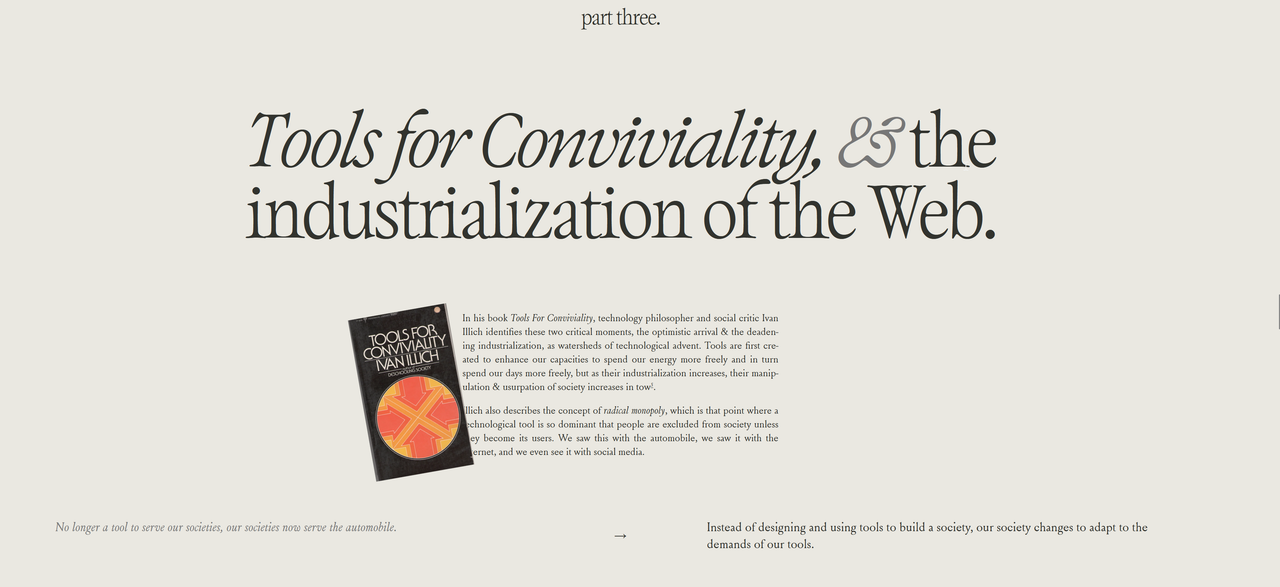
Imagine my surprise, when I opened the site and it looked and felt just like a museum or art exhibit. This was the literal feeling I had -- being at an art gallery, but online.
I guess, these comments tell more about the commenters, than TFA. We should remind ourselves to be more critical to the content we consume, regardless where it comes from.
That's not necessarily a value judgement on the discussion though. From me, at any rate, it's more often a personal perspective: sometimes I'm just more interested in or charmed by the thing, and in digesting and coming to my own conclusions about it, than I am in reading other peoples' thoughts and perspectives on the thing.
But, yeah, to me it felt almost like an old magazine: the typography, the layout, the way images are used. A lot of the discussion about web design in the 90s came about as a result of people coming from a traditional publishing background and really struggling to do what they wanted with the web medium, so to me it sort of hearks back to that a bit, does a good job of embracing some parts of that older aesthetic, but works well with modern web capabilities. Mind, I'm looking at it on a desktop browser, and maybe the experience on mobile is less good (I can't say), but overall I like it. It has some personality to it.
The challenge when tackling difficult problems is to bring in solutions to those problems.
Subway offered an alternative to junk food. By offering custom flavors of choice, giving consumers more control over what they eat. I don't see any fresh food at subway. Does it mean what they did is futile? No. Can't we point out this is another type of junk ? We better do.
The site is wonderful when rendered with JavaScript. A web to aspire to is one where the system font is set by default, at least could be chosen.
All valid concerns looking at an endeavor discussing a better web. The author may even take note and iterate, there was no claim it was definitive work.
“I personally could not view this page [because I turned off JS], therefore I will dismiss it out of hand as it didn’t cater to my needs.” A choice made by the consumer somehow makes the author accountable for it.
Or more succinctly, “but what about me [or people I’ve anointed myself as spokesperson for]?”spoken by someone not the intended audience for the piece, trying to make the author responsible for their need.
The answer to which, I think, is either, “it’s not for you then so move on,” or perhaps even “misery is optional, just enable JS ffs.”
The idea that the creator of a work must bend to the will of those that consume it seems to be highly prevalent, and is pretty much at odds with creativity itself.
Having said all of that, I certainly don't think it's bad, nor is it a commentary on the arguments being made. It's just not my cup of tea.
But the images are a part of the work, not separate from it, no?[0]
You might have a preference against that, which is absolutely fine, but I think you're making an artificial distinction.
[0] There's obviously a separate conversation to be had about how much that part contributes or detracts with any such work, but the point stands that I tend to view such works as all of a piece including all constituent parts.
TFA works with iOS reader mode, which is all that matters to me. I use it instinctively as it makes style more or less uniform and lets me focus on the content of the article.
Design and content are inseparable. When design reinforces the point of the content, that is good design, even if it's ugly, even if it's not aesthetically pleasing to you, even if it's not how you'd do it.
But I'd argue that questing for neutrality is worse than taking a stance, even the wrong stance. Besides which, what one now considers "neutral" is also a giant set of design decisions - just ones made by committees and large corporations, so the blame for its drawbacks can be passed off, and there's plausible deniability for the designer.
Someone takes risks and makes something creative they consider artistic. You're reducing their choices to a question of whether they intended to be popular or to court criticism, flattening the conversation into one about social media credit, and completely discrediting the idea that they had true intent beyond likes and points. That response itself betrays something slightly cowardly about the ethos of neutrality you're proposing.
But damn, it is absolutely beautiful. The fonts and paintings, wow.
Now I'm in my 40s, oh wow. Small, illegible, font is everywhere. Instructions on food is especially bad for this. At least on the computer you can usually force 125% font rendering.
Point being, the site is probably quite legible to people in their 20s.
That's just one complaint, but it's not me, it's the site.
I think people are nostalgic for the social environment that enabled people to create websites of all fashions, may they be well or poorly designed. We simply hold up the poorly designed websites as an example of how accessible content creation was ("hey, anyone can do it"), though perhaps we should hold up the better sites ("hey, look at what we can accomplish").
On the one hand, the pages were kind of ugly. Nobody likes autoplaying music. On another hand, they ruined their own site with a (separate) series of boneheaded decisions. On the other hand, Tom didn't seem quite as odious as Zuck (Myspace had a visible wall, you otherwise knew what you were dealing with with the privacy settings, and the wall was a good way to have network effects and connect with people). On another hand, Myspace worked (there was Friendster too and apparently their problem was the servers only worked half the time) because in 2006 relatively few people were online, so you knew you could find people on there
I don't know how it would have evolved if Murdoch(?) hadn't ruined the site; yes it was always a bit messy, but still. (At the same time, they completely lost all user data in some 2015 (possibly 2016) database incident, so so much for that)
But saying we don't like someone that calls themself a tech bro? Well they had it coming.
This is the tech bro people speak of. It is that psychopathic desire for status at all costs which sadly is learned, emulated, and exalted. Ironically, yc is the poster child for breeding this culture over the last 8 or so years and the place it is most often complained about outside of reddit ofc.
I’ve heard people use the term to disparage Linus Torvalds and even Aaron Swartz because they didn’t like them.
To that end, I made a trivial Chrome extension and an equivalent CRUD backend that just helps me store lists of users I like and dislike. The former are highlighted, and the latter are simply removed from comments.
As an example, the user I'm responding to is someone whose comments I like so I have had them in my highlight list for two months now and not regretted it https://overmod.org/lists/view?pk=ELpqNsanTYP9_wZXNjdF-FcEOc...
My personal tool is particularly idiosyncratic but I think information sieving is particularly important these days, so I recommend everyone build something like this for themselves. One thing I've found it particularly helpful with is the usual outrage bait. But I also killfile users who I think particularly misunderstand the comments they respond to, and I also killfile users who express what I think are low-information views.
Thank you for sharing what works for you. I think it's great other people have been doing this style of read-side filtering. It's a pity that there's no way to inject code into mobile apps safely (i.e. this is an easy path to app-store rejection). Perhaps there's no option there but to push `shouldFilter` out to a server where you can run the logic. My use of my phone is the weakest link in my filtering strategy.
As Terry Pratchett observed in a 1995 interview with Bill Gates: “There’s a kind of parity of esteem of information on the net”.
Equal internet votes means any propagandist with a human or machine bot army can bias whatever they want. Now we have people with unimaginably large propaganda machines drowning out those who act with integrity, intellectual nuance and selflessness.
I definitely want an "overlay network" for those sites that have hijacked the term "social network". Also I'd like one for movie reviews too please.
People talk about social media is if it were passive, when its deep intel, deep analysis, manipulation. Where everything we do, is not just used to manipulate us, but in aggregate, improves manipulation overall.
It is amazing what toxins people will accept, if the toxins become baseline familiar.
I black-hole plenty of sites via pihole above and beyond the typical adblock lists. On a very few rare occasions I have turned off the pihole to unblock a site because I was curious after following a link that was blocked by said pihole. Every single time I quickly learned why that site was blocked, and visiting that site gained me nothing.
Reels is able to keep me engaged because it is able to surface similar content I would like but from different users. And they have such a breadth of producers these days.
The X home feed algo is not so good apart from it being text only, even for infotainment content. YT shorts also does not work as good as the Insta algo
It's beautiful to be sure, I wanted to actually read what the author had to say, and stuff kept flying around my screen, so I did not get far.
Maybe if I printed it out...
Edit: Half joking with the printing (although I do find it much easier to read printed materials), but it definitely seems to me it that the author was trying to make a magazine and not a website. (A magazine where everything moves while you're trying to look at it!)
Amateur radio is a remarkably niche hobby so that kind of attention is rare, but it took ragebait to do it. A title like “The Next Generation of Ham Radio” would have flopped. I know this because that’s what I titled it first, and after 40 views in 2 months I slightly rewrote it and reposted it under the new title and within a day it appeared on just about every ham radio forum, facebook group, numerous email reflectors, and so on.
The singular destroys the monolithic many.
Not designed to fool anyone into some random extremist view.
It may be that people who don't pick up on subtext humor, post more than average.
And they are complaining precisely because it has pompous title. If it was "badly designed but personal website" there would be much less of that
I mean for f-sake we even have agentic tools that can summarize the thing for you so you don't even have to visit it.
I had fond memories of programming my CP/M machine back in the day, built a re-creation and was painfully aware of how limiting a 25 line by 80 character display could be. Nostalgia, remembering the good times, reality some things really sucked too.
Then there is the paradox of freedom to deal with, specifically if everyone is free to change anything they like to be the way they like it, other people will hate it and the entire system will be "bad." But for everyone to use the same basic frame work, and the dislike for the lack of freedom will be a common cause that builds community.
Back in the early days of the web and SGML, the focus was reversed, which is to say "web" sites would just publish content and the "user" could apply what ever style they liked to get a presentation that worked for them. This infuriated web site authors who had their own idea about how their web site should look and act on your display. You were the consumer and they presented and if you didn't like it go somewhere else. You can still see vestiges of that with things like "use this font to show things" Etc.
So yeah, nostalgia is never a good motivation for a manifesto. :-)
Like of course you had your CP/M machine and it had its restrictions but you are seeing them now with the added information of the current stage
There were also things that you liked too and still like and they may be better than somethings in current time
So you can then take things that you like and add it to modern or remove previous restrictions by taking access to modern upgrades.
> So yeah, nostalgia is never a good motivation for a manifesto. :-)
I think the problem's more so spiritual. The social contract is sort of falling off in most countries. So there is a nostalgia for the previous social contracts and the things which were with them like the old internet because to be honest the current monopolistic internet does influence with things like lobbying and chrony capitalism to actively break that social contract via corrupt schemes.
People want to do something about it, but speaking as a young guy, we didn't witness the old era so we ourselves are frustrated too but most don't create manifesto's due to it and try to find hobbies or similar things as we try to find the meaning of our life and role in the world
But for the people who have witnessed the old internet, they have that nostalgia to end up to and that's partially why they end up creating a manifesto of sorts themselves.
The reality of the situation to me feels like things are slipping up in multiple areas and others.
Do you really feel that the govt. has best interests for you, the average citizen?
Chances are no, So this is probably why liberterian philosophy is really spreading and the idea of freedom itself.
Heck I joined linux and the journey behind it all because I played a game and it had root level kernel access and I realized that there really was no way to effectively prove that it wasn't gone (it was chinese company [riot] so I wasn't sure if I wanted it)
I ended up looking at linux and then just watched enough videos until I convinced myself to use it one day and just switched. But Most people are really land-locked into the Microsoft ecosystem, even tiny nuances can be enough for some.
using Linux was the reason why I switched from trying to go from finance to computer science. I already knew CS but I loved finance too but In the end I ended up picking CS because I felt like there were chances of making real impact myself which were more unique to me than say chartered accountant.
So my point is, I am not sure if I would even be here if I had even the slightest of nuances. Heck, I am not even much of a gamer but my first distro was nobara linux which focused on gaming because I was worried about gaming or worried about wine or smth. So I had switched to nobara.
Looking now, I say to others oh just use this or that and other things and see it as the most obvious decisions sometimes but by writing this comment, I just wanted to say that change can be scary sometimes.
> Then there is the paradox of freedom to deal with, specifically if everyone is free to change anything they like to be the way they like it, other people will hate it and the entire system will be "bad." But for everyone to use the same basic frame work, and the dislike for the lack of freedom will be a common cause that builds community.
I would say let the man have his freedom. I would consider having more choices to be less of a burden than few choices in most occasions. Of course one's mind feels that there is a sweet spot but in longevity I feel like its the evolution of ideas and more ideas means more the competition and we will see more innovation as such.
Indie Web, while nice and fascinating, lacks the large audience. You write things down, and nobody cares. Well, maybe a few friends who keep an eye, and a hiring manager when your candidacy is considered for another job.
Some people are fine with that, and just enjoy the process of producing content, and seeing it published. They are a minority. Most people come to consume more than to produce, and to get quick feedback.
The most efficient way for an indie website to gain an audience is to be briefly featured on one of these bad, terrifying behemoths of the current Web, like Reddit, or Xitter, or, well, HN. A few dozen people will bookmark it, or subscribe to the RSS feed. Sites that are true works of art and craft, like https://ciechanow.ski/, will get remembered more widely, but true works of art are rare.
It is, definitely, very possible to build a rhizome of small indie sites, along the lines of Web 1.0. But they would also benefit from a thoughtful symbiosis with the "big bad" giants of the modern Web.
That’s exactly what the article says. Seems like you made assumptions about the argument based on the design instead of actually reading it.
This is what the article / indieweb mean with POSSE
The biggest problem of any indie publishing is obscurity; not that nobody cares, but rather nobody has an idea, and has no way to have an idea.
This is a really nifty website.
What you cannot notice is what shapes your "noticement" ability.
The best design is the shape of your perception.
The best design is already implemented in your reception of reality.
The quest for "good design" is a game.
On the other hand, your aesthetical culture and the shape of your perception create a system in which elements are more or less "understandable", "readable", "accessible".
The game of design does not have stable rules and is inconsistent among world populations.
"No design" is impossible, the nature of reality is such that entities are embodied. To be embodied is to be rendered in the game of design.
Ideas are not embodied OR their apparent embodiment in the game of design (electrical information ?) does not contain their content for the observer.
"No design" is perceptually inintelligible.
(side note I put your comment into LLM to make sense of what it meant re my comment without mentioning HN, it said "this is a classic Hacker News–style metaphysical sidestep: You made a practical design aphorism, He responded with ontology and epistemology. That usually signals polite disagreement or intellectual one‑upmanship" LOL)
Woah homie, watch out for the model which is trained on reddit comments dataset to talk about intellectual one-upmanship xD
Also another thing but holy shit, LLM's are sycophantic man, it tries uses big words itself to show how the person has intellectual one-upmanship while cozying you up by saying practical design aphorism.
Like I agree with both of you guys and there's nuance but I am pretty sure that nobody's tryna sound intellectual hopefully.
Sorry for turning this into a rant about LLM's being sycophantic but man I tried today watching big bang and asked it if sheldon and raj were better duo in more common about physics (theorist and astrophysicist) since I was watching a episode where they both have dark matter in common and chatgpt agreed
Then I just felt the sycophancy in my heart so I opened up a new thread and I think I used the same prompt and changed it to sheldon and leonard and it ended up saying yes again.
The problem felt so annoying to me that I ended up looking at a sycophancy index being frustrated of sorts and wrote a lengthy ddg prompt lol to find this https://www.glazebench.com/
We really don't need more yes man's in our lives and honestly I will take up a less intelligent model than a sycophantic one. So I am curious what your guys opinion are on it too as sometimes I use LLM's as a search engines to familiarize myself with things I don't know and I am lately feeling it will just say yes to anything even silly ideas so I would never know what's the truth matter of the reality ykwim?
examples for ---hughhhhh--- inducing stuff :
"I'll be blunt !"
"Here's the ground truth, no bullshit"
"Bottom line : <UPPER CASE EXPRESSION>"
"No fluff, technical, precise, no bullshit, devoid of unnecessary rethorical shapes, <etc..."
"Blunt answer: <bold text>"
"<title> : the hard truth"
I am becoming snob ?
We can hope that "Elements of Style", or similar, comes back into fashion.
Alignment between the shape and the content is done in a circular fashion : what you see educates you to fabulate about design, once you fabulated enough you begin to say things are bad or well designed.
I often express myself online by writing a bit what goes through my mind, in a joyful and not very attentive manner, and I find it amusing to be barely understandable sometimes (I like the fact you had to use an LLM, lol) because, well, I feel it may bring a certain color to the otherwise often too uniform and immediate/instantaneous world of internet -- So, what I said previously is also mostly what occurs when you let your mind wander;
now, if I rejoin my own person and body, I can agree with you that my culture of good design is about the testimony of the removal of intention, in such a way that I feel content is highly readable, (fictionnaly) devoid of style, and somewhat raw or pure.
But again, at the "philosophical stage" all of this is pure fiction, and with a certain mindset, I am pretty sure I could shift my habits to adapt to what I feel as weird design, ugly, barely readable etc... It would be totally useless and absurd, but I could (given I have no specific perception-related medical conditions) !
We saw the web become a repetition of the same design, and while it IS good design in our "minimalism" addicted brains, I am pretty sure stumbling upon weiiiiird websites makes us great good sometimes, so much that maybe we also start to think about the absurdity of our standards : we arrived to the point in the "lie" where we identify this specific style as "the shape" of our perception, and yes : it become invisible to us, and is good design, but also it is a bit depressing.
My window manager and my emacs/vim/terminal configuration aren't what I call good design. They are highly readable but stratosphere-reaching levels of kitsch (yes ! I WANT to cosplay and feel as if I was writing code for aliens or to fight the matrix at work, and yes that's a bit cringe but at least I am honest with myself).
I don't wish the world and internet to be "more like that" and am ok with the actual state of design. Nevertheless I find that's a bit arbitrary and somewhat boring.
Sometimes, you can go the scenic route, where the journey itself is the goal, not the place it gets you to.
The author starts with "we’re doom-scrolling brain-rot on the attention-farm, we’re getting slop from the feed." and continue with a web page that dooms scrolls emphasizing on big titles with pictures out of context, hard to read layout etc. There is a lot of valid criticism in the comments.
Of course uniqueness and beauty is probably subjective thing but I think about this often about the web. For example if you spend some time in websites like awwwards, dribbble, framer gallery you are going to end up with same design over and over.
I am not sure when exactly but probably in the early 00's graphic prints started to get into web, and sure it does seems cool, and different but I don't think the web should be a graphic print.
I am really struggling to find unique web pages, websites these days they are all the same, and in search of their "uniqueness" they often fail big with the user experience.
One website that is unique in my opinion very well taught is - https://usgraphics.com/ everything about it makes sense, the pages, the labels, colours, buttons at every step on the website you know why are you there you know purpose of everything it is hard to get lost, and not understand the purpose of the page. It looks very simple but the design is sophisticated.
half of dancing hampsters.
De da dee dee doh!
[1]https://web.archive.org/web/20000301193204/http://www.hamste... [2]https://en.wikipedia.org/wiki/Hampster_Dance
I do miss "memepool" and snarky curation from ye olde web days
https://web.archive.org/web/20050225005911/http://memepool.c...
An easy way to help with the negativity is to stop leaving bait comments
"toward the left" aside, it's always a little frustrating to read the ubiquitous "this place sucks" comments on here and Reddit. I have tons of problems with HN--both petty (markdown when??) and fundamental (SV/PE has metastasized in a discomforting way...)--but I'm still here because I love it, and think it's one of the best communities the internet has to offer.
Specific critiques of specific people or ideas are always welcome, but comments like "everyone here is curmudgeonly" just makes me wonder why they bother to log on in the first place...
Skunk Anansi would likely disagree with that.
It reads like you are upset at the poster using "DEI" and projecting your own behaviors onto them ("tedious and unproductive political discourse", "immune from critique or any burden of evidence").
I can't quite tell if you're trying to support or attack that concept/acronym/cultural flash point, but regardless: kinda besides the point :)
> It has become political (toward the left)
I wonder what you're talking about - your definition of 'political' or 'left'.
Tech and politics are so deeply intrenched. More than just "is DEI evil and there's no such thing as algorithmic bias". Should Apple be restricted from collecting its Apple Tax and locking down its devices?? Should the EU be able to regulate American companies? Should governments demand encryption back doors in devices? Should Australia ban teens from social network? Should there be a Right to Repair for our devices?
Honestly one of my biggest gripes with HN is that it does seem to be a place where pretty regressive social viewpoints seem to flourish.
---
On topic: discussions like these are as old as human discussion forums and communities. I think that the participants each grow and change on an individual level just as much as the community and platform does. I think humans have a hard time identifying how much of their feelings of nostalgia are based in reality.
Maybe the platform has not actually changed in the ways people fear, and instead, peoples' opinions on what is interesting, important, or valuable has changed?
Since this thread has been discussing politics-adjacent things, let's consider Senator John Fetterman from the United States. Mr. Fetterman is notably different today from when he first started his campaign, regarding what he believes is important and valuable. (Mr. Fetterman suffered a stroke, which is suspected to have brought about personality changes and shifts in political ideology.)
---
I think we, as individuals, should always be focusing our first line of questioning on how _we're_ changing, rather than trying to figure out how the world, or the zeitgeist, or Hacker News, etc. is changing.
Sometimes we outgrow things that we hold dear, and instead of accepting that it's not really the place for us anymore and moving on to a different environment, we try to shape our current environment around our new personality by instituting new rules or adding new features.
> Please don't post comments saying that HN is turning into Reddit. It's a semi-noob illusion, as old as the hills.
The actual quote has links, the first of which is to a comment from 2009.
this website isn't turning into Reddit, this website has been a pretentious orange subreddit for well over a decade if not right from the get go and a link to this site's Reddiquette page (just as ignored as on any subreddit!) is evidence TO that effect, and not against it!
the fact that the link petuously denies reality notwithstanding!
I don't get people who use "you say [thing] is getting worse but someone X years ago said the same!" as an argument that somehow proves [thing] isn't getting worse. Things can become progressively worse over long periods of time, it's not an instant change that can only happen once.
Another context where I often see this "argument" is major Windows versions. People rightfully say they want to stay on Windows 10 because 11 is objectively worse in many ways, and someone jumps in to say "you said the same about 7 to 10" as if it's some sort of gotcha. Both complaints can be right, each new version can be worse than the last.
Right now, we have at least one aspect in which HN has become objectively worse in the past years: AI-generated content. It didn't exist a decade ago, so good luck using that "argument" there. Thankfully, its prevalence is still nowhere near as bad as on Reddit (it's impossible to browse that site for 10 minutes without noticing bots posting blatant ChatGPT responses everywhere and getting hundreds of upvotes), but still.
HN did give me some leads in the start of just cool things to follow and I have been able to make an understanding of what things interest me and what don't due to it. And this has also been the reason I read a lot of comments etc. and content here, maybe more than I should.
I don't know to me, building my own website and forum etc. are possible but they feel complicated and I still can't seem to get eye balls. On Hackernews Comments its easier personally to write something, get feedback on it, (improve?/learn?)
Of course if one wants to optimize for eyeballs, they can probably go for reddit or twitter maxxing or similar because cmon this is exactly the stuff the article is talking about from what I see.
Hackernews does indeed sit on the perfect spot. I feel like if you want more informationally dense topics, perhaps lobsters can be good for ya.
2. Block the website.
3. Critically evaluate your goals, and whether or not your actions align with those goals.
I don’t feel this way at all. Maybe it’s one of the only places you’re actually consuming mixed opinions.
What do the voters want? Zero taxes, no crime, world peace and infinite benefits.
It's easy to identify things as shitty because the above doesn't describe the world yet and thus it's a banal observation. Implementing real, practical improvements is really hard and requires much more thought and consideration and introduces the possibility of failure. Which is why that part isn't discussed as much.
Your comment is "but you live in society too!"
Society acknowledging the shitty things is the first action in rectifying them.
The thing about criticism is, we're a long way from "the worst possible outcome". That is, there is a lot that the current system gets right.
That's why the burden of proof gets put on the one proposing changes. The wrong change could make things worse rather than better, and we really don't want that.
So it's not enough to note that society is broken in some ways. Yes, it is. Yes, we notice too. Now, what are you proposing? Let's take a hard look at your concrete proposal, and see whether it's an improvement or not.
Oh, you don't have one? Yes, it's still valid to point out that there are problems. It's valid to demand that we not become complacent with the current problems. That's not wrong.
Two actually - the guideline against being "curmudgeonly" is separate from the guideline against going on a tilt because you get triggered by any website that doesn't look and act as much like plaintext as possible.
And yet if someone so much as cracks a joke they get rapped across the knuckles and lectured about a rule that doesn't actually exist (no humor allowed)?
Yes, that's negative. That's a culture of performative misanthropy.
I think the OP website is pretty cool by the way.
The POE shilling might be what pisses me most off about him.
Though he also sucks at video games.
But hey, at least it isn't memes, right?
Your post reads to me as a complaint that people who complain too much have a problem.
but the way I see it, If I assume you are correct, hackernews is in a bit of rough spot because there was this one comment which did some analysis and it feels like hackernews is definitely saturating a bit/(peaked?)
From my personal experience, I feel like we all just use reddit (as the article says) and so we just deal with the annoyances with it and not look for anything else. Or perhaps we join some discord communities.
If people who are within Hackernews are resonating this statement, its in a tough spot because people say such things.
Perhaps, its that Hackernews grew too big for some people and its too small for others. Perhaps one side's currently on reddit not even knowing about it and the other's complaining it on hackernews
And perhaps there's also a middle sweet spot where people aren't complaining but nobody hears them either because they got nothing to complain.
But from the outside what people see are other people complaining about hackernews on hackernews. Same goes for redditors too I guess.
I checked your comment and it says 5 months, I had been assuming you were here for years from the tone but perhaps I was wrong.
I don't know but to me hackernews felt like an information arbitrage of sorts which had these tid-bits of info which made me feel better if I ever were to do somethings like this or gave me confidence in myself in finding the right tool for the right job
If you are tired of hackernews, I would suggest you to open up a fediverse lemmy instance about anything related to hackernews because of the masses perhaps, then you would have less people but more signal since clearly someone would be interested if you create a lemmy instance about similar topics to hackernews but the problem then becomes is if that thing stays idle.
I see your concerns but do you have any suggestions, I see dang and others around here, I am sure if they could do something about it, they probably would?
What distinguishes so much of the right wing and left wing politics is that so much of it is angry and zero sum.
I've also been looking for greener pastures. Lobsters has better technical signal/noise but is much more bitter, zero sum, and political.
More projection here than a drive-in movie theatre... This website sucks, but not because of any (incorrectly) perceived leftwing bias.
Clever people tend to be on the political left. Computery people tend to be on the left because they have a higher level of literacy.
That's also why there are no particularly successful right-wing comedians.
This ensures that the published materials have certain authenticity and inherent amount of quality. Publishing them "the indie way" functions as a kind of proof of work: not a guarantee of excellence, but evidence that something meaningful was at stake in producing and sharing it.
By contrast, the corporate web has driven the cost of publishing effectively to 0. This single fact opens the floodgates to noise, spam, and irrelevance at an unprecedented scale.
The core problem is that the average consumer cannot easily distinguish between these two fundamentally different universes. Loud, low-effort content often masquerades as significance, while quiet, honest, and carefully produced work is overlooked. As a result, authenticity is drowned out by volume, and signal is mistaken for noise.
To sum it up: this is not so much a problem of the internet as a lack of discernment among its users.
This is very true. I've found that there's more good content than there ever was before, but that there's also much more bad content, too, so the good is harder to find.
RSS helps me, curated newsletters help me. What else helps build this discernment?
Human curation is still where it’s at.
I recently did a deep dive of an (allegedly) human-curated selection of 40K blogs containing 600K posts. I got the list from Kagi’s Small Web Index [1]. I haven’t published anything about it yet, but the takeaway is that nostalgia for the IndieWeb is largely misplaced.
The overwhelming majority of was 2010s era “content marketing” SEO slop.
The next largest slice was esoteric nostalgia content. Like, “Look at these antique toys/books/movies/etc!”. You’d be shocked at the volume of this still being written by retirees on Blogger (no shade, it’s good to have a hobby, but goddamn there are a lot of you).
The slice of “things an average person might plausibly care to look at” was vanishingly small.
There are no spam filters, mods, or ways to report abuse when you run your content mill on your own domain.
Like you, I was somewhat surprised by this result. I have to assume this is little more than a marketing ploy by Kagi to turn content producers who want clicks into Kagi customers. That list is not suited for any other purpose I can discern.
Historical parallel: the advent of newspapers showed the same catastrophe.
Maybe publishing on HN should have a cost.
Personally, I believe it would be better if we had more technological self-direction and sovereignty, but this kind of essay, which downplays and denigrates the progress and value of our modern systems, is a perspective from which the insights necessary for such a transformation cannot possibly take root.
When asking such questions seriously, we must look at youtube, not twitter. Mountains of innovations in media publishing, delivery, curation, navigation, supplementation via auto-generated captions and dubbing, all accreted over 20 years, enabling a density and breadth of open-ended human communication that is to me truly staggering.
I'm not saying we should view centralized control over human comms infra as positive, or that we'll be "stuck" with it (I don't think we will be), just that we need to appreciate the nature and scale of the "internet" properly if we're to stand a chance of seeing some way through to a future of decentralized information technology
If YT shut down tomorrow morning, we’d see in a heartbeat why considering them a net benefit in their current form is folly. It is inherently transitory if one group controls it.
The OP article is correct about the problem, but is proposing throwing mugs of coffee on a forest fire.
Even Valve of all people made a streaming apparatus that was more advanced than Twitch's which had then innovative features such letting you rewind with visible categories and automated replays of moments of heightened chat activity, and even synchronized metadata such as in-game stats - and they did it as a side thing for CSGO and Dota 2. That got reworked in the streaming framework Steam has now which is only really used by Remote play and annoying publisher streams above games, so basically nothing came of it.
That's how it always goes. Twitch lags and adds useless fake engagement fluff like bits and thrives, while competitors try their damnest and neither find any success nor do they have a positive impact anywhere. The one sitting at the throne gets to pick what tech stack improvements are done, and if they don't feel like it, well, though luck, rough love.
Also the collective capability of our IT is inhibited in some ways by the silo-ing of particular content and domain knowledge+tech, no question
While I agree with much of the article's thesis, it sadly appears to ignore the current impact of LLMs ...
> it’s never been easier to read new ideas, experiment with ideas, and build upon & grow those ideas with other strong thinkers on the web, owning that content all along.
But, "ownership" ? Today if you publish a blog, you don't really own the content at all. An LLM will come scrape the site and regenerate a copyright-free version to the majority of eyeballs who might otherwise land on your page. Without major changes to Fair Use, posting a blog is (now more than ever) a release of your rights to your content.
I believe a missing component here might be DRM for common bloggers. Most of the model of the "old" web envisions a system that is moving copies of content-- typically verbatim copies-- from machine to machine. But in the era of generative AI, there's the chance that the majority of content that reaches the reader is never a verbatim copy of the original.
For however much I can respect individuals for showing their creativity, the novelty of it wears off. The majority of people in the Indie Web scene all blend together. The presentation might be different, but the essence is mostly the same. Not everyone needs to express themselves and voice their opinions. "Lurk five more years before posting" as people used to say.
The article is also laden with a certain kind of politics. You can infer the philosophical premises that led to some of these conclusions.
- Run my own site (not much there yet)
- Use RSS Feeds instead of Reddit
- If a YouTube creator you like has a newsletter, SIGN UP!
- If a short form content creator makes long form content, watch that instead
- Post on forums, instead of their subreddit/Discord (lots of Linux distros have all three)
- Invest in my cozy web communities[1]
Speaking of the last one there, newsletters, RSS feeds and forums are the best way to be in control of the hose of content.
Will these ever be as “big” as the monolithic platforms? No. That’s okay.
I'm doing my part on the human curration side. My shameful plug: https://randomdailyurls.com
A human curated newsletter and site if you just prefer that. Lots of people use email --> RSS. I don't block it or stop it.
Like to me especially signing up to each and every forum and then waiting to be accepted by a person feels good but has tons of friction and has some stress attached because you never know how strict the community is as well, it might take a day or two, perhaps this is the reason why we got the dumpster fire of mega internet forums called reddit or twitter of sorts
To me, federation feels better in this context since I can still have a single identity of sorts across multiple forums and you got better idea / ways to filter as well if need be
Another thing I feel about private forums where users have to wait for permission signing up is that I feel like something even as simple as having a cute cat or cute apple LOL or anything relaxing could make it less stressful for people to join. I assume its impact would be few but it would leave a deeper impact on those who do want to join.
Seriously, haven't we been working tirelessly to expand the circle of access? Nostalgia reflects when the circle was smaller, and we felt that we knew everyone in it.
One of my biggest issues was that on some occasions, Youtube algorithm would give me home run so I would still frequent Youtube algorithm
Another issue was that smh, youtube's rss feeds couldn't really find the difference between shorts and normal videos.
So if you have a channel which makes lots of short form content, you would see that so much more often.
Like I remember taking a few hours out of my life to fix it but ended up giving up.
Although now thinking about it, I feel like what can be done is seeing all the youtube videos and seeing all the shorts videos from an api or similar I guess and then seeing the difference and having it for an rss or such to pass another rss.
But one can see the pain in the ass for that and I am not sure how that would even work.
I must comment, Hackernews has been the perfect spot between algorithmically generated and completely self feed as it gives me new things.
is there anything like Hackernews but for youtube/video content?
I wouldn't mind getting back to reading more from RSS over aggregators, even though I often appreciate the comments on HN. Aside: it's a shame that so many sites removed comment sections, and any attempt to create a comment extension for any site turns into a cesspool.
This is often smuggled in under the language of "network effects," as though the relationship were mutual. But "audience" is fundamentally one-directional. It turns participation into performance.
I think a lot of internet nostalgia is really grief for a time when you could participate without being on stage. Sure, you wanted lots of people to read your blog, but we did have an era when posting didn't implicitly ask: how big is your following, how well did this travel, did it work.
Today, the "successful" participants (the successful audience-builders) are called "creators", while everyone else (who is also creating, just without large-scale traction) is categorized as lesser or invisible. You can write a blog post, a tweet, a Reddit thread; you have undeniably created something. Yet without an audience, you haven't achieved the status that now defines digital legitimacy.
What I miss is a participation model that didn't say: audience or perish.
I think people see the very western culture of haves and have nots where all that matters is big number dominating the digital landscape the way it does in the physical world. It is gross but not remotely new. You put the audience or perish pressure on yourself when you value big number go up opinions. Dont be friends with those opinions. They change nothing and have no real power if you dont depend on them for survival.
I would assume they also try to derive associations to social media accounts via passport information if you don't provide any to them. So I think it's rather an additional bureaucratic step added on their side rather than a red flag.
Yes, because even if you do, they will find other ways to exclude you. Their stated goal is to exclude as many non-Americans from the USA as possible, regardless of whether they consider you "innocent" or not.
I'm talking about (per the article) whether self-exclusion from social media will soon become a worldwide red flag for travel.
That's all we need. Maybe throw in a few images:
If you don't feel like keeping a server secure, there are free and easy hosting solutions (Cloudflare pages publishes at a press of a button, for example).
You’re also the one that is being a little nostalgic for the past. Even 15 years ago bots would immediately hit sites looking for vulnerabilities in things like phpmyadmin, Wordpress, etc
I do not for a second believe that the doom-scrolling brain-rot phase will not pass. It will pass like the many before it, the important question is what will replace it..
Effort should not be put into pulling us backwards as that's a fools errand. Instead it should be invested in asserting some control over current trajectories so we get something closer to what we like and further from what we hate during the next cycles.
As far as web is concerned, I would really like to see more decentralized services in every facet of our online usage. Mastodon to me is exactly what I wished things become.
Those who enjoy saying "I do not learn enough, I do not improve myself enough, I do not work hard enough" (but you say "the humanity" instead of "I"), that is just your own fault. Let people use the internet the way they want to use it.
In the same way heroin proves itself more useful for everyone year after year.
How in the world does that sound like a reasonable conclusion?
If your goal is to suffer as much as possible, it does not matter. You are still making choices that lead you to your goal as fast as possible.
Maybe this is just a disagreement of what it means for something to "become more useful"? As an example, If I need a bank account and every bank goes online only and shutters their physical locations, that is not online banking becoming more useful to me. I was perfectly happy going to the physical location, but i am now spending more time doing banking on the internet.
Regarding your argument of “better” you seem to be arguing by definition.
Edit: I now realize you are the original poster who said “more useful”, so why did you change it?
If you write things for your own website you would make more of an effort and it would ideally find an audience that enjoys your world view or insights into your topics.
It would be great to lure you into that experience. HN is a terrible dating agency. Gathering down votes here is the opposite of making friends. It is however great for discovering authors like Henry.
He could have spend his time complaining on x how bad it is.
Your logic seems to be wanting.
I choose to spend more time at work than on vacation. Do you think I like it better, or can you imagine one reason explaining why I work?
Most people will readily admit to this, especially when it comes to the internet, and it’s well documented that many people are not happy with how much time they spend on the internet or how it impacts their lives.
People have a tendency to push blame to external forces rather than take responsibility for their own actions. But personal responsibility cannot be the full story, because (almost) everyone acknowledges that drug addiction is something over which people have starkly reduced control.
So the question remains: What about other things "in the middle" like social media or porn "addiction"? Is it the fault of the person, the external force (which you must admit is consciously organised with the goal in mind of promoting the addictive behaviour, since their bottom line depends on it), or some mixture?
Without the retatrutide dose I'm on I frequently consume large amounts of food. I love apples, and blueberries, and chicken and rice. I can easily eat an entire Costco bag of Envy Apples at a stretch. Inevitably, I regret this once I have exited my fugue state of food consumption. So why do I do it? My behaviour on retatrutide is far superior at getting me both total content and joy (in the sense of area-under-the-curve rather than point-in-time).
This concept has been explored for a long time[0]. The earliest documented I know of is the concept of Akrasia https://en.wikipedia.org/wiki/Akrasia from the Greek philosophers. But I think any notion of utility must build in the notion of regret and perhaps the bicameral mind and perhaps also the notion of non-rationality. My utility functions for the things I do are not time-translation invariant, therefore I think any model that optimizes for greater content and greater joy must necessarily involve temporally non-local terms. I don't yet have a strong model of this.
But we know this is common to many mental disorders. Part of Cognitive Behavioral Therapy is an interruption of some mental pattern. My wife and I have a game we find amusing to play when we want to overrule the other's temporally local preferences: we challenge the other to a game of rock-paper-scissors to see whether the countermanding applies. When she exercises it, I frequently find that even if I win the momentary desire has passed.
tl;dr: Utility functions have different values depending on the temporal stride they take
0: Recently, Elon Musk claimed that the aim for Twitter should be "unregretted user minutes". Sadly, despite this stated aim, I found that his changes decreased these and increased regret so I had to stop using his platform. I agree with the notion of maximizing (value - regret) expressed in some abstract form, however.
A lot of these arguments are really arguments about an unstated "baseline" that we feel we deserve.
Move on, and find the next thing before it hits mainstream.
“These days, however, we write increasing amounts of complicated, unsecure code to express less and less meaning, in order to infinitely generate shareholder value.”
That line signals a tribe: “infinitely generate shareholder value” is the ritual incantation that turns every topic into the same morality play, with the same stock villain. It’s the worldview of someone who wants to live in a small enchanted technical garden, treating the economic world as a gross external thing, that you can blame whenever you need a cause.
And “unsecure code” in that context is part of the aesthetic: modernity is decadent, business is corrupting, therefore the code is “unsecure” and “meaningless.”
The Brendan Eich stuff is the same genre: petty culture-war residue kept alive long after normal people moved on.
So yeah, the internet continues, and until such artistic types learn to tamp down their own biases and refrain from injecting those into every word they write, I will keep away from their walled gardens.
I think there’s a way though.
Modern self-hosted open source is easy to run for semi-experts, so what if communities banded together to host stuff at the local library?
A bunch of enthusiastic teens could form a volunteer core that runs a bunch of services for their community and teaches anyone interested, giving kids a chance to learn how to host stuff online. There’d be high trust if it’s all locals providing services to locals. Host it on a cheap VPS so the library doesn’t even need infra; just a very small budget for the initiative.
It’d be super decentralized. And the teams running these services would provide high quality feedback to the developers on features & operating of their services.
Seems win-win.
I agree with that goal, but then I might change the title. Maybe that's part of the problem - "website" sounds like something a big corporation makes.
A possible piece of the puzzle: I originally read the article on mobile, no issues. Then I opened it on my desktop, and found the design quite jarring. The margins are much too large for my taste, forcing the text into a single narrow column, and the header animations were distracting and disorienting (fortunately the page works perfectly with JavaScript disabled). Perhaps this triggered people?
Now, someone's going to come out of the woodwork to remind me, "Well, ackshually, research suggests that it's easier to read text that's constrained by blah blah blah blah" I don't care. It sucks. It's always sucked. It will forever suck. I have a nice 27" monitor, and I want to use the whole thing. I don't want to have to hit ctrl-] ten times just to have text that is readable and spans my monitor.
It's by no means a perfect article, but the general message seems to be that we're not powerless to build the web we want, and you can host your own website, which is still true.
* As a sidenote, people who just say "This." and "Cool." irk me, and I don't want to elicit the same annoyed reaction in others.
Social media bad, Javascript bad, cars bad, old internet good, RSS good, personal websites good, HTML good.
If you want to farm upvotes on Hacker News, write about these topics. This content is like crack to developers.
"Gender-based discrimination..."
"Fuck Brendan Eich [for opposing gay marriage at a time that Obama did as well]..."
"As ever, unionize, free Palestine, trans rights are human rights, fix your heart or die."
Ugh. What if you could possibly focus on technology instead of woke virtue-signaling (and threatening to kill those who disagree)?
Anyway, 'write ur website by hand' is absolute garbage advice, sorry. No, you are not going to effortlessly syndicate it elsewhere when you are manually updating your index.html to point to your latest hand-coded plain html file. Surely you won't even have a sitemap.xml. Will you write the sharing-friendly meta tags by hand every time too? No.
A joy to read and loved the artwork on mobile.
Why does the internet function the way it does? It is really pretty simple. The internet is primarily characterized by very-high-volume-very-low-value transactions.
How much does it cost to send an email? When I send a real letter, I buy a stamp $0.78. So if I can send an email instead, it will save me a lot of money. You can try to calculate how many email transactions you can provide on one VPS costing $5.00 per month.
Here is a great business opportunity! You sell people email stamps at $0.01 per letter for 10k bytes. Cool. And 1,000,000 people each buy 10 stamps. Wow. That is a lot of money for your $5/month VPS, right?
But how do you get the money? You need to find a way for the one million people to each send you a dime. You cannot do it. If they put a dime in envelope and mail it to you, it will cost them $0.78. Etc.
So you have another idea. Why not let scammers include details of their scam in all emails send and they pay for the email. Oops, I should have used the term "advertisers". Now the people who email pay nothing and the scamm.... oops advertisers pay for the cost.
And you surprisingly find many, many people and corporations from all over the world are eager to exploit, oops target with advertising users. Especially if you can identify what kind of target they are.
So to fix the internet, you'd have to decouple the content from the toll to access it.
So what stops me today? I don't have hosting.
Eventually livejournal, blogspot, etc. came around and provided a decent approximation of what people wanted to do, for free. Yes there might be a little ad on the side but it was basically 'okay'.
Eventually FB etc. came along and provided a decent approximation of a blog and allowed easy readership. Friendfeed got bought and soon enough everyone was in everyone's business.
The problem is facebook, linkedin etc. are too easy to propogate information. My ramblings shouldn't show up on everyone's feed. They should show up to people who inbound come want to actively seek them out; those are the people for whom they might be interesting. It's kind of like talking to your neighbor.
You find out what's going on in their life, but maybe you don't want everyone on the street to know, but you're fine if they happened to ask you about it. Chances are if someone is genuinely interested in you, they'd come to your website... but do you want your boss to come?
I don't know maybe the internet was a little safer when it was not anonymous, but at least somewhat selective as to who would access it.
I think bringing back websites like hawkee etc and providing an easy way to host is the right way forward, but it needs a catalyst (like most things) to become a trend.
Jim: "Pam texted back saying we could give them all iPods".
Phyllis: Oh, if they don't have an iPod by now they really don't want one."
Website creation has reached its equilibrium rate of growth. Those who want a website will make one, and the rest won't. Personal websites are one of many media for public self-expression today; in 2004, the options were far more limited. Those who are on Neocities or mmmm.page or Bearblog etc., are the spiritual successors of that MySpace HTML template generation. They are a trickle relative to the number of people who'll start a Tiktok, Bluesky or Youtube account. It's not going to grow any faster than what it is, regardless of whichever points of friction in creating one can be eliminated.
I guess fetishising books and personal blogs has a limit.
1. Start small
2. Reduce friction to publishing
3. Don't worry about design
4. Use the IndieWeb
5. Join us in sharing what you've made
Webmentions do get you there - because it's a commenting system. But for finding the center of a community, it seems like you're still reliant on Bluesky or Mastodon or something. (Which doesn't "destroy all websites.") Love the sentiment ofc.
The same goes for website creation. You can post text, pictures and images on any social media site. The independent web is never going to be able to match that level of usability, and IMO it shouldn't try to. Part of the reason the indie web is interesting is because it's full of people who found their way towards wanting to build their own site.
Manually writing html is more of a barrier than this. Back then there was a multitude of wysiwyg html editors like FrontPage, or Composer which was bundled with Netscape Navigator.
It’s like suggesting that everyone become HAM radio operators or join Gemini (the protocol).
What the... How RSS which is an XML can predates internet and computers and even transistors?
as someone who grew up in a fairly insulated & isolated suburb, i think those types of experiences were really important in turning me from an unconfident, kinda angry kid into the aesthetically-engaged, witty, openly-gay man w/ a pretty big breadth of creative interests i ended up being. i'm truly not sure if i would've turned out this way if most of the internet remained as undiscoverable as it was ~20 years ago.
though i have more appreciation for the slow web nowadays, where my identity is a bit more solidified, i still feel a pretty strong pull towards "the platform", and my visions for a healthier internet include it. but, that's about as far as i've gotten.
It is quite nice on iPhone, while I agree font is smaller in iPad for readability.
Although, they didn't block zooming/pinching (I hate when they do) therefore I was satisfied with the overall design.
I also found half-skimming it worked pretty well, using the images as markers to find what I really wanted.
Also it looks like it works pretty good on mobile, I thought it was small on my laptop too, but hey, thanks the heavens for built-in-browser zoom...
Not just no. Hell no. If it were a choice between whatever you claim to offer and an Internet that made me select from among curated sites as if they were cable channels, I'd take the latter. I thank my maker that such a choice remains hypothetical, and I feel no small amount of joy that you can't "fix" that.
then it's an instant jump to "Let's write down what we want", which skips so many steps in between. why is the current internet bad, what are the reasons and causes that go along with it?
I'm saying this because, if I add these steps, I always conclude that it's just the past talking to me. The old internet also sucked, but for different reasons. You were yearning for things you take for granted now.
Okay, well have a nap and then fire ze missiles!
This spends a lot of time on mood setting and analogy and doesn’t address: network effects, discovery economics, hosting and maintenance costs, security, spam and abuse mitigation, user incentives.
It’s aspirational rather than operational.
I agree. I remember when you could read pages without requiring JavaScript enabled, and when enabled it was enabled it wouldn't cause things to constantly float about as you scroll.
One of the biggest reasons you'll never get the "old web" back, is because the culture of the "independent" world wide web morphed into something entirely different from what it was (or more aptly was outright replaced with general "weirdos" rather than model train hobbyists and the like[1]). Ironically all of the people complaining about "capitalism and corporations killing the internet" as they scroll their federated social media feeds and start their "indie" initiatives[2] don't realize that they are part of the problem.
And while you could make the argument that these forms of media were superior to TikTok, I’d also argue that this is mostly just taste.
While we have closed ecosystems now, they’re much easier to make and share content to than the web of the past. It’s much easier to get distribution and go viral. There’s also a well trodden path to monetization so that if you craft great content people love, you can make a living from it.
Yeah quirky designs, guestbooks, affiliate badges, page counters, all that stuff. I miss it. But only ever a very small fraction of society was going to be able to make and consume that stuff.
This new internet is much more accessible and it occasionally produces diamonds of culture, you just have to know where to look.
So no, I don’t think any amount of decentralized protocols or tooling or any technology really can change this. I think this trend is set and will continue, and I’ve had to learn to be more open minded to how I perceive internet content.
No one is going to make personal websites or change their behavior in a major way.
Look, you can still sign up for free web hosting and make an HTML page and tell your friends. There are still people that do this. But it’s naturally eclipsed by these other methods of much easier content sharing.
The point is the content itself, not the packaging. Just get over the shape of the packaging and enjoy.
You can still do that right now. I highly recommend it.
None of these things are gone. They're just not new anymore for a lot more people, and they probably have significantly less social impact and cachet. But that's all.
If you want to make a better world from a better internet you need to save people from the tyranny of the marginal user (https://nothinghuman.substack.com/p/the-tyranny-of-the-margi...). It's not the web, its the people. Those people incentivize enshittification. People will need to change, not the companies, the government, or the creators... the supply is purely filling this demand. The indie web isn't going to help a grandma see photos of her grand kids as easily as facebook will. And the indie web won't help you find a used guitar as well as craigslist will.
The current state of things is not something that spawned out of nowhere. It's not some random trend. 2008 happened and normal people got online. That is basically the whole story. It is not coming back because people are not going to log off, as a matter of fact it's only going to get worse and worse as people from worse-off countries progressively get online.(Don't take that to mean that I think that's bad)
You can tell people to build personal sites and such, sure, go at it, I'm all for personal expression. Where are they going to find them? Whoops, back to social networks. But that wasn't the case before I hear you say? Yes, because we didn't have colossal enterprises which entire purpose is to vacuum as much data as they could, you see, those didn't make sense before, but they do now since normal people use the internet. Google is dead and the only old-school forums still running generally either have political inclinations that would induce a heart attack to someone that still thinks Brendan Eich resigning over a thousand bucks was good or are established niche places in their communities.
>With some basic HTML knowledge and getting-stuff-online knowledge, a handful of scrappy protocols, and a free afternoon or two, one can build their own home to post bangers for the tight homies, make friends, and snipe those new friends with those hits of dopamine they so fiendishly rely on.
My brother in Christ people today are not even trusted to choose their font when messaging their friends, what in the world makes one think that there's a desire to build whole websites? Like who is this for? It's definitely not for laymen, it's not for the majority of web developers, it's not for programmers either, is it for the fraction of designers who are also developers? Does that really make sense?
Some of us remember Eternal September, roughly 15 years early than 2008.
Don’t just stop at social networks, this paradigm can be used to disrupt every marketplace!
In fact, I’m building open source SaaS for every vertical and leveraging that to build an interoperable, decentralized marketplace. Social media is a marketplace as well. The good being sold is people’s content and the cost you pay is with your attention. The marketplace’s cut is ads and selling your data.
> But that’s not what we use the Internet for anymore. These days, instead of using it to make ourselves, most of us are using it to waste ourselves: we’re doom-scrolling brain-rot on the attention-farm, we’re getting slop from the feed.
No one is making you do any of these things. If you don't like it... stop? And go use the sites that you do like instead?
> Now, Learning On The Internet often means fighting ads and endless assaults on one’s attention — it means watching part-1-part-2-part-3 short-form video clips, taped together by action movie psychology hacks, narrated gracelessly by TTS AI voices. We’re down from a thousand and one websites to three, and each of those remaining monolith websites is just a soullessly-regurgitated, compression-down-scaled, AI-up-scaled version of the next.
Not really? There is an absurd amount of high quality content on the Internet to learn from - now more than ever. Yes, there is also poor quality AI slop garbage. But, again, if you don't like it... stop? And go watch the good stuff instead?
It always sounds to me like "life was great when it was just me and a few dozen people exactly like me". Now it's got stuff for other people, too, and people seem to resent that.
This is why people created alternatives like the gemini protocol - explicitly designed to never grow and never become mainstream.
Sure, I guess, but if a site that's primarily text doesn't work without Javascript then that's a design failure. I sometimes use a browser like links2 because eliminating everything but text can sometimes help me focus. If the site displays nothing, I'm probably not going to bother reloading it in a different browser just so I can render the text.
(It's a nonissue for this site, which appears to render fine in links2.)
I think this one is kind of better because it tries to place social transformations on a material base, but it still fails to do that properly with tech.
Tech or the internet isnt a freeform thing that just exists and obeys everyones psyches and wants. Tech is something made in factories from specific industries by specific companies and organizations to fit within certain monetizeable bounds.
The early internet obeys the grasp of the early industry. Very little was monetized then.
The development of the internet follows the development of the monetization of the internet, it follows the rules of capital.
I think chat apps are a good place to start. It's a place where contents of your friends list matters. Where the only way to have something recommended to you is asking someone for it or someone close to you coming to the conclusion that you, personally might enjoy it.
What's left to figure out is how to connect these systems that have strong identity and viciously curated friends lists to recommendation engines and content mills in a way that's opt-in. That lets users control the content that lands in their lap. That let's them decide where they land between "I'm gonna ask a friend about what's cool" and "just plug me to firehose" spectrum.
The connection should let users make available many freshly generated pseudonymous identities so that content mills can only create ephemeral profiles of you.
I imagine chat systems should let you tag your contacts and expose only a part of your social network when you ask content mill for recommend content.
There's so much more to discover beyond the modern status quo where we basically surrendered everything.
The author clearly spent a lot of time writing and presenting this, but the facts and conclusions don't seem to warrant the presentation. In particular the (useless, in the narrative) section about antibiotics shows that the author is a deeply unserious person suffering from some pretty severe fallacies. Nobody can have seen a chart of childhood mortality over the 20th century and still believe such things.
If a tree fell and there was no one around, did it make a sound? A cursory look through r/newtubers would show you that there are a lot of people who get no views on their videos. Youtube's distribution mattered when it was looking for user-generated content to splice ads into. Today, it is filled with that content, and no longer has to encourage people to post by giving them thousands of views overnight.
Besides that, people starting Youtube channels are looking for fame, which is why they unquestioningly follow all the usual tricks for "going viral": inane thumbnails, one-minute preambles before the "like and subscribe" beg, engagement bait content to draw in comments, etc. This kills whatever original voice the uploader may have had, before their first video is even posted.
All indication point to the fact that the general population really, really likes getting angry at fake slop videos, endless discussion about the most inane over discussed topics and today's celebrity gossip.
Great educational content exists on the internet, social media could easily be about close connection to people around the world, but people evidently do not care about that.
I think the author should take a step back. He's complaining about politicized brain rot while engaging in politicized brain rot. He ruined his entire plea in one sentence. I was skimming to see if I could find anything useful in his words before reading, saw this, and closed the page.
These people just can't help themselves to inject activism in everything they do, and this is why so many people are turned off by otherwise great projects.
Tech as a whole needs to take a step back and stop preaching to people about things they probably don't agree with.
1. Describing "proponents [of the industrial revolution]" as some external group seems pretty absurd, and gives the rest of the piece an unsettling Kazinsky vibe. Yes, of course there are a variety of problems in the world related to the textile industry, that's obvious. But blaming "wage theft" and "over consumption" on the technology itself just seems absurd. You can still buy handmade clothes, and due to transportation-enabled specialization, they'd almost definitely be much cheaper and higher quality than they would've been in 1725!
2. Citing a 256 page report on antibiotic resistance[1] with no page number for the vague claim that they were overprescribed to some extent in the 1950s-70s is just plain rude! Regardless, there's no economic system forcing antibiotics on you; if you really wanted to for some reason, you could even save money by refusing them. Rather, the basic realities of human health are what makes them so ubiquitous, in the same way that they make food or hand washing ubiquitous.
3. This summary of the issues with LEO internet satellites is just way, way oversimplified -- the most egregious part being the implication that it is now "impossible to use earth-based sensors... to learn about space"! More fundamentally, equating LEO telecommunications with astrophysics research because they both involve things above our heads is goofy and misleading. Even more fundamentally--and to return to my overall point--there's no attempt to even vaguely gesture at a "radical monopoly" here! It's fair to say that the vast, vast majority of people only interact with LEO satellites when using GPS, which, again, is absolutely not mandatory.
And, finally, the web:
The web is no exception to this pattern. A vision of interoperability, accessibility, and usability, the World Wide Web was first conceived in 1989... But the proliferation of access and ultimate social requirement of access has spawned countless troubles for human society...
It’s an industrial, production-minded way of approaching a discipline that has all the hallmarks of being a great craft
Hand-coded, syndicated, and above all personal websites are exemplary
And, finally, my thesis:
The internet does feel genuinely so awful right now, and for about a thousand and one reasons.
I, for one, see a world without advertising within our grasp -- still-capitalist or otherwise. We can do this. The Free and Open internet can exist once again.
[1] https://iris.who.int/server/api/core/bitstreams/a04b4607-044...
Huh, I wonder. What if we had a domain that is actively anti-capitalist. No ads, no products, no asking for financial support. Kinda like how GNU operating systems are hostile towards closed source software. (Tho I am AI-doomist and I don't think that online spaces can survive several billion new human-like agents that are trained to be as cunning and malevolent as possible.)