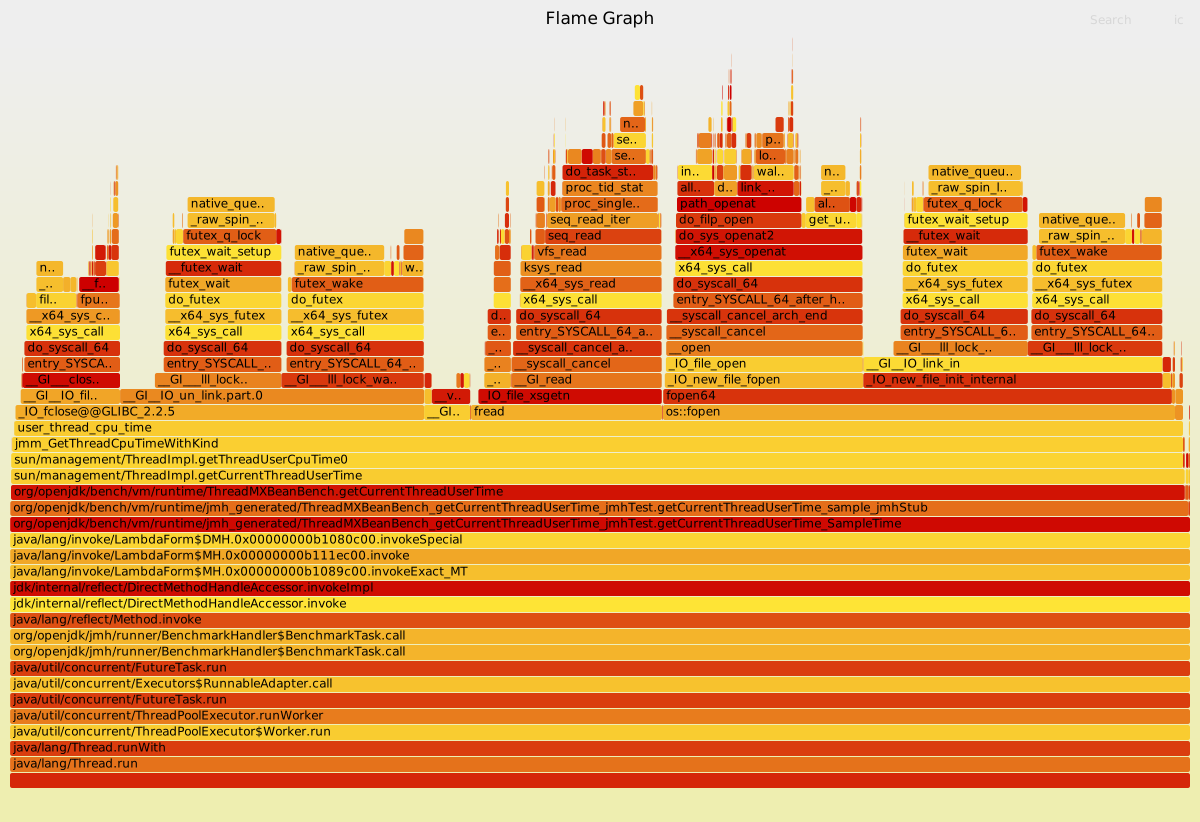
This is not well documented unfortunately, and I'm not aware of open-source implementations of this.
EDIT: Or maybe not, I'm not sure if PERF_COUNT_SW_TASK_CLOCK allows to select only user time. The kernel can definitely do it, but I don't know if the wiring is there. However this definitely works for overall thread CPU time.
Presumably you mean you just double check the page value after the rdtsc to make sure it hasn't changed and retry if it has?
Tbh I thought clock_gettime was a vdso based virtual syscall anyway
Me: looks at my code. "sure, ok, looks alright."
Me: looks at the resulting flamegraph. "what the hell is this?!?!?"
I've found all kinds of crazy stuff in codebases this way. Static initializers that aren't static, one-line logger calls that trigger expensive serialization, heavy string-parsing calls that don't memoize patterns, etc. Unfortunately some of those are my fault.
Regular flamegraphs are good too, icicle graphs are just another tool in the toolbox.
https://github.com/brendangregg/FlameGraph
Useful site if you are on to perf/eBPF/performance things with many examples and descriptions even for other uses as e.g. memory usage, disk usage (prefer heatmaps here but they are nice if you want to send someone a interactive view of their directory tree ...).
Or another great one: new instances of ObjectMapper created inside a method for a single call and then thrown away.
If you're referring to "one-line logger calls that trigger expensive serialization", it's also common in java.
https://github.com/facebook/folly/blob/main/folly/docs/Bench...
The mean does get proper statistical treatment (t-distribution confidence interval), but you're right that JMH doesn't compute confidence intervals for percentiles. Reporting p0.00 with three significant figures is ... optimistic.
That said I think the core finding survives this critique. The improvement shows up consistently across ~11 million samples at every percentile from p0.50 through p0.999.
edit : I had an afterthought about this because it ended up being a low quality comment ;
Bringing up such TLDR give a lot of value to reading content, especially on HN, as it provides way more inertia and let focus on -
reading this short form felt like that cool friend who gave you a heads up.
> Click to zoom, open in a new tab for interactivity
I admit I did not expect "Open Image in New Tab" to do what it said on the tin. I guess I was aware that it was possible with SVG but I don't think I've ever seen it done and was really not expecting it.
Normally, I use the generator included in async-profiler. It produces interactive HTML. But for this post, I used Brendan’s tool specifically to have a single, interactive SVG.
Thanks for the write-up Jaromir :) For those interested, I explored memory overhead when reading /proc—including eBPF profiling and the history behind the poorly documented user-space ABI.
Full details in my write-up: https://norlinder.nu/posts/User-CPU-Time-JVM/
edit: I just read your blog in full and I have to say I like it more than mine. You put a lot more rigor into it. I’m just peeking into things.
edit2: I linked your article from my post.
Very interesting read.
here it gets the task struct: https://elixir.bootlin.com/linux/v6.18.5/source/kernel/time/... and here https://elixir.bootlin.com/linux/v6.18.5/source/kernel/time/... to here where it actually pulls the value out: https://elixir.bootlin.com/linux/v6.18.5/source/kernel/sched...
where here is the vdso clock pick logic https://elixir.bootlin.com/linux/v6.18.5/source/lib/vdso/get... and here is the fallback to the syscall if it's not a vdso clock https://elixir.bootlin.com/linux/v6.18.5/source/lib/vdso/get...
Love the people and their software.
Great blog Jaromir!
This is what flame graphs are super helpful for, to see whether it’s really a problem or not.
Also, remember that every extra moment running instructions is a lost opportunity to put the CPU to sleep, so this has energy efficiency impact as well.
While I don't particularly like the IO overhead and churn consequences of real files for performance metrics, I get the 9p-like appeal of treating the virtual fs as a DBMS/API/ABI.