They wanted to aggressively support technological advances to reduce the dependence of transportation on petroleum, giving examples of making cars more efficient (they mention doubling gas mileage) and developing more flex-fuel and electric vehicles. They talked about honoraria of many millions of dollars for technological developments that could eliminate the need for gas powered cars.
They also mentioned promoting wireless communication to increase telecommuting options and reduce business travel.
All that was gone by 2012. I'm not sure what caused the change.
In a very myopic way.
But yeah, I guess your answer still applies indirectly: Fracking -> stronger interests by US oil companies -> money to the Republican party -> fossil fuel friendly regulations.
It's useful for the plastics and petrochemical industry, but it's not going to make the country energy independent, even including battery costs wind still trounces.
In a word: Greed. In two words: Crony Capitalism. The spend on “non-renewable“ energy is significant to the domestic economy. In 2023 (most recent year I could find), consumer spend on energy in the US was $1.6T (https://css.umich.edu/publications/factsheets/energy/us-ener...) with at least 82% of that being fossil fuels - the remainder being “renewables” and nuclear energy (https://www.eia.gov/todayinenergy/detail.php?id=62444). This does not include billions in subsidies and infrastructure investment.
“Going green” would threaten the American Greed Machine by cutting upwards of $150B in taxes annually, interfering with the individual, corporate, and government gains from the stock and commodities markets, causing short-term inflation due to commodity value spikes, and long-term deflation due to renewable energy being relatively very low cost to generate after the infrastructure is in place. Last, but certainly there is more, the US exports a massive amount of oil and gas. Divesting from fossil fuel production would have a significant impact on GDP (find your own source).
This is why the US doesn’t invest in infrastructure that doesn’t generate significant ongoing income like it once did - it simply doesn’t make enough money. We only act once it is falling apart.
It is all about the money, man. That money is power. It keeps the Corporatocracy and those at the top of it in charge, the US as the primary reserve currency and allows the US to have a huge, formidable military.
Unlimited spending from the fossil fuel industry basically standardized Republican candidates on climate denial talking points. Plus whatever bizarre fetishes random Republican billionaires had, like Adelson keeping Gingrich's primary campaign on life support for months. That fucked up Romney's pivot to the general election for no perceivable gain to any of them. According to Wikipedia Adelson spent over $90 million on losing candidates in 2012!
All of that was through Super PACs.
Also, I'd say McCain's policy was more based on a national security argument than a climate argument. As others have pointed out, fracking changed everything. In 2008 we were a huge net importer of oil. Now we're a huge net exporter.
Mines (including oil wells) are huge wealth concentrators. A handful of very wealthy people benefit hugely from resource extraction. And the US government, as a whole regardless of party, represents the interests of large corporations both domestically and overseas.
Anyway, Bush (either one) didn't run on renewable energy. Neither did the candidates that came after. 2012 was just a reversion to mean.
It was all lies to try and win elections.
> Here’s John Boehner, the likely speaker if Republicans take the House, offering his plans for Obama’s agenda: “We’re going to do everything — and I mean everything we can do — to kill it, stop it, slow it down, whatever we can.”
> Senate Minority Leader Mitch McConnell summed up his plan to National Journal: “The single most important thing we want to achieve is for President Obama to be a one-term president.”
Sure Trump took everything to an absurd level of "do the opposite of biden no matter what", but it started back then.
[1] https://www.politico.com/story/2010/10/the-gops-no-compromis...
I remember that day vividly.
It was the middle of the Great Recession, it was the worst our economy was doing in a long time. Millions were out of work. People were looking to the government to see what the plan was to get the country back on track.
A reporter asks McConnell what the senate’s number one priority was.
The answer? Not fixing the economy, not helping out every day Americans. Not finding the root cause of the crash and making sure it doesn’t happen that way again.
No, the answer was “make sure Obama is a one term president.” That’s all we would expect from the senate for the next 6 years.
The day McConnell said that, I said out loud: “I will never vote Republican again for the rest of my life.” (Prior to that point I mostly voted D but not 100% of the time.)
And I plan to keep that promise until I die.
They hated him for what he was.
Obstructionism as a core tenet of the (former) Republican platform is reprehensible, and retrospectively probably led to quite a bit of discontent with the government’s inability to address problems that Americans face. That same discontent fomented the current reactionary swing, so in the end maybe they really got what they wanted. Shameful.
color bait.
It's manufactured grievance. Opportunists politicize losing positions for political gain because they're inherently anti-elite, anti-establishment and upset experts and the informed.
Upon this antagonization is conflict which brings on drama, eyeballs, and advertisers.
It's an attention flywheel that brings loyalty, builds a moat, and sets a differentiator...
His "win" might be one of the most impactful sliding doors in the human history.
[1] https://www.sciencedirect.com/science/article/abs/pii/S23527...
Except, that's not even true. Some existing wind turbines are not recyclable.
Except that's not entirely true either! The tower portion of the turbine is usually steel, and easily recyclable! The nacelle, too. It's the base and the blades that can't be recycled.
Except that's not entirely true either! Existing turbine blades are made (mostly) of fibreglass, which is made of the fibre and the resin. The fibres aren't reliably as strong when recycled (which makes them not-very-useful when recycled), but the resin is just fine. And of course, if the blade is e.g. carbon fibre, then you can either re-use it or just burn it.
So, you statement should be that some (components of) existing wind turbines cannot be profitably recycled with current technology.
The wind turbine's concrete base doesn't need to be smashed up or ignored, incidentally - it can be re-used. Concrete is much sturdier than the e.g. gearbox.
Two points regarding blade recycling techniques taken straight from the top of the article:
- Cement co-processing and chemical dissolution are primary viable methods, yielding $27.57/ton and $199.71/ton returns respectively.
- Chemical recycling achieves top circularity (PCI=0.7) and notable carbon reduction (−0.475 t CO₂/ton).
Chemical recycling is not yet ready for industrial use; cement co-processing is.
The materials for renewable energy are still in a usable form.
But because they take so long to form, stumbles along the path of energy advancement mean a planetary civilization could run out of fossil fuels before reaching the level of advancement necessary to move beyond them. At that point, the civilization is essentially doomed since they lack the technological ability to move beyond fossil fuels and they lack the energy resources necessary to develop that technology.
The globe burnt about 8.8 billion tons of coal in 2024. Which is a huge amount. This is the peak, most estimates are that we will reduce from there.
Australia alone estimates that it has 147 billion tons of economically recoverable coal. That is Australia alone could supply the entire globe at peak usage for over 16 years. And Australia only has about 14% of the globes coal reserves, we can keep burning coal at this pace for at least the next hundred years. And it a hundred years the scope of what we consider to be economically recoverable will have expanded greatly, further increasing our supply.
We will cook ourselves before we run out of fuel.
That doesn't contradict your statement, of course. But in the long term the fossil fuel niches will start looking more like today's rocket-fuel niches.
Every time someone uses the term “renewable” they are providing coverage to this notion.
It is deeply bizarre you can think otherwise.
The user was arguing that the materials to exploit them are renewable too.
Recycling now recovers >95% of raw minerals (and will continue to improve).
The learning curves for battery and solar tech will more than make up the for the shortfall.
Meaning at some point in the near future (2050 IIRC), humanity will have mined all the lithium it'll ever need.
Also, in the same time frame, it'll be economical to mine our garbage dumps. Further reducing the need to extract raw materials.
Not of plastic - recycling rates are decreasing. This is largely due to the excess ethane begin produced as a by-product of US fracking.
The ethane is converted to ethylene, then to polyethylene as a cost below that of collecting, cleaning, and processing used plastic.
This is Big Oil propaganda. The impact from this is massively less than the horrific damage caused by every part of the fossil fuel industry.
And our lovely tailings: Syncrude Tailings Dam
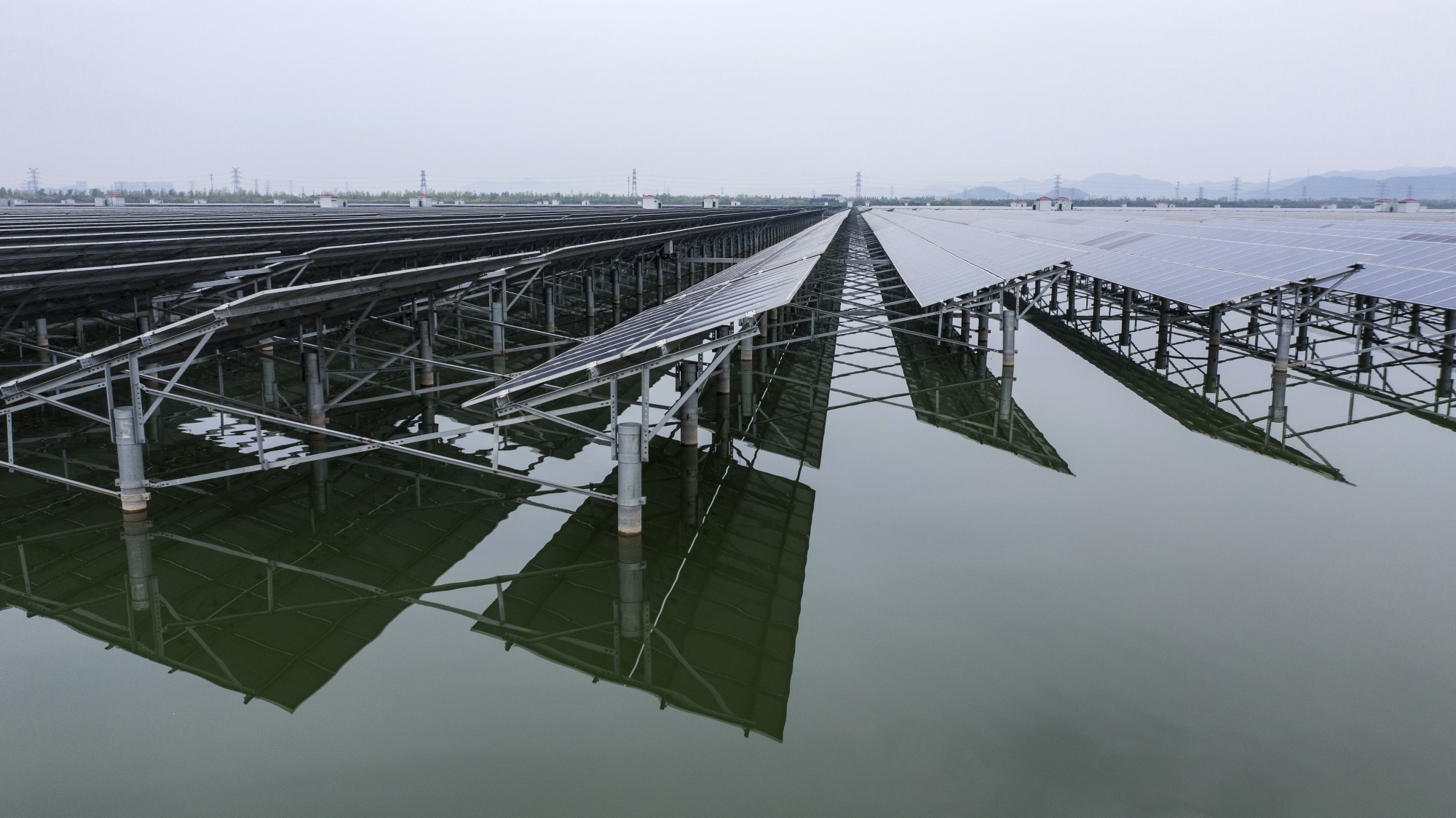
Note: I'm not suggesting China is not doing better here. Rather, I'm going off the title "Photos capture the breathtaking scale of China's wind and solar buildout" and I'm not seeing anything in those photos I haven't seen in the USA.
Driving down the 580 from SF to Tracy you pass several hundred windmills. Driving through Mojave the same. Also solar. Driving toward Vegas as well. And those are just the ones I've seen with my own eyes. There's many others.
https://www.google.com/search?udm=2&q=altamont+pass+windmill...
https://www.google.com/search?udm=2&q=mojave+windmills&sa=X&...
https://www.google.com/search?udm=2&q=palmdale+solar+farm&sa...
https://www.google.com/search?udm=2&q=desert+stateline+solar...
https://www.google.com/search?udm=2&q=barstow+solar+plant&sa...
https://www.politico.com/news/2025/12/11/how-the-wind-indust...
https://www.politico.com/news/2025/12/22/trump-leaves-wind-i...
And the Mojave solar concentrator is being shut down, from what I've heard.
The article here starts with: Last year China installed more than half of all wind and solar added globally. In May alone, it added enough renewable energy to power Poland, installing solar panels at a rate of roughly 100 every second.
Is the US anywhere in this ballpark?
The difference is just scale, China has 3x our population but very many of them had little or even no electricity available so they’re playing catch up. Americans are functionally all served by the power grid already. So of course they’re building more of it as an absolute number.
But I’d also bet they built more coal plants last year than the entire world built in a decade.
https://docs.cpuc.ca.gov/PublishedDocs/Published/G000/M586/K...
https://www.latimes.com/environment/story/2026-01-11/trump-b...
A graph comparing China to the US would have been better.
Meanwhile, China has made the obvious realization that independence from oil and gas is economically, geopolitically, and environmentally beneficial.
[0]: https://www.canarymedia.com/articles/clean-energy/us-new-win...
China being so big and populous makes it hard to make simple comparisons.
edit: looked it up, US is still ahead of China as of 2024:
https://ourworldindata.org/grapher/renewable-electricity-per...
Bear in mind that pre 2000 is likely hydro, in the early years of solar and wind that confused matters if lumped in together but I think it's now obvious when the new tech kicks in.
But no one talks about it because it doesn't provoke the only important narrative: "It's a shame that the US isn't doing that!"
People regularly talk about how much new coal capacity China has been building.
Quite often this is followed by "capacity, sure; they're not using all that capacity, those plants exist and are mostly not running", or some variation thereof. I've never bothered fact-checking the responses, but this conversation happens is most of the Chinese renewables discussions I've seen in the last few years.
Nuclear capacity: +2GW in 2025 (https://world-nuclear.org/information-library/country-profil...)
Solar capacity: ¬300GW capacity
https://english.www.gov.cn/archive/statistics/202512/26/cont...
It looks like you've been misled but are having trouble admitting that to yourself?
https://www.canarymedia.com/articles/fossil-fuels/chart-the-...
This also happens in China. With better ratio for renewables but still. Globally there was more energy from coal than before. Much more was from renewables but in context of climate change absolute numbers of CO2 are what matters.
EU is also reverting it's green targets because of this new situation. So near future does not look good.
It should be _every_ thing that isn't a bad idea.
Solar
Wind
Geothermal
Tidal power?
Got a way of using that tasty oil cleanly? Maybe we want to reserve those complex hydrocarbons for some other use like growing crops, making solid rocket fuel, or some other national priority.
Nuclear - Yes, craft regulations that make sense and squeeze all the damned energy possible out of that 'waste'. No, I don't mean burn the fuel the easy way only - I mean send it back to military run reprocessing centers to concentrate the power and make the (effective) half life of the waste decades rather than civilizations of time (yes, concentrating it, there will also be some super mild things that decay slowly enough to be useful in other applications rather than waste).
We want to maximize energy in the long, medium and short term. Try Everything.
For a brief window of time our consensus for decarbonization extended all the way to (the most) popular media.
Over 90% of new power generation being built (both domestically and globally) is renewables. We do it for the same reason China and everyone else is: it’s just cheaper now.
That’s the best reason because it’s the one that gets the job done. Renewable energy prices will keep falling while fossil fuel prices rise, widening the gap.
In 25 years there will be little fossil fuel generation left.
Honestly, I think building regulations should mandate solar energy for homes.
Anecdotally, a ton of solar has gone up in the last four years here in Germany, both rooftop and, increasingly, in what were likely canola fields for biodiesel along highways - at first driven by Russia's invasion of Ukraine and the need to reduce natural gas consumption, but now by how absolutely cheap those panels are. Too bad they're not being made here...
My favorite installation so far: a large field in SW Germany, with the panels high enough for cattle to wander and grass to grow under them. The cattle were almost all under those panels, munching away - it was a hot day.
They had a huge specially-made array of lead acid batteries, a backup wood-fired stove for cooking when their power went out, a refrigeration setup where they had to child-lock the fridge during an outage so visitors wouldn't open it and spoil their milk, and no grid connection (which wouldn't have easily allowed residential exports until the late 90s anyway). They also had no cooling other than a fan and windows, and wood heating.
It's honestly pretty impressive how far we've come. Particularly in Australia, where we're world leaders in home solar capacity but are lagging behind in utility-scale renewables, it's really breathtaking to see the country go from 44kWh to 1880kWh per capita capacity in 15 years based mostly off incentivised rooftop solar.
So i would have to disagree. We are significantly far ahead from the initial “idea”.
It happens all the time...
People have home solar, but it's hardly widespread. It's still a "fancy" thing to have.
https://en.wikipedia.org/wiki/Solar_power_by_country#Global_...
https://elements.visualcapitalist.com/top-20-countries-by-ba...
Australia > all of Europe (yes all of Europe, not just EU) combined on that one.
I had solar installed last year, at the end of the summer, it cost roughly £14,000 for a system that can produce 6.51kWp and with 12kWh of battery storage (about 10kWh usable).
The 465W all-black panels (14 of them) I had installed are a little under £100 each to buy off-the-shelf, that accounts for 10% (£1400) of the cost of my system.
The batteries and inverter together another roughly £3.5k, so, about £9k of that cost was not for "solar and battery tech", a good chunk of it, somewhere around 40% of the total was labour, and the rest in scaffolding. Even if we allocate say another £1k to "hardware"; rails, wire, switchgear etc, that's still £8k easily.
Even if the hardware was free, £8-10k installation costs seems prohibitively expensive for the average UK household, unless you were totally wiping out your monthly bills and could pay it off over the lifetime of the system.
I suspect part of the issue in Australia is the same; I believe (perhaps incorrectly) you have a lot more sun down there so I'd expect the scale of (number of) installations to be higher.
https://www.aemo.com.au/energy-systems/electricity/national-...
But also, due to infrastructure. Everyone who could afford it has had a battery and inverter in our homes since forever. Hooking up some solar panels to it is relatively straightforward.
I think there are also some state sponsored subsidies involved although I couldn’t tell you how much.
[1] https://www.greenlancer.com/post/california-solar-mandate
[2] https://www.energy.ca.gov/programs-and-topics/programs/calif...
You can go out and buy solar panels to cover your roof for a few thousand dollars/pounds/euros. You could definitely not do that in 1999.
I'm not against nuclear per se, but it's like this part of italians don't realize that:
1. if you decide to make a power plant today, it won't be online before the 2050s, in the best case scenario. It's very difficult to bring nuclear plants online, especially in the west. Even the countries with the capital and know-how (US and France) see more projects cancelled than brought online. I think US has put online a single nuclear plant in 20 years, France not a single one.
2. Nuclear needs tons of water, we have less and less of it as it rains less and global warming doesn't accumulate enough snow in the alps (which generally melts in the summer), our rivers are literally dry stone most of the year.
3. Renewables can be attached to the grid (or close to where they are needed) in the span of few months and with very little know-how required.
4. Money isn't limitless, building a 20B+ nuclear plant (realistically 50 knowing these projects + Italy) means this budget won't be available for the next decade on projects that could bring benefits immediately.
I'm sure that Italy and Germany, which are manufacturing heavy countries that need lots of energy cannot rely renewables alone, of course nuclear should be considered, but hell, in my region (around Rome), 95% of our energy comes from imported natural gas, I'm sure we could invest some more in that.
Your 2050’s comment assumes a level of dysfunction that’s presumably exaggerated. Averaging 10 years puts you at 2036 and is itself somewhat pessimistic.
The cost of canceled nuclear projects is generally quite low compared to lifetime subsidies of nuclear. Nuclear may be an inefficient use of government resources, but it’s also offset a staggering amount of emissions and the subsidies tend to end back up in the local economy recuperating some of the expense. IMO, there’s probably dumber things your government is doing that are worth fighting instead.
The average time globally is 14 years. The latest point of reference in the west, Vogtle was announced in 2006 and came online in 2025, 19 years later. It took 7 years alone just to start building it.
There's no chance this would take less time in Italy, where you need to also find a suitable place, you don't have the know-how and there's an anti-nuclear referendum that's been voted 3 decades ago. So there is a lot that needs to be changed, starting from having a public voting.
Hinkley Point C, in UK, has ballooned it's cost from the planned 18B pounds to a 43B pounds in the span of a decade. These projects always go overbudget, badly.
Until there’s actual funding talking about nuclear doesn’t really mean anything. Vogal was a boondoggle but it didn’t get construction approval until 2012 and like many projects ran into COVID delays on top of everything else.
> These projects always go overbudget, badly.
Using the worst examples means there’s something very wrong with each of them.
Well there you are, then: projects experience delays in construction approval and run into other unexpected delays, which extends a ~10yr estimate.
You can always pick worse numbers by using a smaller sample of projects, but it isn’t necessarily meaningful to do so. California’s high speed rail has gone far worse than Italy’s projects, America is currently comically bad at large construction projects.
Detail and detail on cost benefit analysis https://www.csiro.au/en/news/All/Articles/2024/December/Nucl...
Needless to say not at all cost effective to go nuclear at this point. There's no reason that wouldn't hold similarly in other nations since the scale of the difference in costs are so huge too.
Worst part is, even if price comes down I think they further poisoned the idea of nuclear in Australia because their plan was brazenly to keep the coal & gas plants running in the meantime rather than spend money on wind/solar. They didn't even make an effort for their timelines and costs to be remotely believable.
wars / empires etc are built on mastering an energy source
the Brits on Coal
the US rose on Oil
China is rising on renewables
my worry is can renewables be quickly brought online to power industry / power hungry Data Centers etc at a reasonable cost
Good luck to them, because someone has to.
I mean, clearly the answer is yes. The problem is political, not economic.
https://minimallysustained.substack.com/p/beyond-the-greenho...
China is also building unfathomable amount of coal plants as well.
Arguably the US is energy independent. It has Texas, Canada and Venezuela.
They never did discover any large oilfields in China despite decades of frantically searching for it.
The amount of hard, soft and economic power that are being burned for the bedtime stories of one person is unreal. As are all the cooperators and lobby harnessing conspirators whose actual dreams are getting implemented.
It isn't the fall of the USSR, but it is still a dramatic ceiling bounce.
I don't blame them.
However, it's also true that if the US builds a new pipeline to the Canadian border, Canada will happily fill it with heavy crude.
Our elites refuse to concede dominance of the affairs of the world, so they will never allow the fossil fuel infrastructure to decline unless forced.
By contrast, China has every incentive to do the right thing.
The Chinese grid isn't renewable or non-renewable. It's built to keep the lights on for anything short of a thousand year catastrophe.
Their 2060 plan has enough non intermittent base load that they can run the whole country off it for a decade.
That half of your grid capacity is there 'just in case' is something no one in the west can wrap their head around. China building out massive solar and wind farms isn't because wind and solar are the future. It's because they can tick off their 30 year plan 25 years ahead of schedule and focus on the hard parts next.
The reality is that they don't have a good source of fossil fuels, and energy independence is a core necessity.
IIRC that list of companies that polluted the most on the planet, 1 and 2 were Chinese state owned entities. China Coal and China Petroleum from memory.
OFC they are dwarfed IIRC by the US Military.
But coal is the worst fossil fuel from a practical stance. It's really only good for energy generation. You can't really power tanks or warships with it.
https://en.wikipedia.org/wiki/Bergius_process
https://en.wikipedia.org/wiki/Fischer%E2%80%93Tropsch_proces...
The elites are pinning us to fossil fuels and driving up the cost of necessities.
China has been building 5% extra nuclear capacity every year for the last 30 years. On target for making up 24% of their energy mix in 2060.
Like I said in the original post:
>Even the people who understand the scale don't understand the purpose.
>The Chinese grid isn't renewable or non-renewable. It's built to keep the lights on for anything short of a thousand year catastrophe.
Only capitalists are so penny wise and pound foolish to bet their civilization on the lowest bidder while hoping the inevitable doesn't happen in the next quarter.
Also, they're soon going to run out of women, so they need to perfect artificial wombs.
The few remaining party elites will want to live practically forever, so biology will be on the programs once fusion and robots have been cracked.
And it doesnot even seem like china will make ussr-level mistakes.
Our only hope for beating China, at this point, would be to recreate an "opium wars" situation where the whole population becomes dumb and stop caring. (A bit like what tiktok and X are doing to use at the moment, but with much more social control.)
Compare that to something like the California High Speed Rail, or our every 4 year tug of war for elections (and mid term elections). Everything is short sighted "wins" for the next reelection, of one party vs another party, instead of making actual progress.
Its almost like when there is a good benevolent leadership in charge, for a long term, then progress comes much faster. (Singapore, China, ?)
They could preserve all that scenery by just building out nuclear. That's without mentioning the horrible ecological impact of blanketing an entire ecosystem in panels.
You may never see them. Not because we aren't adding renewables, but because South Australia was at about 80% renewable last year (average, not peak) so if you were going to get those sort of pictures anywhere in Australia, you would be getting them from SA now.
You probably don't see them because while the countries are about the same size in land area, but China has 50 times the population so it needs about 50 times more power.
However, we could also build out more green energy technology to become a large energy exporter. (You could argue we are kind of that now, with the amount of coal we export.)
Especially given we have strong but complicated geopolitical ties to both China and the USA, it feels like guaranteeing our own energy sovereignty, plus gaining the ability to export power directly, would be a strong political as well as environmental move.
I'd also love to see solar panels on top of every Bunnings, Westfield, and other warehouses/complexes, as well as above every outdoor carpark, which would have the added bonus of preventing hand roasting in summer.
7 days ago, 93 comments https://news.ycombinator.com/item?id=46536866
Still impressive for a country of that size, but "world leading" is technically no longer correct.
[1] https://www.renewableuk.com/energypulse/blog/uk-wind-and-glo... [2] https://www.statista.com/statistics/1489147/uk-offshore-wind...
ps.: Per capita it's also not #1 — Denmark and the Netherlands both have higher offshore wind capacity per person.
You also have situations, like today, where a German developer has handed back a seabed lease for 3GW of offshore power because they didn’t get a contract for power from government (CFD) and their lease fees are approx £400m/yr if they want to continue developing the windfarm. This is after spending £1B already on lease fees with nothing to show for it.
(TBF Irish standards have gotten much better for airtightness)
Especially wind mills - they are all over the place. Outside of cities and forests it would be difficult to not see at least one ... and they like to flock.
For example:
- https://www.google.com/maps/place/Energiepark+Witznitz+MOVE+...
- https://www.erneuerbareenergien.de/energieversorger/stadtwer...
- https://www.erneuerbareenergien.de/energieversorger/stadtwer...
When did German achieve that?
How can Germany achieve it? It is 10x less people?
So what if you read his emotions correctly? It’s not like your response will change his mind?
In a world of 1 > 0, someone needs to be looked down upon. Why not look down on me? Why can’t others look down on China? And why would looking down based on “truth”, which you seem to so much value, change anything?
Battery storage isn't quite where it needs to be, yet, so there's still some need for fossil and nuclear power, but when it is, decommissioning the remaining fossil power system is a no-brainer, and those with the biggest existing solar and wind estates will benefit most, and fastest.
(direct link to image: https://assets.bwbx.io/images/users/iqjWHBFdfxIU/iy93Jvbye2e...)
Solar panels are meant to be water proof, after all they are meant to survive rain storms and melting snow and coastal weather.
Seems like a weird location to me, but what do I know.
"The US Geological Survey estimates that onshore northeast Greenland (including ice-covered areas) contains around 31 billion barrels of oil-equivalent in hydrocarbons – similar to the US’s entire volume of proven crude oil reserves."
Source: https://theconversation.com/greenland-is-rich-in-natural-res...
Denmark does not (since 2009) control Greenland's minerals, nor take revenues from resource extraction[0,1]; and Greenland's democratic government has in fact totally banned oil exploration[2].
[0] https://www.politico.eu/article/europe-neglect-greenland-min... ("In 2009, Denmark handed Greenland's inhabitants control of their natural resources...")
[1] https://english.stm.dk/the-prime-ministers-office/the-unity-... ("Revenues from mineral resource activities in Greenland are to accrue to the Self-Government. Such revenues will have influence on the size of the Danish Government subsidy, cf. section below on the economic arrangement.")
[2] https://news.ycombinator.com/item?id=27871672 ("Greenland bans all oil exploration (cbc.ca)" (2021))
> "Global warming means that retreating ice could uncover potential oil and mineral resources which, if successfully tapped, could dramatically change the fortunes of the semi-autonomous territory of 57,000 people."
> ""The future does not lie in oil. The future belongs to renewable energy, and in that respect we have much more to gain," the Greenland government said in a statement. The government said it "wants to take co-responsibility for combating the global climate crisis."
Regardless, the US isn’t taking over Greenland for its oil. That is just ridiculous and there would be far easier targets to go after if that was the case.
My experience is that the UK (for example) doesn’t really know why it is building offshore wind. Is it to reduce bills to consumers (OFGEMS remit), is it to create local jobs in manufacturing (Clean Industry Bonus Scheme), is it to stimulate national wealth by ownership of projects (British Energy). It’s a mess unclear picture for me.
It would be nice if politicians could spend some time trying to work together, cross parties a come up with some sensible resolutions and long term plans instead of trying to score points for soundbites and clips.
The NEXT more challenging part is to build the necessary storage and "power network transmission lines" so that the supply can be made ( Large Scale ) reliable - 24/7 , independent of the weather.
No, it was agreed during Kyoto that developed nations would reduce emissions, and developing nations (aka PRC, India) would not. Developing nations could keeping scaling fossil to industrialize until Paris where all countries had to submit climate plan (again not explicitly to reduce), and PRC's was to peak emissions by 2030s, which they're on trend to do early. PRC did what was legally permitted / agreed upon, and if developed nations want to cope / be butthurt and label following the agreement as dirty and not cooperate in the future global projects because they're not financial beneficiaries then that's on them. Also "some" solar and wind is ~ROW combined, which surely is very unimpressive.
> sell the solution
Selling solution to problems is solving problem, selling solutions to problems cheaply is solving said problem faster. As if developed economies did not decarbonize by selling clean tech solutions... which btw PRC bought. PRC simply doing globe a favor by selling real climate solutions at cost and scale that makes global difference, instead of scaling retarded paper solutions like carbon credits from countries that primarily scales spreadsheets.
> and PRC's was to peak emissions by 2030s
This appears to be wrong. Peak is supposed to be before 2030. They will not hit it.
1% off according to dashboard analysis for 2025 5 year plan target. There's study from Q4 that PRC emissions has been stalled/trending, i.e. peaked for past 18months. Functionally they've peaked emissions before 2030 NDC commitment.
All that said, I don’t think wind and solar are the answers. Geothermal and fusion will need to be the solution.
I think it's a bit better now. I don't think invasions change that much.
Found the Oil & Gas lobbyist / apologist.
China might not have oil, but at least they are trying to figure something else out. Credit to them. Say what you want about The Party (I certainly have) but gotta give credit where and when its due. They have an interest in pushing alternative fuels, and by god they are doing it.
China needs power NOW though.
Seems to me like wind solar batteries and nuclear are the answer, what’s actually being built now in a big way, not pie in the sky like fusion.
I speak this having lived south of Moffett airfield where the entire area was poisoned from the degreasers used on the military planes in Moffett Field. It's one of the largest Superfund sites in the US and there are thousands of families living there. It might seem innocuous but I'm wondering whether solar panels in the environment leak any chemicals.
Does this question make any sense at all?
The only way this could change net heat if it significantly altered the reflectivity of the surface, and in practice the affected area is too small to matter. As an exaggerated example, I found an article [1] that calculated the area that would need to be covered by solar panels to generate power equal the total global electricity consumption to be 115,625 square miles, approximately equal to the state of New Mexico.
[1] https://www.axionpower.com/knowledge/power-world-with-solar/
Direct thermal pollution like this is not yet globally significant, but if demand increased to the point that land constraints actually applied then it would become important.
What is free of side effects for "nature" ?
A lesson Europe could learn.
We've learned that lesson. Not to toot our own horn too much but we to a large extent kickstarted the thing in Germany with very little reward for it. 50% of Europe's energy produced is now reneables[1]. China's progress is incredibly impressive, but they are also the largest consumer of middle eastern oil in the world. Not really to their own fault, countries are going to be dependent on oil for a long time to come. (it's used in many more things than energy production)
[1] https://ec.europa.eu/eurostat/web/products-eurostat-news/w/d...
> “All you have to do is say to China, how many windmill areas do you have in China? So far, they are not able to find any. They use coal, and they use oil and gas and some nuclear, not much. But they don’t have windmills, they make them and sell them to suckers like Europe, and suckers like the United States before.”
One of the most factually BS statements ever.
[0] https://www.forbes.com/sites/mattrandolph/2026/01/12/china-d...
Even though associated costs exist, a free source is the lowest of its kind you can find.
But I get it, and tradeoffs are necessary.
Another reason China may prefer this to more concentrated nuclear power is that is is much more distributed and resilient to targeted attacks.
If you think wind turbines are a significant cause of bird deaths it shows that you have no clue what you're talking about. Please don't bother commenting on this topic again.
However had, there is one thing working for China: decision-making steps.
I don't have any illusion about the sinomarxist party and I don't suggest that their model - which is a dictatorship, just like the USA has transitioned into now too under an orange-painted TechBro minion - replaces democractic processes. But you do have to ask yourself what the EU is doing here, other than failing in epic ways. You can not assume that current wealth will be retained in the future; and while "green energy" is great, what we in reality see right now is simply price increases. That ultimately means wealth is deducted from a majority, and only a very few profit from this. That is a design-by-failure process now.
China is rocketing ahead in every domain possible, from resource and financial independence, to infrastructure in terms of high-speed rail, bridges, roads, advanced fission reactors and bleeding-edge fusion research. Heavy industry like mining and processing, chemicals, ship-building.
Let's not even get into semiconductors. I fully expect them to achieve parity with TSMC before 2030 and surpass them shortly after.
Meanwhile, Western countries will say 'clean coal' or have a million different stakeholders squabble about where and how to build nuke power plants.
Oil, cigarettes and alcohol were all clearly being pushed and promoted. Pretty sure it was episode four where a women rather matter-of-factly stated that one alcoholic beverage when pregnant was perfectly fine - inso much that it was good because it helped her body generate breast milk. Such a weird statement to shoe-horn into this soap opera.
Coupled with BBT chain smoking the coffin nails, the rampant shit-canning of renewables and incessant self promotion of how large and wonderful the fossil fuel industry is the money behind the show was as subtle as a sledgehammer.
Plus the sexual objectification of women in this show is ludicrous.
It's 2026. It seems everything old is new again.
Oh, and the
I guess it is a bit like François Truffaut's statement that there are no "anti-war films". I imagine if some population segment has chosen to identify with a particular lifestyle (oilman, soldier, gangster, etc.) then it doesn't really matter quite how that lifestyle is portrayed so long as the viewer can make a connection with it.
oh Paramount
the ones that just decimated CBS News, put talentless propagandist Bari Weiss in charge, and censored a critical report on human rights abuses ordered by POTUS
all running on Oracle (tm)
If you assume that .5% of population are "einsteins" then China has 7.5m einsteins who are now able to access universities and advance sciences whether it's AI or solar power or self driving cars.
There's no doubt about the fact that the future belongs to China.
There's just no way to deny this. The economical and political power will shift to China.
Your current government seems determined to make sure this won't happen.
Unless there's a serious reckoning afterwards, the rest of the world is gonna operate on the assumption that it can and probably will happen again soon.
I keep wondering where the line in the sand is for the wider GOP base. We keep crossing what I think "this is the line … right?" and nope, that wasn't it, either.
And on the foreign front, well, the trust has been broken and I don't think it can be repaired easily. The remaining NATO allies are very stable, they understand mutual respect and collaboration is the foundation of their survival, whereas attacking each other breaks trust completely. Even if a new fantastic president is chosen that understands his huge responsibility both for Americans and the world, other countries learned their lesson hard and understand there is no guarantee in a few years the USA become their enemy again.
Of course there is "way".
All the above above in itself sounds like propaganda. You forget other political (authoritarian system making massive mistakes), demographic (1.0, probably less in reality, birth per woman), psychological (disillusioned young population), and geographic (food and other imports) aspects, among other things.
No, too much Fox "News".
That may hamper us more than anything else. If AI proves to be as beneficial as its proponents hyped, the economic gains will just mostly get soaked up by landowners. Even UBI won't save us, because it will just get absorbed by landowners. Ditto for renewable energy.
Europe is also at least a decade ahead.
And since renewable + batteries is now cheaper than nuclear, we should spend our money and time wisely.
Eggs in one basket. Renewables are good, but it gets cloudy, it becomes night, it might not be windy. Nuclear will output power come rain or shine, and like I said, it's not like China isn't investing in advanced fission. They're throwing money at everything to see what sticks. They're working on SMRs, molten salt, thorium, and more.
Also, we can't survive an asteroid crash/extinction event with solar.
Nuclear is transcedental. If we had practically unlimited fusion power, we could build underground, grow plants in aquaponics and aeroponics and ride it out in underground cities and farms.
Maybe tell the Chinese they have it wrong and are risking extinction.
This is pie-in-the-sky, by-and-by fantasy. Fusion's sole accomplishment is likely to be making fission look cheap in comparison.
Just because something became a science fiction trope doesn't mean it's actually going to be a part of the future.
In that:
* Nuclear power plant failures can be very, very nasty. As in, "producing uninhabitable land for eons" nasty. Yes, dam failures are spectacularly nasty, too (but don't create unlivable land as much). Yes, fossil fuel power plants also are quite bad in a "more silent way" via pollution (plus the occasional centuries-burning coal mine fires etc.). All power sources have problems. But this is a pretty big negative.
* What this means is that big centralized nuclear is also a big target for rogue actors... similar to dams, but not similar to more distributed energy sources like solar or wind. Blowing up a single solar farm or windmill doesn't have a huge impact, relatively speaking, compared to blowing up a nuclear plant. Nuclear plants thus have to spend extra expense protecting themselves against this sort of thing. (And, in the United States at least, classify much of the process of doing so.)
* Nuclear power plants can also be used to produce nuclear weapons. Now this is where the really fun politics begins. Many countries would be really unhappy if their adversary countries start making nuclear weapons from their nuclear power plants. A lot of military stuff has been spent over the last decades trying to prevent such.
This last point is where China's solar panel play actually makes more sense compared to nuclear. Think of the politics involved if China builds a big nuclear point in (insert adversary of some other country here). Could be very, very tricky in many cases. Whereas, there is very little if any politics involved with shipping a solar panel somewhere.
The distributed, small scale nature of solar panels also means that customers in countries with poor centralized power grids (common in developing countries) are able to use them to bypass the current system. This happened previously in many of these countries with mobile phones, where customers were able to bypass poor centralized phone networks. In this aspect, I think the "decentralized" aspect is far more important than the "renewable" aspect... but still.
(There are positives to nuclear, of course; I'm mainly countering the "transcendental" word here. All power sources have plusses and minuses.)
(Note: I have heard of work on smaller scale nuclear systems, but I am not certain if even a small nuclear power device completely resolves political or security concerns.)
Chernobyl is pretty much habitable now in most places. People live there, work at the power plant.
The asteroid is just science unlikely fiction.
The Chinese, Indian, Indonesian, French, British, and even Singaporean[1] (of all places, one might expect a tiny equatorial city-state to be the last place to think about nuclear, but it is all the same, because nuclear is ridiculously power-dense) governments seem to agree with me.
[1]: https://www.world-nuclear-news.org/articles/singapore-seriou...
That's two baskets right there.
That's where long distance interconnects come into play.
...which is why China has 40 000 km of UHV transmission lines forming a vast network to move the energy from where it is abundant to where it is needed. They have 8 new UHV projects that started in 2024 or 2025 that will add another 10 000 km.
I can think of two possible reasons: (1) it's America, and it's very hard to build anything, and nuclear is smaller and fits on site, and (2) we have an administration openly hostile to solar and wind energy for political "vibes" reasons.
Vibes are dumb. I think looking back this is going to be seen as an age of people deciding based more on vibes, which ultimately comes down to tribal dog whistles, than reason.
OpenAI bets on SMRs (now an ectoplasm, check NuScale...) and solar arrays: https://cdn.openai.com/global-affairs/openai-doe-rfi-5-7-202... , and drives breakthroughs on renewable energy: https://openai.com/index/strengthening- americas-ai-leadership-with-the-us-national-laboratories/
Microsoft: https://www.reuters.com/sustainability/climate-energy/micros...
Alphabet (Google) buys 'Intersect' which "delivers ((...)) infrastructure for data centers and other energy-intensive industries by co-locating industrial demand with dedicated gas and renewable power generation". 4.75 billion USD. https://abc.xyz/investor/news/news-details/2025/Alphabet-Ann...
They're looking for credulous investors in the nuclear startups they founded?
What makes this more valid than something like "it's incredible how many YIMBY talking points there are" in a thread about housing, aside from you agreeing with the YIMBYs? Is "talking points" just a roundabout way to summarily dismiss the opposition's arguments and imply they're dumb/misguided?
Current US estimates for solar land usage are 500,000 acres.
The land use arguments are bunk. Anyone who complains is repeating oil and gas propaganda.
Conservatives, protesting on the street to save the whales. Talk about a sight to see.
It is. I've read dozens of comments like this on HN, and repeatedly see the "it's incredible that...", "talking points"/"propaganda", and "wow look at how much bad stuff there is in this thread"/"I'm so disappointed in HN" memes, and every single time it's because the author is trying to dismiss the opposition's arguments without responding to them individually and actually addressing their points.
This kind of thing clearly fits into the "sneering" category of things that aren't allowed on HN and so is valid for flagging. I do it and I highly encourage anyone else to do it who wants to preserve the culture of HN.
For me, yes it is. It wouldn't if policy discussions were purely technical and well informed. In the arena of public discourse they aren't. The majority of the population (including HN) is tribal, ideologically biased, emotionally driven and badly informed. Public discourse, particularly in America, is contaminated by propaganda of established economic powers (i.e.: Big Oil, Big Pharma, Tech companies). They can easily advance their talking points because they have much more economic resources for propaganda and lobbying.
I agree that, eventually, most people will discover that oil & coal are doomed and destroying the world. Reality has a way to force itself into ideologies.
But that will take a long time. I need truth and certainty now.
that oil & coal are doomed and destroying the world
to be green-agenda talking points?
Edit: I don't have the facts about reliability of green energy (though you didn't provide any evidence against it either), but it's clear the "not knowing where your energy comes from", "having messy grid" and "not investing in nuclear" are unrelated to renewable energy.
https://x.com/duncancampbell/status/1647109450438955008
I'm not saying the idea is institutionalized by the democrats, but I think musk/tesla hatred is kinda driving it
We can speculate about how quick/slow all this will progress. But it's worth pointing out that e.g. IEA, EIA and similar institutes have been repeatedly wrong and overly pessimistic with their predictions for things like adoption and cost of renewables. People are still basing policy and important decisions on their reports. So this matters. The "What if they are wrong, again?" question might have some uncomfortable answers if you are betting on them not being wrong.
A lot of developing markets are skipping oil/gas/coal completely and are going straight to renewables. They are not first building a grid using coal/gas plants but working around what little they have in terms of unreliable grid by going straight for solar/batteries and microgrids. That's a pattern you see all over parts of Africa with historically very little/flaky power infrastructure and countries like Pakistan. These are growth economies showing much quicker economical growth than the world average. That's going to spread.
Lots of countries are going to be decimating their oil/gas imports over the next 20 years. That includes transport and power generation. They'll be installing wind/solar/batteries and buying lots of EVs. Fossil fuel usage won't go all the way to zero. But it won't stay at current levels or anywhere close to that. Some countries will be faster some will be slower. Being slower isn't necessarily good for economies.
Good advice here is to take an economic point of view and be aware of things like growth trends, cost curves, learning effects, technological changes, etc. You don't have to be an early adopter or believer. But there's a lot of data out there that supports an optimistic view. And a lot of pessimistic wishful thinkers that are not really looking at data or just cherry picking reports that support their believes. The fossil fuel industry sponsors a lot of reports research. And they are about as trust worthy as the Tobacco industry is when it comes to the pros/cons of smoking. That's why the IEA and EIA keeps getting it wrong. It helps to understand who pays for their reports (hint: fossil fuel companies and countries that depend on those).
A healthy personal perspective is maybe considering what happens if your pension fund bets on fossil fuel and that cliff I mentioned turns out to be very real in about 10-20 years. Because if you bet wrong, that affects the value of that. Before you knee jerk to an answer, take a close look at what institutional investors have actually been doing for a while. Hint: coal plants were written off as good investments ages ago and gas plants aren't looking much better at this point. I think you'll see them move on oil funds next.
To your point about the fossil fuel cliff, I think it was either a Bloomberg or Forbes article that discussed how China's deep involvement in the EV/battery/solar/wind Expansion in dozens of countries around the world gives it a chance to put a serious dent in oil consumption as well as locking American interests out of developing markets.
That said "you're just repeating what you're told" is a comforting argument but doesn't go all that far.
Most people don't normally think it's the boomers in particular unless their powers of observation are somewhat limited.
Which is understandable, you don't reach maturity overnight.
Edit: not my downvote btw
> Most people don't normally think it's the boomers in particular
Interesting because most of the critiques, especially to electric cars come from boomers. Also to Solar and Wind, the kind of silly criticism like "Why are we filling our barely-arable lands with Solar?!"
Now we'll watch how the European car manufacturers get swallowed by Chinese electrical manufacturers.
You might notice comments simply arguing for less energy usage are buried at the bottom too. Have you considered whether you may have fallen for the "green" propaganda? It's so predictable after all.
Two wrongs don't make a right. We look back and curse our ancestors for their unbridled use of fossil fuels. Who is to say future generations won't look back and curse us for destroying all wilderness?
I curse my ancestors for destroying all wilderness to get at fossil fuels.
Right.
Not so scenic any more... I get it, electricity good, but man are we destroying places just to get this stuff. In the UK I reckon within my lifetime it won't be possible to go to the sea any more. I mean, the sea how it used to be, without wind turbines in it. Fossil fuels gave us too much. If only we could figure out how to want less.
We’re never going to reduce energy consumption. It’s a balance between gas and wind here, just pick how many wind turbines you want, and burn gas to fill in the gaps.
Your ruined horizon is my safer future for my kids. I like seeing them there. I wish there were more.
US energy consumption per capita peaked in 1975 and has trended down even as population has increased. There's going to be a peak in global population, likely before 2100 (and it keeps getting revised sooner, not later).
So it stands to reason that as we become more energy efficient (already happening) and we start to have fewer people on earth (likely to happen in your/ your children's lifetime) that overall consumption will in fact go down.
I would rather they not have to be built in the first place. Yet, this is unfortunately the price we must pay today for not reducing our carbon emissions yesterday.
Had we taken a serious effort to do something in, say the mid nineties when the scientific community reached a large consensus regarding the major contributors of climate change it had been less urgent to do something now thirty years later and we would have had a much longer time for the academies and industry to research and improve performance of non-fossil energy production and do the same for energy using applications.
It's not the renewables which are to blame, because if we continue to burn fossil fuels the way we do then these places will either soon be destroyed, or nobody can appreciate them due to civilisational collapse.
I didn't know they were so big that you can't fit in the sea anymore. /s
In the U.S. and EU, if the government takes your land, they have to reimburse you for it, and you can fight them every step of the way. In China, the government can take your land and if you complain, you can spend the rest of your life in a labor camp.
> Wouldn't it be better to just go with nuclear
If this is legit : https://world-nuclear.org/information-library/country-profil... then they have 59 reactors right now with 37 currently in production. Wikipedia lists 62 reactors being built in the world in total, and 28 of them being in China. The amount of power those additional plants will generate will take them from third in the world to second this year (wikipedia) and in total would pass the US when built.
They're not slouching on nuclear, they're ramping up energy production at an incredible pace on a lot of fronts.
Compared to their renewable buildout the nuclear scheme is a token gesture to keep a nuclear industry alive if it would somehow end up delivering cheap electricity. And of course to enable their military ambitions.
Very renewable. Solar panels are mostly glass, silicon and a little bit of metal. And they last ~30 years. Wind turbine blades are made out of fiberglass or similar materials. They may need replacing every ~30 years as well.
Other infrastructure would not need any significant maintenance for even longer.
These kind of power plants, apart from being renewable, have very low running costs. And that is the point.
Of course their production is very variable and therefore they cannot be used as the only power source. So e.g. nuclear power plants are still needed to back them up.
I think it is very rational to build as much power plants that are cheap to run. And back it up with nuclear or other power plants that are expensive to run but which can cover for time when the production of renewables is low.
Only if you want the spicy radioisotopes. For some people that's a benefit, for others that's a problem.
Who controls the spice, controls the ~~universe~~ nuclear deterrent.
If all you care about is price, the combination of PV and batteries is already cheaper, and builds out faster.
> Isn't this a gigantic waste of space and overhead to maintain it?
No. Have you seen how big the planet is? There's enough land for about 10,000 times current global power use.
If your nation has a really small land area, e.g. Singapore, then you do actually get to care about the land use; China is not small, they don't need to care.
> And how "renewable" are the materials used to produce these?
Worst case scenario? Even if they catch fire, that turns them into metal oxides which are easier to turn back into new PV than the original rocks the same materials came out of in the first place.
Unlike coal, where the correct usage is to set them on fire and the resulting gas is really hard to capture, and nuclear, where the correct usage is to emit a lot of neutrons that make other things radioactive.
“According to the U.S. Energy Information Administration, the LCOE for advanced nuclear power was estimated at $110/MWh in 2023 and forecasted to remain the same up to 2050, while solar PV estimated to be $55/MWh in 2023 and expected to decline to $25/MWh in 2050. Onshore wind was $40/MWh in 2023 and expected to decline to $35/MWh in 2050 making renewables significantly cheaper in many cases. Similar trends were observed in the report for EU, China and India.”
I think the only thing that may be able to beat this is nuclear fusion, and that’s hypothetical at the moment.
And even that may be undesirable. If fusion requires huge plants, it may put power (literally and figuratively) into only a few hands.
Recycling of solar panels and glass-fiber wings is an issue, though.
The cost models for first generation fusion plants show ¬$400 per MWh - it will take a while for them to get to reasonable cost levels.
Recycling of mono-crystalline solar (the dominant tech today) and modern turbine blades are solved problems.
Nuclear Power Plants are only good too spread the cost of maintaining strategic nuclear jobs and industry and some hope that nuclear space propulsion could be available later.
Better to point out that in China the nuclear targets are many years behind and continually lowered while the renewable targets are met years early and raised.
[1] https://en.wikipedia.org/wiki/Electricity_sector_in_China
2025 was the first year where coal generation declined YoY. Nuclear capacity additions in 2025 were about 1% of solar additions - there is no comparison. Primarily solar and secondarily wind is the core generation strategy.
But for economics. Renewables are simply the cheapest option for generation.
For reduced land use, and hence reduced impacts (overall) on the environment and agriculture, nuclear wins hands down. But decades-long lead times, radioactive waste disposal, encumbering safety regulations, water supply etc. etc. etc. are problems you don't have with renewables.
> gigantic waste of space
Good thing China isn’t running out of space
Moreover, they would be considerably more expensive than existing plants (especially if fuel is to be reprocessed), so they're nonstarters.
Anyway, they are going with nuclear too.
Especially Fukushima is more of a political issue than a safety one.
Scientists are on the fence: https://knowablemagazine.org/content/article/food-environmen...
> Fukushima is more of a political issue
A very, very expensive political caprice, if any: https://en.wikipedia.org/wiki/Fukushima_nuclear_accident_cle...
The supply chain for nuclear power, including fuel from mining to waste storage, is not tiny either.
Furthermore, by stimulating production of solar and wind related products with domestic consumption, the Chinese state has effectively captured absolute majority share of production across the entire supply chain. This is incredibly useful, when developed countries roll out subsidies for clean power.
Since there are no manufacturers that can match those in China in both price and volume. The bulk of subsidies is used to buy Chinese produced equipment.
At the same time, China is also investing in nuclear technology, and deploying far faster than anywhere in the world.
Chinas nuclear share is declining every year.
I'd prefer the nuclear route.
Solar panels require mining.
Wind turbine blades aren't recyclable because they're made of epoxy resin and fibreglass.
Recyclable wind turbines blades are appearing (RecyclableBlade, ZEBRA, PECAN...) and even existing ones (today, decommissioned blades are burned in cement plants, thus providing energy) may become so (check the 'CETEC initiative')
Also, Uranium is only recyclable once with light water reactors. With breeder reactors (which have been built in the past) it can be recycled a hundred times.
Economically, I'm sure the locations chosen were optimal. You'd imagine that actual mountainous wilderness would be a much more expensive terrain to blanket with solar panels, compared to flat areas. If there were other choices, economically they'd better options.
As others have said, it's hardly waste, it's an installation with a 30-year lifespan.
It's also not just aesthetic - flat terrain is just so much more practical.
Outside of peak summer it's much more optimal to have a south facing slope actually.
I'm not saying that deserts are a bad place for solar. What I'm trying to say is - it's often worse than people think and it requires special infrastructure.
https://www.iea.org/countries/china
https://ourworldindata.org/grapher/coal-consumption-by-count...
https://ourworldindata.org/explorers/energy?tab=line&facet=n...
Because fossil fuels have higher in/out losses this is number is larger than usage. This metric is generally used to track decarbonization.
Using the IEA number you can see the hydro+solar+wind production is about 9.5% of the total, not 18%.
ChatGPT or you favorite LLM can explain in greater detail, just send it the plot image and ask.