I once confronted a gallery owner who was proudly presenting a newly discovered work by Mondriaan [1]. An original black and white photo in an old newspaper [2] was shown as proof. But many details such as the creases in fabric differ in the original and the new painting. No OpenCV required to see that.
Instead of responding, the gallery owner simply turned away.
[1] https://upload.wikimedia.org/wikipedia/commons/b/bb/Cavalini...
[2] https://www.vrt.be/vrtnws/nl/2022/03/02/nieuwe-werken-mondri...
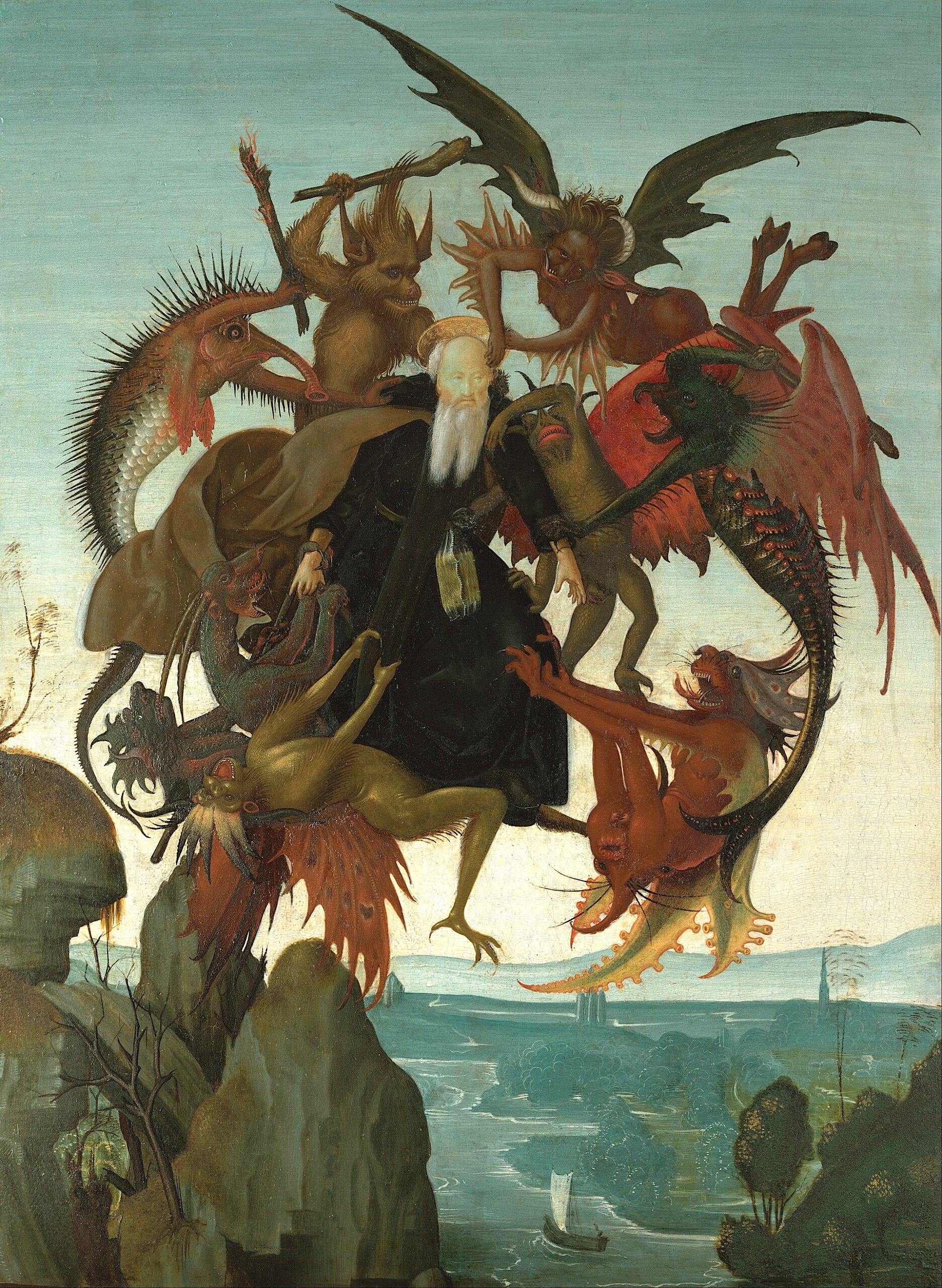
https://en.wikipedia.org/wiki/File:Michelangelo_Buonarroti_-...
I've cropped that little blue sailing ship at the bottom of the canvas to male a wallpaper.
Edit: the butthole is in the original engraving his painting is based on, so not his own vision, fortunately I guess.
https://en.wikipedia.org/wiki/The_Temptation_of_St_Anthony_(...
This painting makes me feel like the bible was pretty much a comic book to the adolescent Michelangelo, and I like that thought. He later went on to paint the ceiling of a huge temple dedicated to his equivalent of Charles Xavier.
I bet that felt pretty cool for him =)
as the others said Michelangelo hated doing that painting. He's a very tragic, albeit heroic to me, man. I'd recommend that book if you're at all fascinated by him.
Edit: as below a more famous and earlier St Anthony was indeed much closer to the time of the gospels
https://www.dutchfinepaintings.com/michelangelos-sistine-cha...
I could believe even quite a bit younger, there are some wildly talented children and it's easy to believe Michaelangelo to have been one.
Why? There were other talented people who produced masterful works at an early age. From the same time as this there's a Dürer self-portrait, also aged 12-13:
https://en.wikipedia.org/wiki/Self-Portrait_at_the_Age_of_13
> We don't have any really reliable records from that time.
Uh, no. There's no documented attribution of that painting to Michelangelo; that doesn't mean that other things weren't reliably recorded.
Source: know how to draw really well.
It is frustrating that the article is so coy about the evidence around the premise of the article! But, this website and the youtube video this article is based around both lean more towards pop than investigative.
Still impressive of course, but remember that it's not straightforward to compare how things are today with other time periods.
All of that misses the forest for the trees, which is he did it at an incredibly young age!
[1] Given the level of pedantry on this site, I suppose I should say "almost anyone", since a small minority of people with severe disabilities may not be able to.
I won’t argue about the obviousness as that’s a tarpit of comparing each others social circles, but let say it’s reasonable to assuming this wasn’t his first ever brush stroke to touch canvas.
Michelangelo would go on to find his first patron, a Cardinal named Raffaele Riario, by forging a sculpture and artificially aging it (which, back then, was a conventional practice to demonstrate expertise and skill: https://www.atlasobscura.com/articles/how-a-forged-sculpture...)
Dishonesty aside, both stories are reminders that there's a power to doing stuff with your own two hands (not genning it), as well as not to let today's emphasis on originality take away from using imitation/transcription to practice your craft: https://herbertlui.net/in-defense-of-copycats/
So he was re-rendering a religious folk story.
On the subject of the content, in actual seriousness, this was a pre-modern, pre-secularized age before the traditionally religious was privatized and viewed as some kind of optional quirky fantasy for adults, subject to taste, one as good as the other. So, moral instruction would have been more overt and crisp, and the subject matter prominent in public. The challenges and difficulties of the moral life would have been taught and spoken of more openly.
I know the OP is joking, but this would be no cause for alarm, as the image is noble in its content. It depicts St. Anthony's triumph over the demonic. It does not glorify the demonic or debase the good.
In this context, Man's fallen state predisposes him toward sin. He is tempted to do things he should not and knows he should not. Add to that the malice and opportunism of the fallen angels - the demons - who, while on a short divine leash, nonetheless can exploit the weaknesses and evil in men to lead them toward their doom. The image would then be received as quite inspiring, perhaps helping to inspire and concentrate the viewer's own efforts to resist temptation, combat evil, and to progress on his own journey of conquering the self.
It’s wild that someone could be that good that young.
Or the massive chemical swings we self-induce, and how those might tear at (or help??) our soul?
https://en.wikipedia.org/wiki/The_Temptation_of_St_Anthony_(...
"pentimenti, or correction marks, a common indication that “a painting is not a copy, but an original work created with artistic freedom.”"
How often are they analyzing copies made by 12 year old. Is a 12 year old more likely to have made errors or drifted from the source during the process of the copy? Could the corrections be attempts to bring the painting closer to its source, because it wasnt close enough?
The remarkable thing about the early painting/symphonies isn't the absolute quality of the work, it's that they showcase the artists' intrinsic baseline talents, which they would then leverage as their skills improved with maturity to become some of the greatest artists of all time.
In 1946, 11 surrealist painters were asked to submit a painting to be used in a film (Albert Lewin's "The Private Affairs of Bel Ami"). Among the contestants were Max Ernst (who won), Leonora Carrington, Dalì, Stanley Spencer, Dorothea Tanning. Among the judges was Marcel Duchamp. The painting is then shown in color - the only color scene in an otherwise black and white movie.
I think the reason why they specifically wanted the temptation of Saint Anthony had to do with censorship, but sadly I can't remember the details
There have always been wolf-in-sheep’s-clothing stories about The Devil too, it’s just a separate category.
Teenage boys love badass, edgy stuff. And what's badass and edgy in Catholicism? Demons! As for the art style, it is the style that was popular at the time.
In a sense, it is not so different from today's kids drawing scenes inspired from their favorite comic. Of course, the painting here shows incredible talent, he is Michelangelo after all, but that doesn't make him less of a kid.
Articles like this contribute towards the gatekeeping feeling people get about the arts in my opinion.
Sorry, that's like saying with enough math practice, any kid could perform at the level of young Terry Tao (e.g. teaching himself calculus at 8, winning a gold medal at the International Math Olympiad at 12). Some people are just intrinsically talented at certain things, and no amount of hard work in people lacking those intrinsic talents will get them to that level. This is indisputable when it comes to athletic talent; everyone would agree that no matter how much an average tall person practices basketball, they will never play at the level of Michael Jordan, LeBron James, or even the lowest ranked NBA player [0], for that matter. Artistic and intellectual talent is no different.
[0] https://old.reddit.com/r/todayilearned/comments/1oxpng5/til_...
Without anyone wanting to buy this and spend resources on that, finding claims to proof the contrary might be a quite futile task.
The whole board of the Museum is non-experts. Nobody has any interest in devaluing that expense.
In that era even attributing works definively to a single artist and not a school or workshop just feels a bit off.
https://kimbellart.org/content/nuestro-kimbell
absurdly well citing reddit comment on the provenance:
https://www.reddit.com/r/museum/comments/x6k3mm/comment/in89...
Either that or genius has coincidentally clustered around where the resources have been.
The world could be so much more vibrant if everyone was supported and nurtured.
In such a world, many might find much less need to distract themselves with trivialities.
Even with people like Beethoven who're seen as disruptors and wildly popular by general audiences there were talented disruptors at the time who actually did things he's 'known' for and they don't get played at all. Bach himself had largely fallen into obscurity for +-100 years. There's probably only so many Michelangelos or Mozarts people can be taught about in middle school, high school, university.... I believe it's more about the institutions that basically allowed someone like mozart or michelangelo some kinda 'patronage oligopoly', something which barely exists these days. Free market didn't really exist here well into the 1800s, even then you still had gatekeepers. In the end history picked a few winners very loosely related to their 'musical worth'.
It's like that quote about it taking Picasso 4 years to learn to paint like Raphael but a lifetime to learn how to paint like a child.
Or think of it this way: Your average math PhD today is way better at math than Galois, Bernoulli, Gauss, etc. But they are nowhere near them because the field moved into a different stratosphere entirely.
Movies, video games, music.