There’s also a lot of repetition. Maybe it was AI generated…?
I remember coming across an article from NYCMesh which looked interesting ("Administrating the Mesh" - https://www.nycmesh.net/blog/datadog/) which made sense all the way until they put Datadog on top of everything, and I asked myself:
> What the hell, how is using a centralized service for managing a decentralized mesh a suitable solution? Did the author get employed by Datadog or what happened?
Then I got curious and lo and behold; the author was indeed hired by Datadog (and still works there AFAIK), effectively compromising the entire article and the project itself, because of their new employer.
Idle transactions have been a huge footgun at $DAYJOB… our code base is full of “connect, start a transaction, do work, if successful, commit.” It means you’re consuming a connection slot for all work, even while you’re not using the database, and not releasing it until you’re done. We had to bump the Postgres connection limits by an order of magnitude, multiple times, and before you know it Postgres takes up more RAM than anything else just to support the number of connections we need.
The problem permeated enough of our (rust) codebase that I had to come up with a compile time check that makes sure you’re not awaiting any async functions while a Postgres connection is in your scope. Using the .await keyword on an async function call, but not passing the pg connection to that function, ends up being a nearly perfect proxy for “doing unrelated work while not releasing a connection”. It worked extremely well, the compiler now just straight up tells us where we’re doing it wrong (in 100+ places in fact.)
Actually getting away from that pattern has been the hard part, but we’re almost rid of every place we’re doing it, and I can now run with a 32-connection pool in load testing instead of a 10,000 connection pool and there’s no real slowdowns. (Not that we’d go that low in production but it’s nice to know we can!)
Just decreasing the timeout for idle transactions would have probably been the backup option, but some of the code that holds long transactions is very rarely hit, and it would have taken a lot of testing to eliminate all of it if we didn’t have the static check.
If the codebase is large, and full of that kind of pattern (interleaving db writes with other work), the compiler plugin is nice for (a) giving you a TODO list of all the places you’re doing it wrong, and (b) preventing any new code from doing this while you’re fixing all the existing cases.
One idea was to bulk-replace everything so that we pass a reference to the pool itself around, instead of a checked-out connection/transaction, and then we would only use a connection for each query on-demand, but that’s dangerous… some of these functions are doing writes, and you may be relying on transaction rollback behavior if something fails. So if you were doing 3 pieces of “work” with a single db transaction before, and the third one failed, the transaction was getting rolled back for all 3. But if you split that into 3 different short-lived connections, now only the last of the 3 db operations is rolled back. So you can’t just find/replace, you need to go through and consider how to re-order the code so that the database calls happen “logically last”, but are still grouped together into a single transaction as before, to avoid subtle consistency bugs.
> It may sound surprising that a single-primary architecture can meet the demands of OpenAI’s scale; however, making this work in practice isn’t simple.
And it also says that this approach has cornered them into a solution that isn't trivial to change. They now use different database deployments (the single primary one that is the focus of the post and *multiple* other systems, such as Azure CosmosDB, to which some of the write traffic is being directed).
> To mitigate these limitations and reduce write pressure, we’ve migrated, and continue to migrate, shardable (i.e. workloads that can be horizontally partitioned), write-heavy workloads to sharded systems such as Azure Cosmos DB, optimising application logic to minimise unnecessary writes. We also no longer allow adding new tables to the current PostgreSQL deployment. New workloads default to the sharded systems.
I wonder how easy it is for developers to maintain and evolve this solution of miscellaneous database systems.
So yes, you can go far with a single primary, but you can also potentially never easily get away from it.
Quite possibly they would have been better off staying purely postgres but with sharing. But impossible to know.
This would be a particularly nice-to-have feature for Postgres - the option to have heavyweight locks just proactively cancel any conflicting workload. For any case where you have a high-throughput table, the damage of the heavyweight lock sitting there waiting (and blocking all new traffic) is generally much larger than just cancelling some running transactions.
There's nothing novel about optimizing queries, sharding and using read replicas.
For that reason, I find it actually bold that they disclosed it, and I appreciate it.
The article reminded me of a similar post about MySQL use for Facebook from the Meta team, which had the same message: big database servers are powerful workhorses that scale and are very cost-effective (and simpler to manage than distributed setups where writes need be to carefully orchestrated - a very hard task).
The two core mesages of both articles combined could be read as: 1. big DB servers are your friend and 2. keep it simple, unless you can't avoid the extra complexity any more.
> The primary rationale is that sharding existing application workloads would be highly complex and time-consuming, requiring changes to hundreds of application endpoints and potentially taking months or even years
On one hand OAI sell coding agents and constantly hype how easy it will replace developers and most of the code written is by agents, on the other hand they claim it will take years to refactor
Both cannot be true at the same time.
But how would any of that change by going outside Postgres itself to begin with? That's the part that doesn't make much sense to me.
Ie. if you shard by userId, then a "share" feature which allows a user to share data with another user by having a "SharedDocuments" table cannot be consistent.
That in turn means you're probably going to have to rewrite the application to handle cases like a shared document having one or other user attached to it disappear or reappear. There are loads of bugs that can happen with weak consistency like this, and at scale every very rare bug is going to happen and need dealing with.
Not necessarily? You can have two-phase commit for cross-shard writes, which ought to be rare anyway.
Other clients (readers) have to be able to deal with inconsistencies in the meantime.
Also, 2PC in postgres is incompatible with temporary tables, which rules out use with longrunning batch analysis jobs which might use temporary tables for intermediate work and then save results. Eg. "We want to send this marketing campaign to the top 10% of users" doesn't work with the naive approach.
If you're having trouble there then a proxy "layer" between your application and the sharded database makes sense, meaning your application still keeps its naieve understanding of the data (as it should) and the proxy/database access layer handles that messiness... shirley
Can you, though? OpenAI is haemorrhaging money like it is going out of style and, according to the news cycle over the last couple of days, will likely to be bankrupt by 2027.
You suddenly have literally thousands of internal users of a datastore, and "We want to shard by userId, nobody please don't do joins on user Id anymore" becomes an impossible ask.
I don't really get the point here. What is novel and great? It feels they followed the first " how to scale pg" article.
I think they handled the massive growth by a lot of 2am emergencies and editing config files directly in production in the hope of fixing fires.
> We added nearly 50 read replicas, while keeping replication lag near zero
I wonder what those replication lag numbers are exactly and how they deal with stragglers. It seems likely that at any given moment at least one of the 50 read replicas may be lagging cuz CPU/mem usage spike. Then presumably that would slow down the primary since it has to wait for the TCP acks before sending more of the WAL.
Other than keeping around more WAL segments not sure why it would slow down the primary?
You could use asynchronous WAL shipping, where the WAL files are uploaded to an object store (S3 / Azure Blob) and the streaming connections are only used to signal the position of WAL head to the replicas. The replicas will then fetch the WAL files from the object store and replay them independently. This is what wall-g does, for a real life example.
The tradeoffs when using that mechanism are pretty funky, though. For one, the strategy imposes a hard lower bound to replication delay because even the happy path is now "primary writes WAL file; primary updates WAL head position; primary uploads WAL file to object store; replica downloads WAL file from object store; replica replays WAL file". In case of unhappy write bursts the delay can go up significantly. You are also subject to any object store and/or API rate limits. The setup makes replication delays slightly more complex to monitor for, but for a competent engineering team that shouldn't be an issue.
But it is rather hilarious (in retrospect only) when an object store performance degdaration takes all your replicas effectively offline and the readers fail over to getting their up-to-date data from the single primary.
I'd like to know more, since I don't understand how this could happen. When you say "block", what do you mean exactly?
So it is not really scaling too much now, rather maintaining current state of things and new features go to a different DB?
This is however the most down to earth: How we scale Postgresql I've read in a long time. No weird hacker, no messing around with the source code or tweaking the Linux kernel. Running on Azure Postgresql it's not like OpenAI have those options anyway, but still it seems a lot more relatable than: We wrote our own drive/filesystem/database-hack in Javascript.
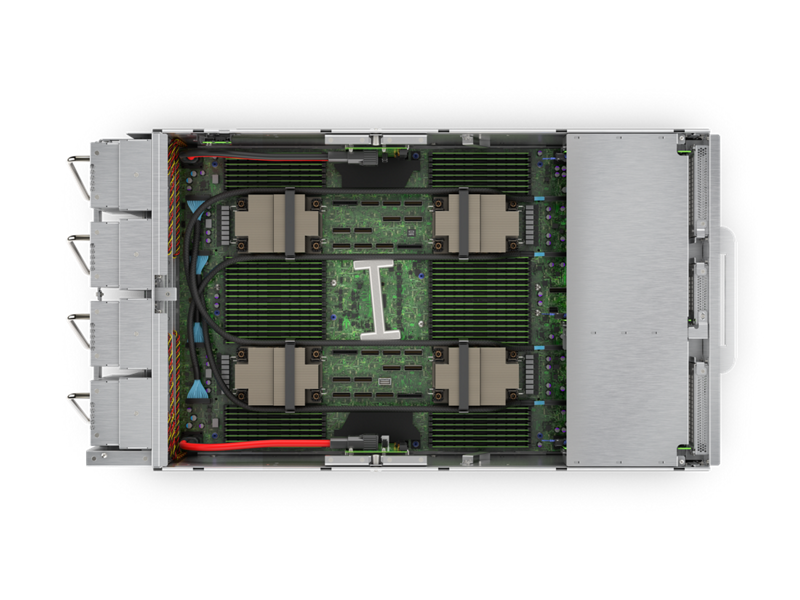
I always wondered what kind of instance companies at that level of scalability are using. Anyone here have some ideas? How much cpu/ram? Do they use the same instance types available to everyone, or does AWS and co offer custom hardware for these big customers?
For example, Azure Standard_E192ibds_v6 is 96 cores with 1.8 TB of memory and 10 TB of local SSD storage with 3 million IOPS.
Past those "general purpose" VMs you get the enormous machines with 8, 16, or even 32 sockets.[1] These are almost exclusively used for SAP HANA in-memory databases or similar ERP workloads.
Azure Standard_M896ixds_24_v3 provides 896 cores, 32 TB of memory, and 185 Gbps Ethernet networking. This is generally available, but you have to allocate the quota through a support ticket and you may have to wait and/or get your finances "approved" by Microsoft. Something like this will set you back [edited] $175K per month[/edited]. (I suspect OpenAI is getting a huge effective discount.)
Personally, I'm a fan of "off label" use of the High Performance Compute (HPC) sizes[2] for database servers.
The Standard_HX176rs HPC VM size gives you 176 cores and 1.4 TB of memory. That's similar to the E-series VM above, but with a higher compute-to-memory ratio. The memory throughput is also way better because it has some HBM chips for L3 (or L4?) cache. In my benchmarks it absolutely smoked the general-purpose VMs at a similar price point.
[1] https://learn.microsoft.com/en-us/azure/virtual-machines/siz...
[2] https://learn.microsoft.com/en-us/azure/virtual-machines/siz...
lol, no, cloud is nowhere near that good value. It’s $3.5M annually.
> The Standard_HX176rs HPC VM size gives you 176 cores and 1.4 TB of memory
This one is $124k per year.
I noticed that the M896i is so obscure and rarely used that there are typos associated with it everywhere including the official docs! In once place is says it has 23 TB of memory when it actually has 32 TB.
https://docs.aws.amazon.com/sap/latest/general/sap-hana-aws-...
That AWS instance uses these 60-core processors: https://www.intel.com/content/www/us/en/products/sku/231747/...
To anyone wondering about these huge memory systems: avoid them if at all possible! Only ever use these if you absolutely must.
For one, these systems have specialised parts that are more expensive per unit compute: $283 per CPU core instead of something like $85 for a current-gen AMD EPYC, which are also about 2x as fast as the older Intel Scalable Xeons that need to go into this chassis! So the cost efficiency ratio is something like 6:1 in favour of AMD processors. (The cost of the single large host system vs multiple smaller ones can get complicated.)
The second effect is that 32-way systems have huge inter-processor cache synchronisation overheads. Only very carefully coded software can scale to use thousands of cores without absolutely drowning in cache line invalidations.
At these scales you're almost always better off scaling out "medium" sized boxes. A single writer and multiple read-only secondary replicas will take you very far, up to hundreds of gigabits of aggregate database traffic.
Multiple of these can be linked together with “NUMALink” cables, which carry the same protocol as the traces that go between sockets on the motherboard. You end up with a single kernel running across multiple chassis.
The main point of the article is that it's actually not that hard to live with a single primary Postgres for your transactional workloads (emphasis on _transactional_), and if OpenAI with their 800M+ users can still survive on a single primary (with 50(!) read replicas), so could you, especially before you've reached your first 100M users.
Any non-distributed database or setup is orders of magnitude easier to design for, and it's also typically much more cost efficient too, both in terms of hardware and software too.
There are some curious details, e.g.:
- you can ship WAL to 50 read replicas simultaneously from a single primary and be fine - you can even be using an ORM and still get decent performance - schema changes are possible, and you can just cancel a slow ALTER to prevent production impact - pgbouncer is ok even for OpenAI scale
There are so many things that contradict current "conventional wisdom" based on the experience from what was possible with the hardware 10+ (or even 20+) years ago. Times finally changed and I really welcome articles like these that show how you can greatly simplify your production setup by leveraging the modern hardware.
Months passed by since this application was developed (a simple Phoenix/Elixir backend), and yesterday I was casually checking my database to see how many rows it had - about 500,000+ roughly. I didn't notice a single hint of the volume the Postgres was handling, granted - I'm the only user, but there's always a lot going on - RAG, mostly that requires searching of the database for context before multiple agents send you a response (and respond amongst themselves). Absolutely zero performance degradation.
I'm convinced that Postgres is a killer database that doesn't get the attention it deserves over the others (for chat). Already managing some high traffic websites (with over 500M+ requests) with no issues, so I am extremely unsurprised that it works really well for chat apps at scale too.
Honestly, only us nerds in Hacker News care about this kind of stuff :) (and that's why I love it here).
edit: also, the article cites OpenAI did adopt Azure Cosmos DB for new stuff they want to shard. Still shows how far you can take PostgreSQL though.
How do they store all the other stuff related to operating the service? This must be a combination of several components? (yes, including some massdata storage, Id guess?)
This would be cool to understand, as Ive absolutely no idea how this is done (and could be done :-)
If you treat Postgres strictly as a Key-Value store for transactional integrity, it flies. But if you try to run complex discovery or tsvector search on that same primary, the locking/CPU load kills it instantly.
The real hero here is aggressive segregation: keep Postgres for 'Truth', and offload all discovery to specialized indices that don't block the write-head.
I wonder, is there another popular OLTP database solution that does this better?
> For write traffic, we’ve migrated shardable, write-heavy workloads to sharded systems such as Azure CosmosDB.
> Although PostgreSQL scales well for our read-heavy workloads, we still encounter challenges during periods of high write traffic. This is largely due to PostgreSQL’s multiversion concurrency control (MVCC) implementation, which makes it less efficient for write-heavy workloads. For example, when a query updates a tuple or even a single field, the entire row is copied to create a new version. Under heavy write loads, this results in significant write amplification. It also increases read amplification, since queries must scan through multiple tuple versions (dead tuples) to retrieve the latest one. MVCC introduces additional challenges such as table and index bloat, increased index maintenance overhead, and complex autovacuum tuning.
So, this is the part that actually made me left wondering why.
When did you get your results, might be time to re-evaluate.
.
> Author Bohan Zhang
> Acknowledgements Special thanks to Jon Lee, Sicheng Liu, Chaomin Yu, and Chenglong Hao, who contributed to this post, and to the entire team that helped scale PostgreSQL. We’d also like to thank the Azure PostgreSQL team for their strong partnership.
e: and the link points to en-us at time of writing. I frankly don't see the value in your comment.
I'm not sure that's the answer people are looking for.
Sure, but choosing from the start a DB that can scale with ease would have taken far less time and effort.
You can bend any software into doing anything, but is it worth it?
if there is a read replica that has reached required snapshot - it is usually enough (depends on your task of course) for it to be the snapshot that was at the start of your transaction - and if the read query doesn't need to read your transaction uncommitted data, then that replica can serve the read query.
/s