Japan and America have now both gotten TSMC to commit to a decent level of domestic advanced-node fabrication.

Meanwhile Europe only got 40k WSPMs of 12+ nm capacity: https://overclock3d.net/news/software/bringing_advanced_semi...

Germany squandered so much money on nonsense, when they could have simply driven the few kilometers over to Eindhoven and bought an ASML machine for "Silicon Saxony". Sure, it would have taken years and years and serious commitment by the government and private sector to make that a successful move. But instead of putting in the hard work with a clear vision for the future, we mostly spend our time whining and wailing. It's a shame.
  • jorvi
  • ·
  • 2 hours ago
  • ·
  • [ - ]
High-end chips should be more of a EU concerted effort rather than every country for itself.

The problem is that unlike Airbus, which (highly inefficiently) can be made in multiple countries, you can't really spread out parts of a fab that way. The most you can do is fab machines + chips + chip packaging. Netherlands already has fab machines and in packaging there isn't a high margin.

That leaves chips, and you can be sure that whoever gets the fabs, the other EU countries will throw a shit fit and demand counter investments to compensate. And on top of that there is also regional animosity. So even if it makes logical sense to pop the fab down in the middle of the blue banana, it won't make political sense because France and all of South and East EU will be angry about "the rich getting richer".

>High-end chips should be more of a EU concerted effort rather than every country for itself.

And how are we gonna do that exactly? EU runs on national interests of those footing the bill, mainly France and Germany as the largest net contributors.

When you're relying on national subsidies to build and run a factory and adjacent infrastructure in a country, you're tied to national interests and demands of those countries footing the bill for all that infrastructure.

So the likes of France and Germany aren't gonna give billions in subsidies from their taxpayers' money to semiconductor companies so that they can incorporate in Netherlands to dodge taxes and then create jobs in low-cost Poland and Romania instead of at home, even though that's already been happening to an extent in other industries over the last 20+ years.

It's the same with arms purchases now. France blocked Ukraine from using its money to buy British made weapons that are already available, since it expects that money to go back into the French economy, not to the economy of a competitor, even if the much needed weapons will arrive much later.

Yeah I know, UK isn't EU anymore, but the point still stands, as EU nations are still economically competitors to each other and they're not gonna spend their tax money to fund competing economies even in the EU block.

  • ido
  • ·
  • 20 minutes ago
  • ·
  • [ - ]
The solution is to make the EU more like an actual unified economic and monitary union- with a central fiscal authority, unified public debt, all member states joining the Eurozone, unified tax system, etc.
So in your opinion, to fix this, national serenity should be abolished and the EU should have the liberty, nay, the authority to fleece its highest payers into the system, like France and Germany, and then redistribute their money to others as it sees fit, for the the greater good of the union, with no obligation to provide them proportional benefits in return?

How is this not communist tyranny with extra steps?

> How is this not communist tyranny with extra steps?

Isn’t this exactly how the United States and every other country works?

Firstly, NO, the US is a country, the EU is not.

Secondly, even if the US as a country is more integrated than the EU as a union, the US is not a successful model example of a well functioning country people in the EU would aspire to emulate.

Most likely French people would prefer living in a country resembling France and their values and being accountable to them, rather than ceding money and control to a higher authority they can't directly control.

  • ffsm8
  • ·
  • 36 minutes ago
  • ·
  • [ - ]
> Yeah I know, UK isn't EU anymore, but the point still stands, as EU nations are still economically competitors to each other and they're not gonna spend their tax money to fund competing economies even in the EU block.

Uh, no the point doesn't stand anymore if your example isn't actually a reflection of it - at least not anymore then any other unfounded opinion pieces with no collaborating evidence

>Uh, no the point doesn't stand anymore if your example isn't actually a reflection of it

What part of my original statement you quoted

   "EU nations are still economically competitors to each other and they're not gonna spend their tax money to fund competing economies even in the EU block"
do you think does not stand anymore and why?

>unfounded opinion pieces with no collaborating evidence

Maybe reading comprehension or understanding of international politics within the EU is not your strength, but I gave you the evidence and arguments in the comment you quoted. Maybe you don't like to hear what I said, but that's another thing entirely.

Specialization takes away a lot of the competitive pressure.
  • whstl
  • ·
  • 18 minutes ago
  • ·
  • [ - ]
Good point, but gotta remember that people don't buy chips, they buy products. There's plenty of stuff to be produced. From components to PCBs to casing to packaging.

China didn't become the manufacturing giant it is because of a single product, they did because the whole supply chain was moving there while the EU and US were only concerned about higher-margin products and activities.

I'm sure some town in Italy wishes it was still the world's #1 diode manufacturer or something.

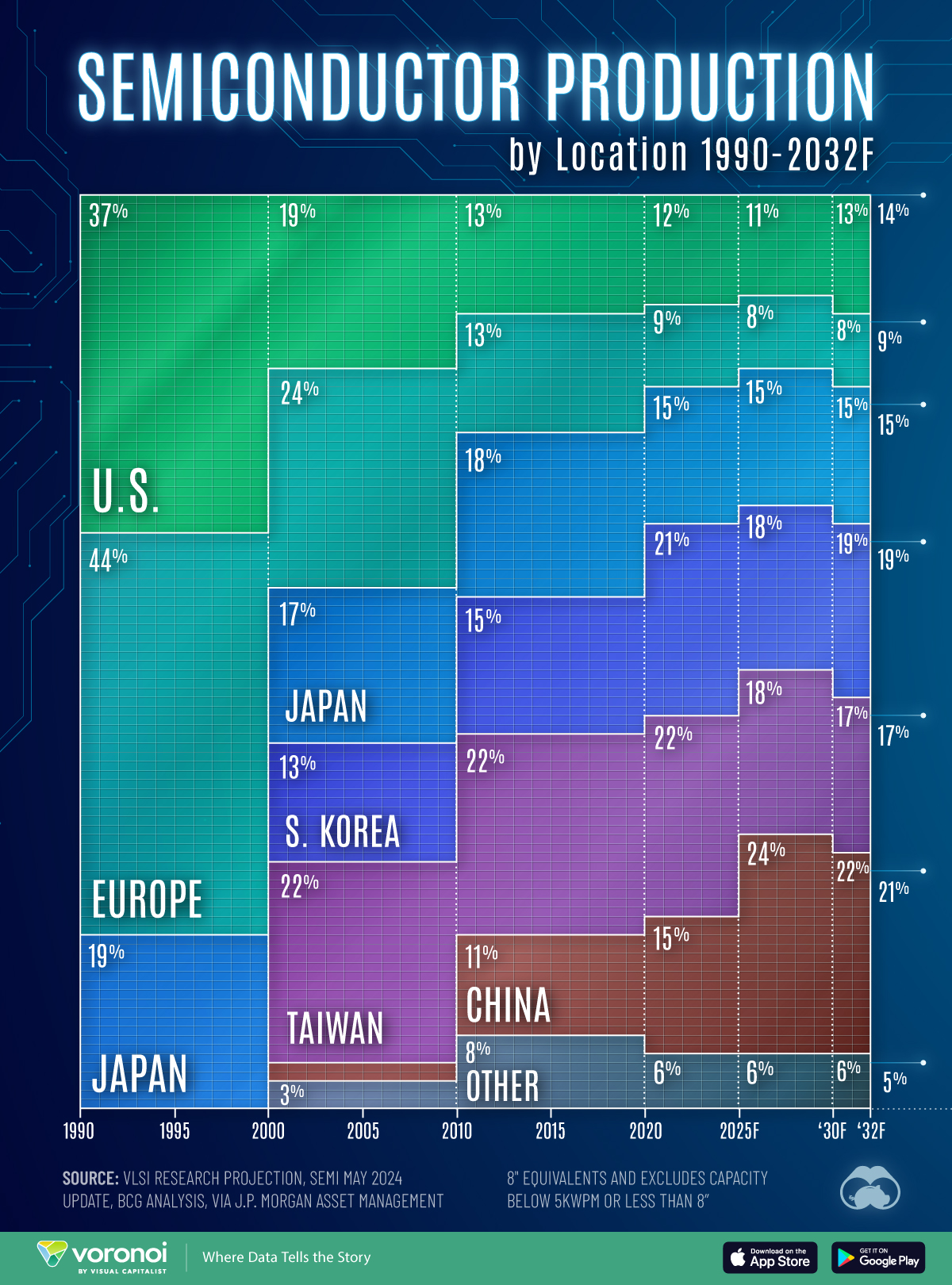
That seems a bit too simple. I saw one particular graph [0] once that really stuck with me illustrating just how decisively Europe was ejected from the semiconductor market. It takes more than just inaction to achieve results like that. In many ways it could be called an impressive feat that only the Europeans could achieve. 44% of production to 9% - losing a steady 1% of the market every year, largest to smallest player. No other region is even in a position to do that badly even if they tried.

[0] https://www.visualcapitalist.com/wp-content/uploads/2025/01/...

  • IsTom
  • ·
  • 18 minutes ago
  • ·
  • [ - ]
I wonder what that would look like on an absolute scale instead of relative %. Might be that just the market grew really big, really fast.
I think it can just take inaction, because it's a market that moves so fast and requires constant enormous investment to keep up.

If you just do nothing within half a decade or so you'll be far behind the cutting edge and at that point the decline gains its own momentum

  • roenxi
  • ·
  • 3 minutes ago
  • ·
  • [ - ]
It is possible. But that seems out of character for the Europeans, they're pretty consistent about going the distance to make absolutely sure that the next new thing doesn't happen in Europe.

It seems much more likely they had a suite of environmental, social and trade policies carefully calibrated to move semiconductor manufacturing somewhere else.

  • simgt
  • ·
  • 53 minutes ago
  • ·
  • [ - ]
Wow, I had no idea. Thanks for sharing!
Cultural failure on a massive scale
>when they could have simply driven the few kilometers over to Eindhoven and bought an ASML machine for "Silicon Saxony"

That's not at all how it works. You're talking as if you're buying a plug-and-play Xerox copy machine that you can just unbox and start printing copies of your work and make money.

Buying the latest EUV machines doesn't get you the latest nodes and economically viable yields.

Intel, Samsung also have the latest ASML machines that TSMC has and yet they haven't caught up to TSMC because there's a lot more to semi manufacturing that just the machine itself.

If Germany just buys an ASML machine it would be an expensive paperweight without the process know-how that engineers at TSMC have amassed over the decades in order to get the most economically competitive yields.

  • i5heu
  • ·
  • 1 hour ago
  • ·
  • [ - ]
It is so absurd to think that an investment in even the most uncompetitive fab while one has currently none is uneconomical.

Even if this fab is 3 times more expensive then other ones, the result of not having one will tank the entire economy and GDP of a nation if things go bad.

We speak here about trillions of damage while a fab costs only a few billions.

This is like a complete non brainer.

> Even if this fab is 3 times more expensive then other ones, the result of not having one will tank the entire economy and GDP of a nation if things go bad.

That's hogwash. Sorry. Human society won't simply stop working just due to the lack of 2nm chips.

There are plenty of chip manufacturers around the world, including EU ones. Taiwan only has the quasi-monopoly over the cutting edge process.

>while one has currently none

What are you talking about? There's a lot of fabs in Europe, just on much older nodes than Taiwan, US and Japan or even China have.

>We speak here about trillions of damage

Where did you get the trillions from?

>a fab costs only a few billions

Billions just to build, but then who's gonna foot the bill for running it, if the fab is not economically competitive to those from Taiwan and Japan, at EU domestic wages, EU environmental regulations and lacking knowhow supply chains that needs to be built up in the EU? The taxpayers again?

The German government (meaning the taxpayers) are still subsidizing energy costs to keep manufacturing from collapsing or leaving the country altogether because it's not internationally competitive anymore.

So how much more of the private sector should the taxpayers subsidize before we take a look at ourselves in the mirror that everything is FUBAR and that endless taxpayer funded subsidies(aka corporate welfare) are just disguising the endemic rot while not actually fixing the problem?

The only forward facing government that actually had a drive to change anything useful for the future broke apart with internal squabbles, with a big part of it by the market liberals torpedoing things left and right. And now we're back to a government of stand still, like we did the almost two decades before.

We get what we deserve.

Not sure what you're talking about. The last "forward facing" government was about 50y ago, the last one at least driving meaningful reforms almost 25y ago. To me it seems the more Europe got integrated, the more Germany lost the plot.
This standstill mostly started happening when the capitalism took hold too deep and wide, look at Sweden and its golden age that lasted until all the restrictions on capitalism were silently removed.

While capitalism is a good model, it needs to be kept balanced, restricted..

Shareholder primacy is ruining everything, too much influence in politics from too many external sources.

  • 15155
  • ·
  • 2 hours ago
  • ·
  • [ - ]
Who knew that forcing 'green everything, at all costs' and importing millions of unskilled people who don't share your values might not work.
If every time you’re shown an inkblot you see right wing talking points materialize in front of your eyes, it may be time to take a break from social media.
If you think net zero’s failures are a right wing talking point it might be you failing the Rorschach test
Bringing up net zero in a thread about semiconductor manufacturing is a complete non sequitur. Fabs run on electricity which is quite easy produce without emitting any CO2.
  • ·
  • 1 hour ago
  • ·
  • [ - ]
>Meanwhile Europe only got 40k WSPMs of 12+ nm capacity

EU leaders and VCs gave up on the electronics industry 20+ years ago and just kept offshoring it to the cheapest suppliers to lower costs and increase shareholder value.

You can validate this by looking at which sectors pay the highest EU wages and you'll see that hardware and electronics are not in the top.

  • chvid
  • ·
  • 2 hours ago
  • ·
  • [ - ]
ASML and its mostly European suppliers is still the key chokepoint that prevents highend semiconductor fabrication from moving to China.
If Trump was European he would have long ago said “i only allow export of ASML machines if openai/nvidia/tsmc build 5gw urgently here in Europe with advanced nodes”. Fair if you ask me tbh
Except China has fabs on smaller nodes than Europe, so why can't Europe?
Taiwanese politicians, like those under American-style democracy in many regions, only care about safeguarding their own interests and have no concern for how to protect the interests of the public. Once TSMC’s factories are completed in Japan and the United States and the technology is secured, Taiwan will no longer have any value worth protecting. Of course, the politicians can always take planes and leave in advance.
Right now is an AI goldrush. They can get crazy lucrative investments and lock in amazing deals. In a decade the Chinese tech will catch up and the AI boom will slow down and the Taiwanese will have to coast on what they have. They have to capitalize on this moment as much as they can b/c it's not going to last long. Things are going to get much tougher very soon
If there aren't significant changes in the trajectory of world politics the people in charge might just be planning their exit to the fabs they're building in Japan and the US.
TSMC can shut the fabs down whenever they want. If the US think they can take over a fab like it's a t-shirt factory and keep it running without TSMC's cooperation they are sorely mistaken. What are you going to do when none of the Taiwanese workers turn up for work, or worse they do turn up and sabotage the fab.
Of course you’re right, but it’s a hell of a lot easier than when the fabs are located exclusively in Taiwan.
Not necessarily. If TSMC doesn’t build these fabs in Japan or USA, these governments might just mandate that chips are manufactured elsewhere. Intel could have a big comeback.

This keeps ppl locked in to the TSMC universe. The Japan and US fabs produce just a fraction of what these countries need.

More so a damage control move. In the eventuality Taiwan, and its factually on Chinese land production sites get affected, it won't affect as much the supply chain as it otherwise would.

The U.S and Japan indeed will have less incentive to defend the sovereignty of Taiwan, but other reasons remain to ensure the statu quo remains. Purely geopolitical, not just industrial.

The US protected Taiwanese sovereignty for decades before they even had a single semiconductor fab. This idea of "the silicon shield" just shows a complete ignorance of the history of Taiwan and its place in the geopolitical order.
  • mayama
  • ·
  • 21 minutes ago
  • ·
  • [ - ]
Decades in which China started as peasant army(US admin view) and wasn't mostly a peer adversity. But, that changed almost a decade ago and defending Taiwan will become more costly and time passes. New American security document, mostly focusing on America, even acknowledges this.
The US historically did not threaten military action against NATO allied nations as well.

The past is of no value in predicting the future right now.

  • gexla
  • ·
  • 2 hours ago
  • ·
  • [ - ]
I would argue the chips don't even matter (important, but not as a reason for defending Taiwan.) It's a strategically important location that is a stone's throw from Japanese islands. If Japan feels the need, then nukes may be on the table. If that were to happen, S. Korea may not be far behind. And the cycle spirals.
[dead]
Pretty clear these days that the bottlenecks in technology manufacturing are now weaponising their monopolies/duopolies / triopolies.

They’ve become the trolls under the bridge and will squeeze every passerby for every dollar they’ve got.

The days of cheap computing have been in decline and are now dead, replaced with giga profits for this companies who managed to the the indispensable links in a chain with no or minimal competition.

Not surprising from the fact that Taiwanese like Japan
A fact that is itself quite surprising, if you think about it.
Isn’t Japan even more earthquake prone than Taiwan? Is that a good idea for the most sensitive electronics known to man?
I was going to ask if TSMC just have some weird earthquake fetish.

Realistically it's probably just that Japan is politically stable and safer than the other options in the area, while remaining fairly close to the rest of the supply chain.

Isn’t this an erosion of the silicon shield Taiwan is protected by? If they make semiconductors everywhere else then the world has less economic incentive to protect Taiwan from war.
  • typ
  • ·
  • 2 hours ago
  • ·
  • [ - ]
The silicon shield became a slogan that has only been popularized in recent years. The potential crisis of war has been there for more than half a century (even before semiconductors became a thing). The real value proposition of the status quo is the freedom of navigation between the northeastern Asian countries and the SEA (the Strait of Malacca, aka the lifeline of energy imports), and the consequential domino effect of the entire western Pacific.

Also, not sure why everyone forgets about it. People should have learned from the experience of the pandemic that the cutting-edge foundry nodes are not really the crucial ones, as being the bottleneck of industrial infrastructure. A delay of the next-gen iPhone or RTX gaming card isn't that catastrophic. But a shortage of embedded MCUs, which are actually fabricated by mature nodes, could stall the entire industrial base of a country.

The world won’t allow a dependence on a single geopolitically threatened entity in the long run, so either they defuse that risk themselves or risk a competitor filling that role. This move is better for TSMC itself.
Seems likely that Takaichi has given Taiwan a Japanese security guarantee. [1] This may be a quid pro quo.

[1] https://www.youtube.com/shorts/p-4nFgs9fRE

She didn't give a security guarantee. And even if she wanted she can't.

Japan can't even sell arms to Taiwan right now. Even starting selling arms would be a huge change, let alone a mutual defensive pact.

It's extremely hard to change the constitution of Japan. It's the only constitution that has never been revised since WWII. LDP has been pushing this agenda for decades and nothing really happened.

Japan's foreign policy about Taiwan includes the notion that an attack on Taiwan is an "existential threat" to Japan, enabling a constitutional reasonning for a war in such a case.
  • p-e-w
  • ·
  • 2 hours ago
  • ·
  • [ - ]
> It's extremely hard to change the constitution of Japan.

It’s easy to ignore or work around it though, just like it routinely happens for every other constitution in the world.

She just won a super majority in their legislature, she can even amend the constitution now.
No, she can't.

The process to amend the constitution of Japan [0]:

1. two thirds of the house

2. two thirds of the senate

3. referendum

LDP just won the house. IF all LDP house representatives agreed with Takaichi then she could pass the first stage. Only two left!

[0]: https://ja.wikipedia.org/wiki/%E6%97%A5%E6%9C%AC%E5%9B%BD%E6...

Can she? As far as I've understood it, the LDP isn't a particularly united party.
  • jeeeb
  • ·
  • 2 hours ago
  • ·
  • [ - ]
Japan giving a security guarantee to Taiwan would be major news!

In reality no such thing happened and one YouTube video of a handful of protestors doesn’t make it so.

What she did say is that a Chinese attack on Taiwan _could_ clearly become an existential threat to Japan. Note that key word _could_

Which… of course it could!

Japan hosts multiple US military bases. If it developed into an armed conflict between the US and China then it’s exceedingly likely that Japan would be attacked. Think Chinese missiles aimed At Yokosuka, just south of Tokyo.

Not only that but Japan and China have multiple territorial disputes. It’s not hard to imagine China deciding to go all in and settle those as well.

Despite what Takaichi says, if there is a war in Taiwan, Japan can only defend itself and it's interests in its sovereign territory. Japan's pacifist constitution only allows defense, even building an aircraft carrier was very controversial because it's considered to be too offensive. It's highly unlikely that Japan will actively help Taiwan defend itself
Laws and rules can be changed.

Or defending taiwan can be PR'd into a self-defending message.

> Japan's pacifist constitution only allows defense

She just won a super majority in the legislature that allows her to change the constitution.

My guess: Japan deletes the pacifist promises in its constitution, fully rearms, announces nuclear weapons capability (or does an Israel and ‘refuses to confirm or deny’), and signs a mutual defense pact with Taiwan.
Yes, it is. The unfortunate reality is that western societies care more about TSMC than Taiwan, and they’re hedging their bets this way.
Disagree. Making the world less centralized to TSMC chips makes less incentive to invade at the near future. There is no strategic upside to do it right now. If nothing else, to me it seems china is a strategic mover, and will not sacrifice anything for no strategic value.
China doesn't want to invade Taiwan for TSMC.
If TSMC didn't exist, China would probably have already invaded Taiwan.
That’s a deeply oversimplified understanding of Taiwan and reunification. There’s so much good reading on the topic out there and it’s really worth even just skimming the surface of it.
[dead]
Who would protect Taiwan anymore? I have my doubts that any prior defense agreement would be upheld today.
What defense agreements?
Yes.

But it will happen one way or another. Taiwan's Sovereignty is completely depending on one single country, the US. It's not like that Taiwan can just say no if the US demands more diversified chip production.

  • ·
  • 2 hours ago
  • ·
  • [ - ]
America doesn't defend taiwan for its semiconductors - it's all american IP anyways. They defend it for the same reason they defend japan and Phillipines - to control the pacific "frontier" these three countries form before guam. Typically against China, but they would do the same nonetheless.
But why should the world depend on a single country or entity? Everything should be diversified.
[flagged]
The US has done a lot of unsavory things. But this comment is just disingenuous.

For example, discounting Ukraines unwillingness to simply accept foreign rule by the country that brought them Holodomor as purely based on American propaganda and arms sales is either delusional or Russian propaganda.

Then please explain why Victoria Nuland was giving out cookies in Maidan Square in 2014? #NoForeignInterference
The weapons are sent on the basis that more expensive the PRC anticipates an invasion of of Taiwan to be, the less likely it is to invade.
  • trvz
  • ·
  • 4 hours ago
  • ·
  • [ - ]
No. To get to Taiwan, Mainland Taiwan first has to go through China, the ocean, and Taiwan. They’ll be fine without anyone else’s help.
Nature is healing.jpg
China has many faults. Invading other countries is not one of them. They haven’t dropped bombs on foreign soil in over 40 years. The Chinese playbook here is to first copy then out-scale and out-innovate until eventually nobody remembers why Taiwan was so important.
> China has many faults. Invading other countries is not one of them

Literally have ongoing border disputes with practically all of their neighbors, a few of which they’ve been shooting at (India) and ramming at sea (the Philippines) in the last few years.

  • jeeeb
  • ·
  • 2 hours ago
  • ·
  • [ - ]
If this was just about semiconductors then this would be a reasonable take but I doubt semi-conductors are anything more than a minor footnote in China’s strategic calculus vis-a-vis Taiwan.

Reunification with Taiwan has been a major policy goal of the CCP since the civil war and is one of Xi’s explicit policy goals. He just reaffirmed this commitment as part of his New Year’s speech.

Historically China has lacked force projection capability. However it has had a multi-decade modernisation and military build-up which has drastically changed this situation.

Further we’ve seen significant tightening of CCP control over society and in particular the military in Xi’s term.

A straight forward analysis of these events, in line with Xi’s public statements and past Chinese actions, is that the ground work is being laid for encirclement of Taiwan followed by China taking over, by force if necessary.

I don't understand what China want with Taiwan, they should just throw the biggest Uno reverse card in modern history and recognize Taiwan as an independent nation and win Xi the Nobel peace price next year.
Have you ever heard of Tibet?
This is more than 40 years ago and they likely didn't need many bombs for it.
Have you heard of Hong Kong?
In 1962 China launched a surprise war against India. They did it in the same week as the Cuban missile crisis, ensuring that the US and USSR would be too distracted to intervene.

This was after 13 years of friendship between India and China, where India had supported China in many ways including supporting the Communists getting the UN Security Council seat reserved for China. China and India had signed a friendship pact just a few years before.

> Perhaps there are not many instances in history where one country has gone out of her way to be friendly and cooperative with the government and people of another country and to plead their cause in the councils of the world, and then that country returns evil for good

That’s how India’s PM described this barbarous act of betrayal.

This was a good demonstration of how China views its neighbours. As vassals to be brought to heel from time to time, rather than equals. And China will use violence to achieve these aims. That’s the Mao doctrine, followed by every Chinese leader since.

And before you try any nonsense of “oh that’s old news”, China is annexing Bhutan today to put pressure on India to make territorial concessions. (https://youtu.be/io8iaj0WYNI). China is annexing international waters in the South China Sea. China is attempting to annex islands controlled by Japan. China also has border disputes with Russia.

Educate yourself instead of uncritically spreading Chinese propaganda.

You make it to look like if, out of the blue, they attacked they neighbor. Not mention of what the reason of China (right or wrong) could be. Then you complain of uncritically spreading propaganda.

From Wikipedia: "There had been a series of border skirmishes between the two countries after the 1959 Tibetan uprising, when India granted asylum to the Dalai Lama. Chinese military action grew increasingly aggressive after India rejected proposed Chinese diplomatic settlements throughout 1960–1962, with China resuming previously banned "forward patrols" in Ladakh after 30 April 1962."

1- https://en.wikipedia.org/wiki/Sino-Indian_War

I’ve still never seen a good analysis for why Mao did that in ‘62 other than stupidity.

Like, the centre of the world would be Asia today if Mao hadn’t needlessly (and profitlessly) trashed that goodwill.