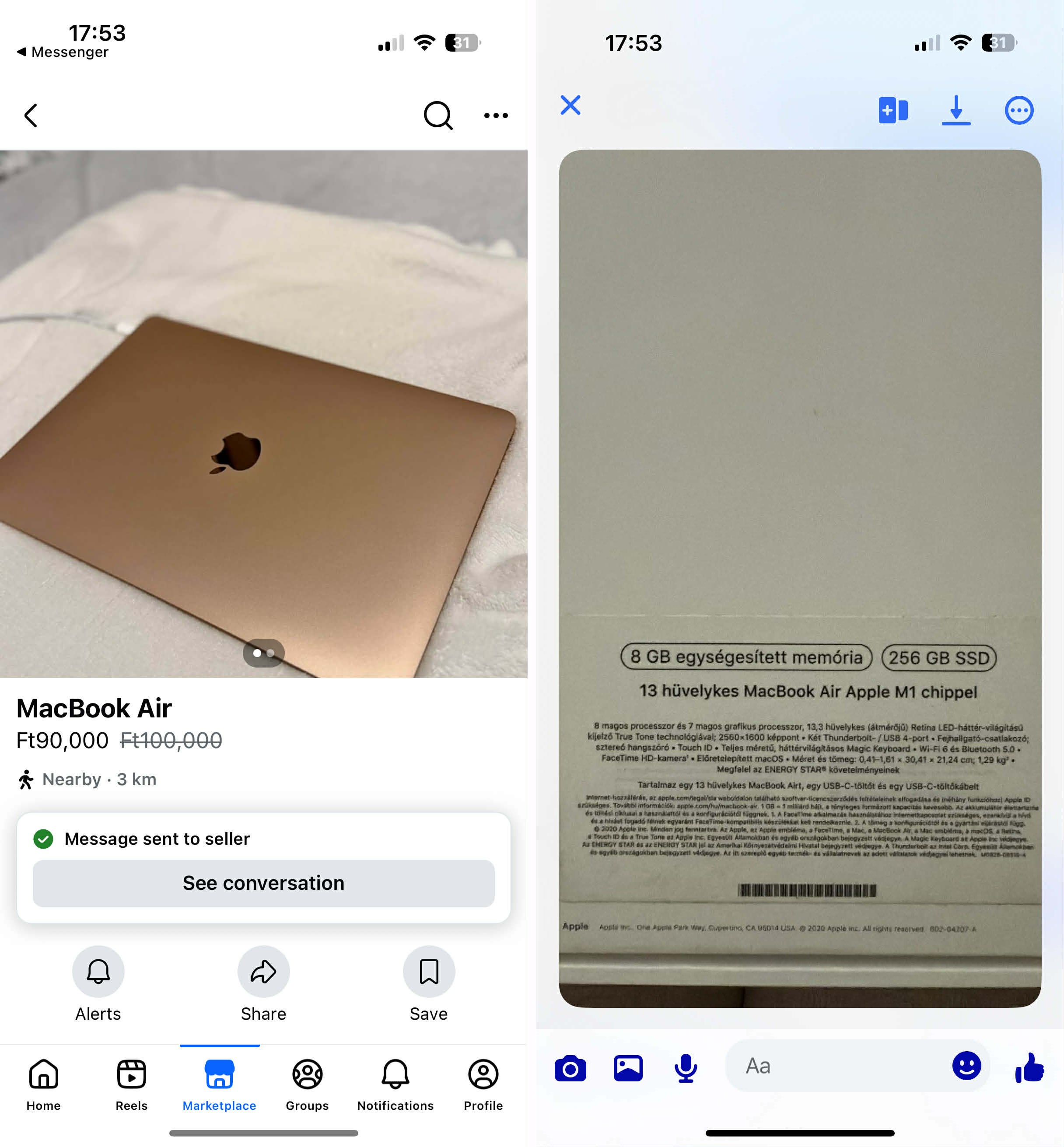
If that's true - I'd say MacBook air M2 is probably the new sweetspot - depending on how cheap you could get an M1.
My impression is that until now, MacBook air M1 was the sweetspot.
Do the M4 and M5 GPUs also change a lot from the M3? I hope it's not too much work to get those going once M3 is usable.
I doubt it. For one, the SSDs have limited lifespans, and are soldered on the mainboard. They'll be fine enough for the planned life of the laptop, but eventually secondary market laptops will start seeing waves of failures, at which point people learn that purchasing one is a gamble.
The entire Apple silicon lineup is designed for limited lifespan.
I think repairability is important, but I don't think it will stop those laptops from being popular.
SSD can be resoldered and that service is actually becoming popular and inexpensive. It's not just MacBooks, nearly all laptops have SSD and RAM soldered. This will become a totally normal thing in a few years from now.
The biggest issue I have with it is macOS Tahoe. Guess I really should be checking out Asahi on it!
Basically starting with M4 you have a choice between starting with Apple's page table monitor already running in their guarded mode extension, or all apple extensions disabled on the CPU cores.
Where?! I just cheeked the used market in Austria and 2020 M1s go for at least 350 for the 8GB RAM models and 450 for the 16GB model. Your 230 for the 16gb one fells more like a rare exception but not them norm everywhere.
Here is another one from today, just messeged them. 230€ rose gold one, and that's without any bargaining offer https://files.catbox.moe/exbrfc.jpg
The ones that I saw similarly low to yours are obvious scams from scam profiles all repeating the same message in the ad.
So maybe the ones you saw are scams as well. Otherwise hungary seems to be a lucky exception for some odd reason. Maybe because people have less disposable income, IDK?
Anyway, I wouldn't spend 400 Euros on a used mac with no warranty. The point of buying an old ThinkPad for cheap was that if something broke on it you could easily swap that part yourself for cheap because it was easily repairable and the used market was flooded with spare parts. But if your used macbook dies out of warranty, then you're shit out of luck, you can't fix anything, it's 400 Euros wasted.
I bought one already so I know it's not a scam. Scams usually communicate badly and they don't want to meet you in a public space (like a McDonald's with free wifi)
Obviously ymmv
>Anyway, I wouldn't spend 400 Euros on a used mac with no warranty.
This I agree with. I still prefer Thinkpads too but these M1s are also pretty good in almost every sense except for repairability
    In fact, the current state of M3 support is about where M1 support was when we released the first Arch
    Linux ARM based beta; keyboard, touchpad, WiFi, NVMe and USB3 are all working, albeit with some local
    patches to m1n1 and the Asahi kernel (yet to make their way into a pull request) required. So that
must mean we will have a release ready soon, right?Edit: this was what I was remembering: https://x.com/XenoKovah/status/1339914714055368704
Such a monumentally Sisyphean waste of effort in behalf of the Asahi devs in my opinion.
If you care about personal computing or Linux, don’t buy a Mac.
They're a fantastic hardware company. But my admittedly very limited experience with Apple software, from iPad to their streaming service website, has been miserable. The UX doesn't work for me, the software just doesn't do what I want. Understandable, Apple very much designs their software to work for a particular workflow they come up with, if you like that workflow it's great, for someone like me it's miserable. But I would gladly buy their hardware if I could freely run an OS of my own choosing.
The assumption that this is a triangulated and well researched strategy doesn't match my experience in "real-job" world. I mean, maybe Apple is different because of their history, but I am not convinced anyone listens to anyone that articulates any math ideas beyond Algebra outside of some niche specialties because they don't understand it. And it's not that I'm some math god - I mean, that's what I studied, but there are people SO much more knowledgeable and capable, and they seem to get ignored too.
Like, I'm sure the guy who runs an insurance company listens to the actuaries about relative risk, but mostly, what I've just seen is someone makes a decision, and then finds post hoc ergo proctor hoc rationales for why this was a good decision down the line when they have to account for their choices.
For instance, it took my like a year at my old job, but I finally got most of the KPIs we were using to set strategy cancelled. The data we were using to generate those KPIs? Well in a few cases, after you seasonally differenced the data was no different than white noise. No autocorrelation whatsoever. In ALL the cases the autocorrelation was weak and it was all evaporated after a month or 2. You could MAYBE fit an MA model to it, but that seemed dodgy to me. And like, I'm not a major expert - I took 1 time series class in gradschool, and frankly, time series is kind of hard. But management had ZERO idea of what I was talking about when I was like, "hey, I don't think these numbers actually mean anything at all? Did anyone run an ACF?"
Then each month someone higher up the chain would say, "why is this number low?" And then they go out and search through the reams of data they had to come up with an answer that plausibly explained things. Was the number particularly "low?" No, it was within expected statistical noise thresholds, you are probably going to have at least have 1 number out of whack every 20 cycles or so... You still had to spend an hour in a meeting coming up with reasons for why it was low that went beyond "ummm, well, this is kind of random, and we'd expect to see this sort of thing ever couple years once or twice, we won't know if it's a trend for a few more months."
Anyway, this is a long anecdote to explain why I have no confidence that most companies do any sort of actual introspection. CEO creates targets and underlings build models that show how they're meeting or not meeting those targets. Now, hilariously, with Apple in particular I might be wrong, because in Tim Cook's defense, I'm pretty sure his education is in Industrial Engineering? So if any CEO is thinking about that stuff, it's him. Still, I am totally and completely unimpressed with the C-Suite sort of thinkers.
They're not dumb - like I've never really had a straight up dumbass manager outside of shitty lower jobs or small-mom-and-pop businesses? But I have seldom met any company that actually cared about the numbers - most say they do, but most just use those numbers to justify decisions they've already made.
Am I just unlucky? I'm I the witch in church here?
As opposed to what hardware, then? Because this is pretty much how most other drivers became a thing in the first place. Linux has come a long way and due to it "winning the cloud" many hardware vendors started properly supporting it, but this was absolutely not the case for the longest times.
As for alternatives, there are many.
I love my Thinkpads, I really do but they are bulky, loud and the battery doesn't last very long. They are not an option for many people.
1. Asahi Linux's battery life is like 2/3 as long as on macOS
2. The Thinkpad X1 Carbon is just about as thin and nice as a Mac but it also costs just as much.
3. Apple is still leading in single core CPU speeds but x86 has caught up or surpassed M devices in both multicore and graphics. And even last gen x86 can beat the 3-generations-old M2 that is the latest one supported by Asahi Linux.
Just why?
And then beyond that, there is simply no laptop manufacturer that meets the quality of Apple's hardware design. I like Macs for their hardware, the software is a compromise. A linux macbook would be my ideal laptop.
Yes, marketplace
Maybe so, but 15-20 year old laptops are definitely starting to show their age.
An M2 MacBook Pro, on the other hand, is only 4 years old, has a fairly OK keyboard, and is still in striking distance of current high-end ultrabooks when it comes to performance.
Granted, this is running GNU/Linux rather than Windows. If you're running Windows then yeah, they show their age.
I don't know what I'll do if and when my X230 stops being sufficient. If I could buy an Apple motherboard in an X200 chassis I'd do it in a heartbeat.
There's this saying, all progress is done by unreasonable people, because reasonable people just accept things are the way they are
Congrats, but I think you may be in a small minority when it comes to developers shopping for laptops.
Personally, I had to upgrade from a late-model i9 MacBook Pro to this M2 MacBook Pro, because the npm + docker setup at work was taking upwards of 20 minutes for a production build...
I recommend Mac's to the people in my life because when they have a problem they can take the machine to the Apple Store in the mall. Or if they want to understand iPhoto or Pages better, they can go to the Apple Store and take a class. They like Apple laptops because they look nice, they feel great, sound amazing (for a laptop) and have excellent battery life.
Like you, I have a ThinkPad (a P-something) and, frankly, it kind of sucks. It's all plasticy, it flexes, battery life is a joke, the trackpad is meh, and the fans are almost always running. I do like the keyboard though (I'm a fan of backspace).
This reasoning is essentially just as true for any other laptop maker Dell, Lenovo, Asus, Framework, HP etc might also decide to bomb linux support at any time.
^ This
Also, the security teams at Apple must be watching Asahi closely from an exploit-perspective. They are basically holes that must be patched.
> Apple allows booting unsigned/custom kernels on Apple Silicon Macs without a jailbreak! This isn’t a hack or an omission, but an actual feature that Apple built into these devices. That means that, unlike iOS devices, Apple does not intend to lock down what OS you can use on Macs (though they probably won’t help with the development).
I so want to run my os on ipad and save it from the ewaste bin.
Above the display is an amber horizontal bar that changes in sync with the activity on the display and my first thought was, "Finally they found a use for the Mac Touch Bar!"
The Touch Bar has so many uses in Linux I can't wait for it to work.
If your design language is “flat as we can make it” how can you visualise a third dimension? You have to already know which things are 3D touch ready.
I blame the software refresh of Apple after the 5-series UI language was removed. Minimal mechanical design with rich complex software is a beautiful contrast that strengthens how both feel.
I was hoping it was a tease for a fully software defined haptic feedback based keyboard. There’s the obvious usefulness and coolness of that, and then the fact that you could make a laptop closer to the sealed clean-ability of a phone. Probably not quite submersible/waterproof due to ports and fans but able to survive a spill and be cleaned well.
Apple is probably the most mainstream supplier of ARM computers at the moment, but Valve is likely to soon have the most mindshare amongst ARM-shippers who actively support Linux. I expect that will improve ARM support in the ecosystem, which should be good for Asahi also.
That said, my question to those interested is why? I've been a daily user of both Ubuntu since 2005 and Mac since 2012. There are some edge case differences but for the most part they are so similar that I nearly always run the same code on both without modification. Clearly I'm missing something important but I'm curious what it is. Thanks in advance.
With the attention this project is getting, I'd be surprised if they can't get the equivalent of a small startup's seed round, just by crowdfunding. Do they have all the funding and resources they need or not? that's really my ultimate question. I know you can't just throw money at these things and make them happen faster sometimes.
It’s clear Apple went out of their way to make Asahi possible in a secure way. I believe people on the Asahi project have said as much.
As a developer myself who uses Fedora Asahi Remix as my daily driver, I can also tell you that Linux runs 2x faster (often much more) for everything compared to macOS - on the same hardware! And that performance gain is also important for my work :-)
Consumers should be allowed to install whatever software they want on decides they own.
The notable missing features are external displays (an experimental kernel branch is publicly available though) and the fingerprint sensor. That's about it, though. Given the amount of polish combined with the hardware, it's arguably the most polished Linux laptop experience you'll get.
Apple is launching the M5. It seems like the future is going to be a world of closed systems and custom silicon, with any free software lagging far behind.
But eventually it wears you down. It's nearly impossible to keep up in the long-term. Normal product evolution, the sheer size of the behemoth and sometimes even malice on their part to thwart the little guy make it really tough to stay current.
Think of Wine vis-a-vis Windows. They will never catch up.
I wonder how much similar behavior influence other buying choices. I’ve been eyeing an upgrade from M1 for a while - so far punting on it, mostly because of Asahi.
It's much more difficult to keep current and support the full functionality of a much larger competitor's offering when you have to support everything. In my experience it was an all or nothing proposition. Either you emulated it 100% or you had nothing. I think Asahi is more in this realm maybe than Wine. It really needs to support all the hardware, 100%, or it's value is greatly diminished.
It didn't.
For Wine/Proton, the core demographic is essentially gamers, who tend to overlap heavily with engineering population later on, and thus core population for Microsoft to capture and retain. Once Steam removed that vendor lock-in, the corporate discussion became more flexible.
For Asahi (proud Asahi user for 4y now), the added value of „most powerful Linux/Arm64 laptop on the market” outweighs the few things that don’t work on Asahi (HDMI out is probably the only one that occasionally matters for me, but screencasting works well enough). Yes, there are gaps, but they are smaller than things from Linux that are missing on OSX or Windows for me.
https://www.apple.com/newsroom/2025/10/apple-unveils-new-14-...
It would be like going back to the days of early Linux and all the Windows-specific hardware we had to deal with, but extrapolated to the entire system. As impressive as all of their work is, it's not worth the IMO minor UX benefits of Apple's hardware.
Mainline Linux on ARM is solid these days; new x86 chips from Intel perform very well and are reasonably power efficient; and battery life of most professional laptops in Linux is quite good. For example, I get a good ~12 hours of work done on an X1 Carbon Gen 13 from a single charge. This may not be as impressive as Macbooks, and the packaging certainly isn't as sleek, but it's good enough for me. The tradeoff for a solid software experience, modulo the usual Linux shenanigans, is worth it to me.
And then there's the fact that it's still a dark ending if the best hardware out there — even if we all refuse to buy it because we're on a moral high ground — is a closed platform that we have to refuse to buy.
At least PCs are open to a greater degree, despite Microsoft's attempts otherwise.
Because all that crypto and tech money is trying to turn money into much more money, and Asahi isn't a great candidate for doing that
But I would gladly match my 1% of my monthly income to anyone here who can pledge the same 1% who makes over $500k a year. So that would be my $20/month vs their $416/month.